You ask Claude for a training plan — Claude delivers. It looks reasonable. Usually it is. The catch: the model never tells you what it assumed about you. Anthropic introduced Skills for exactly this problem — instruction sets that force Claude to ask the right questions first. I built one specifically for training planning.
The Claude Training Plan Skill: how Claude builds plans that actually fit you
 Christopher Klenk13 min read
At a glance
The TheFitFuturist Training Plan Skill turns Claude into a training assistant that asks the right questions first — and only then plans. It covers three goal types: running (5k to ultra), strength and hypertrophy, and mixed training. Installation takes two minutes, works with any Claude account, and the Skill is free on GitHub. It is tested against 41 test personas — but it is no substitute for good coaching.
Stay on top of AI training & analysis? One click — and Google shows you my articles first.
Add as a preferred source on GoogleSkill version 2.6.0, dated 9 October 2026. New: before a wearable value changes your plan, Claude checks the measurement, and missed sessions are handled by their reason. The download further down always serves the current release; what changed is in the CHANGELOG.
What bothers me about standard AI plans — and why I built this myself
The problem with generic AI plans is not that the models are bad. The problem is the missing structured input beforehand. Without guidance, Claude fills information gaps with default assumptions. The result is a plan that fits somebody — just not the person actually asking.
17 years of coaching practice sit behind the question structure in this Skill — not as a claim to completeness, but as a distillate. The real work was not cramming in as many questions as possible. It was figuring out which questions actually matter — because more questions don't bring an LLM closer to the goal, they tend to confuse it. Too much context produces errors, not precision. The current version hits the sweet spot I consider right — more questions only get added once they prove necessary in practice.
Mixed training: the goal type most tools ignore
Running and strength — most apps handle those somehow. Mixed training — meaning both at the same time — is either ignored or handled badly. And yet that is the reality for most serious athletes. Runners who skip strength work neglect injury prevention and leave performance on the table. Strength athletes who cut cardio entirely run into recovery issues in the medium term.
The fact that strength and endurance can interfere with each other is accounted for. Which combination on which day, how much spacing between hard sessions, where strength and endurance training actually get in each other's way — and where that fear is overblown. That is not theory, that is what remains after thousands of plans.
What you actually get — concretely
The output is not a template with your name on it. The plan is built around your goal and your time frame — plus supplementary work tailored to your injury history and equipment. For runners: bpm values for heart-rate zones, pacing, strides, interval structure. For strength athletes: progressive overload, RPE guidance, set and rep structure by goal. For mixed: strength and endurance work coordinated so they don't sabotage each other.
And then it continues. The plan is the starting point, not the finish line — how that works in practice is the next section.
How does the plan stay up to date?
Through three files Claude outputs at the end of every plan: training-log.md for your sessions, health-flags.md for pain and complaints, current-plan.md as a short summary of phase, pace and HR zones. Those three files are the Skill's memory.
For them to work as memory, they have to sit somewhere Claude will find them next time. Create a Claude Project, add the three files to its Project Knowledge, and run every follow-up chat inside that Project. Claude then reads them on startup, recognises the running plan and goes straight into update mode instead of interviewing you again.
Without a Project, none of that happens. A normal chat has no memory beyond the conversation — Claude will build you a fresh plan instead of adapting the existing one. If you would rather work without a Project, just paste the contents of current-plan.md and training-log.md at the start of the new chat. Same result, more manual work.
What the Skill does with your feedback is deliberately restrained:
What you report | What happens |
|---|---|
Warning signs: chest pain, dizziness, fainting, breathlessness out of proportion to the effort (stairs included), a swollen calf | training stops, referral to a doctor — on the first mention. While such a question is still open, Claude writes no sessions, not even an "if not" version |
Pain for the first time | logged only, plan stays unchanged |
Same pain a second time | the exercise involved gets swapped |
Same pain a third time | exercise removed, referral to a physio |
Two or more sessions missed | Claude first asks why, and how sleep and stress were. Scheduling, rested again: no cut, you resume at the last load you actually completed. Fatigue, illness or pain: safety check first, then volume down 20 % |
Two weeks of "too easy" | up 10 % — but only if you actually did most of the sessions. After a break, a lot feels easy |
HRV, recovery or readiness dropping | data check first: same device, same firmware, same fit? Then only with a second signal: the next hard session becomes an easy one. A number on its own never triggers a deload week |
A one-off complaint deliberately triggers no plan change. Rebuild at every twinge and you never get a progression going — and a single signal is not yet a pattern. That explicitly does not apply to warning signs: chest pain, dizziness, fainting or a swollen calf stop training immediately, no matter how often they occur. Keeping those apart mattered to me — a rule that only counts frequency would swallow exactly the signals where the first time is the one that counts.
When your watch disagrees with your body
Since version 2.6, Claude checks the measurement before a wearable value changes your plan. The trigger was a test profile: five nights of HRV about 20 % below the usual value, resting heart rate and sleep unremarkable, legs fresh. And for exactly those five nights the runner had been wearing a new watch. The old Skill version turned that into a deload week in both test runs and never once asked about the device.
Now Claude asks first: same device, same firmware, same fit, same kind of reading? Is anything else moving with it? Only when the data is clean and a second signal agrees does the next hard session become an easy one.
This is not distrust of HRV. Measured in the morning with a chest strap and always the same way, it is the readiness measure everyone can afford. A lactate test or spiroergometry sets your zones; HRV tells you whether today is a day for the top end of them. What breaks the measurement is inconsistency: a device swap looks exactly like a tired athlete in the data.
What the Skill cannot do — and why that matters
It does not replace a good coach. The questions in the Skill come from the same hands-on experience — the issue is elsewhere: a real coach branches in real time. They hear an answer, pull three new questions out of it, prioritise on the fly. That complexity, built up over thousands of cases, cannot be fully captured in an instruction set.
What it does do: deliver a substantially better starting point than a generic prompt for everyone without access to good coaching. How big that gap actually is can be read up on by now — what studies comparing AI and coaches actually show turns out more nuanced than either camp would like.
Still: the better you know how to create a training plan with AI, the more you get out of the Skill. If you'd rather work with Gemini instead of Claude: the TheFitFuturist Gemini Gem for training planning follows the same principle — same sports-science foundation, different model. If you work in ChatGPT instead: with custom GPTs on the way out, you now build a ChatGPT training coach as a project. No AI account? free training plan generator — browser-based, no setup.
Nutrition, mobility and recovery are deliberately left out. A tool that tries to do everything at once does none of it well. Training planning first — the rest comes in later versions.
Can I have an existing plan reviewed?
Yes, and it is the route most people miss. You do not have to start from scratch: paste your current plan straight into the first chat and the Skill skips the assessment and goes into analysis instead.
Claude reads the plan in full, pulls in the matching goal-type ruleset and works out four things — what the plan does well, where the real weak spots are, what is simply missing, and what you should concretely change. Then you choose: have the existing plan reworked, or build a new one. If you go for a rebuild, Claude skips every question your old plan already answered.
This is aimed at the case I see most often: you have a plan from a gym, an app or an earlier AI chat, it runs somehow, but you cannot judge whether it actually fits you. The analysis gives you a second opinion with reasoning attached — not a grade, but an assessment you can think further with yourself.
A real example — including a point worth thinking about
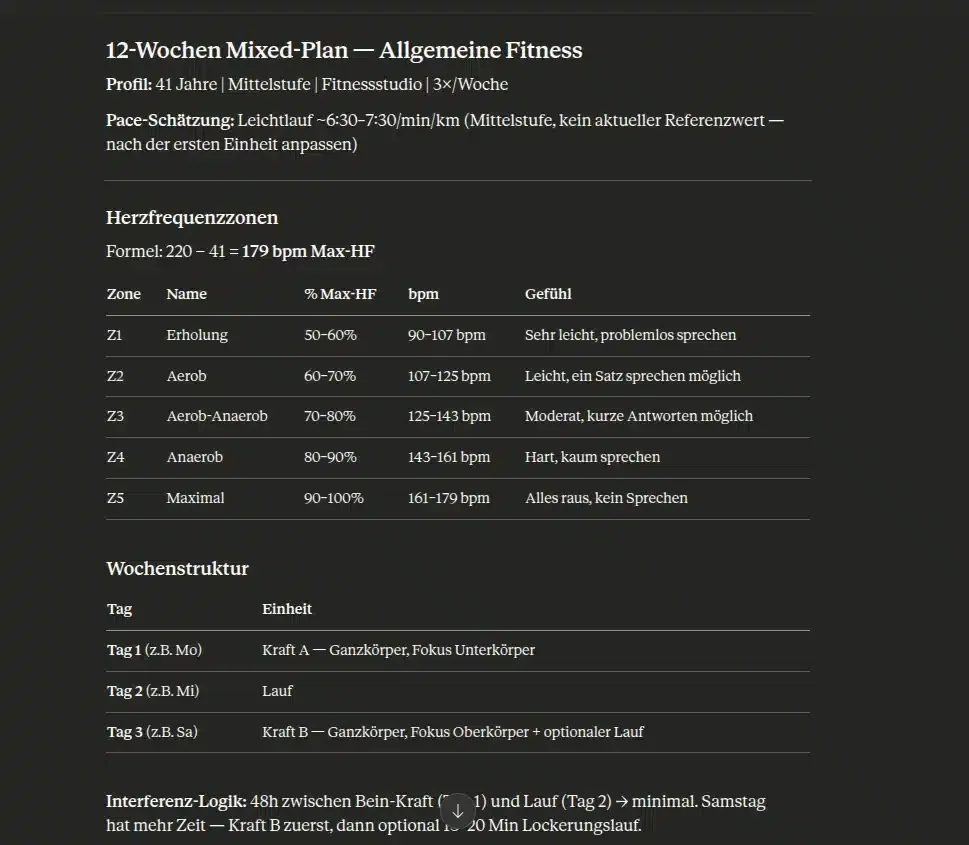
Here is a real output from a test assessment: 12-week mixed plan, general fitness, intermediate level. HR zones with real bpm, deload weeks, injury-prevention anchors, pacing estimate with caveats.
The Skill's instructions tell it to reply in your language, so your actual assessment and plan will be in English. The screenshots below are from a German session and are purely for illustration.

1 / 2
Assessment: Claude asks first
Output: the finished plan
There is a flaw in this example plan and I am leaving it in on purpose: Claude schedules only one fixed run per week, marking the second as optional. For a plan meant to build endurance and strength at the same time, that is too little — two fixed runs would be the sensible floor.
This is exactly what follow-up questions are for. You still have to be able to judge the plan yourself, the AI won't do that for you. Anyone who knows what a good plan looks like spots it and steers. Anyone who doesn't takes the plan as it comes. The Skill is a working version, not a finished end product.
Installation: 2 minutes
Works with any Claude account, free or paid. The only requirement: "Code execution and file creation" enabled under Settings → Capabilities.
Download the ZIP — the link always serves the current version as a direct file.
In Claude, open Settings → Customize → Skills and upload the ZIP.
Start a new chat and describe your training goal — Claude picks up the Skill and starts the assessment on its own.
Uploading works from the web and desktop apps. Once it is in your account, the Skill is available in the mobile app too. What changed in which version is in the release history.
The Skill itself is free and licensed under CC BY-NC 4.0: free to use and adapt privately, commercial use by arrangement only. One note on the free Claude tier: the assessment runs across six blocks and is followed by a longer plan, so that is several messages back to back. If your message allowance runs out mid-assessment, wait for the reset and carry on from there.
What happens to my health data?
After the assessment it sits with Anthropic. This is the part almost nobody discusses around AI training plans: you enter your age, your injury history and your current complaints, and depending on your setup a wearable export with weeks of heart-rate data. That is health data, and it belongs to the most sensitive categories there are.
Before you start your first assessment, take a look at your privacy settings in Claude. Whether your conversations get used to improve the models depends, according to Anthropic's own privacy documentation, on a setting you control and can change at any time. One exception applies regardless: conversations flagged for safety review may be analysed.
How I handle it in practice: goal, age and injury history go in — without them an individual plan is simply not possible, and that is the entire point of the Skill. Raw wearable exports I upload only when I genuinely want HR zones with real bpm. If that goes too far for you, give your age and a rough training status and skip the fine-tuning. The plan does not become worthless, just less precise — and that trade-off is worth making deliberately rather than by accident.
For anyone who wants to look inside: what is under the hood
A lean main Skill with three goal-type sub-Skills — no fine-tuning, no RAG, no API wrapper. Prompt engineering in file structure.
SKILL.md — main Skill: assessment logic, routing, mandatory rules
runner.md / strength.md / mixed.md — goal-type sub-Skills with specific output formats
assessment.json — structured question logic incl. few-shot examples
Which of your inputs actually make a difference and which are just noise is a separate write-up: which physiological data works as prompt context.
A side observation: I checked the Skill against Anthropic's own prompt engineering best practices and built an experimental version — XML tags, compressed rules, few-shot examples, everything that gets recommended. In our tests the experimental version performed worse than the original. Whether that is down to the task, the Skill format or the tests, practice will tell. As of now: the "worse" version by best-practice standards delivers better results.
Testing runs against 41 synthetic test personas across 10 categories — beginners, seniors, people with injury history, athletes who hate cardio, powerlifters, ultrarunners. Internal tests like that say something about consistency, not about training outcomes; how meaningful a comparison between different models can be at all is covered in the FITT-VP study on LLM training plans. Which version is current and what changed most recently is in the CHANGELOG in the repo. How I tested version 2.6 against the decision rules of a research framework is in my article on the framework for daily training decisions.
What I want most are bug reports from real training. The 41 test personas are made up, after all — the places where a plan falls apart in daily life are only found by someone actually running it. So if you notice the Skill producing nonsense somewhere, or failing to ask an obvious question: open an issue on GitHub or send me an email. What helps most is not "the plan was bad" but your goal, your training status and the specific spot in the plan that did not fit — that turns into a rule, a gut feeling does not.