For decades, the choice was clear: anyone who really wanted to know their aerobic threshold did a lactate test. Anyone who wanted even more precision combined it with spiroergometry. Both meant a lab, a doctor, an appointment, and costs. For everyone else, formulas remained — 180 minus age, percentages of maximum heart rate, rules of thumb. Unsatisfying, but for a long time the only option.
Then came DFA Alpha 1. Initially dismissed — an HRV index as a threshold test, really? The first studies were small, skepticism high. But the evidence grew stronger, replications followed, and today it's clear: DFA Alpha 1 is a real alternative. No lab, no blood draw, no appointment. A field test, a compatible chest strap — and our calculator gives you your aerobic threshold and individual heart rate zones. Anyone who already has the necessary equipment pays nothing for it. And gets values that are valid even for ambitious endurance athletes.
DFA Alpha 1 is a valid alternative to lactate testing and spiroergometry for most endurance athletes — no lab, no blood draw, no cost. The evidence is solid, the method infinitely repeatable. Individual deviations exist, as with any threshold determination. Anyone with a compatible chest strap pays nothing and gets heart rate zones that are good enough for everyday training.
Why the Lactate Test Is the Wrong Tool for Most Athletes
First, a clarification that often gets lost in the fitness world: the actual gold standard for threshold determination is spiroergometry — breath gas analysis under load, which determines VT1 and VT2 directly from breathing parameters. The lactate test is far from that.
And not just because of cost. The more fundamental problem is the scientific ambiguity of the concept itself. There is no single lactate threshold — there are dozens of definitions: LT1, LT2, MLSS, OBLA (the blanket 4-mmol/L value), the individual anaerobic threshold after Stegmann, the Mader concept. Which value you get depends heavily on the protocol: stage length, rest times, blood sampling site, evaluation model. Two labs, the same person, different threshold values — that's not the exception, that's the norm.
Add to that the practical hurdles: sometimes 150 to 300 euros per test. Travel to a sports medicine center. An appointment weeks in advance. And then the test gives you a number that won't be accurate in three months — because you've improved. Most endurance athletes don't need an expensive laboratory procedure with questionable reproducibility — they need an instrument that grows with their training.
Then there's the "no man's land" problem: studies on intensity distribution show that most recreational athletes spend too much time between the aerobic and anaerobic thresholds — simply because they don't know their threshold. Too demanding for recovery, too easy for maximum training stimulus. Anyone who knows their threshold value trains more structured — regardless of which method they use.
What Is DFA Alpha 1? The Short Answer
DFA Alpha 1 — abbreviated α1 — is the short-term scaling exponent of Detrended Fluctuation Analysis, a method from time series analysis. The simplified idea: it measures how similar your heart rhythm is over short and longer time windows — how self-organized it is at different scales. High self-similarity = low stress, low value = system under pressure.
The key finding comes from a 2021 study published in Frontiers in Physiology by Rogers, Giles, Draper, Hoos, and Gronwald (DOI: 10.3389/fphys.2020.596567): α1 decreases continuously with increasing training intensity — from values above 1.0 at low intensity to approximately 0.75 at the aerobic threshold and further to ~0.5 at the anaerobic threshold. A review paper by Rogers & Gronwald (2022, DOI: 10.3389/fphys.2022.879071) summarizes multiple validation studies — including data from elite triathletes and women cycling.
What this means for you: after a field test, you can see in the calculator exactly at which heart rate α1 dropped below 0.75 — that's your aerobic threshold. No blood, no lab.
How α1 Works — The Practical View
Your heartbeat pattern is self-similar across different time scales at low intensity — the Autonomic Nervous System (ANS) actively modulates this rhythm and keeps it flexible. As soon as you exceed the aerobic threshold, the system loses this complexity: the heartbeat sequence becomes more uniform, less adaptive.
This shift from "complex and flexible" to "uniform and rigid" is what α1 quantifies.
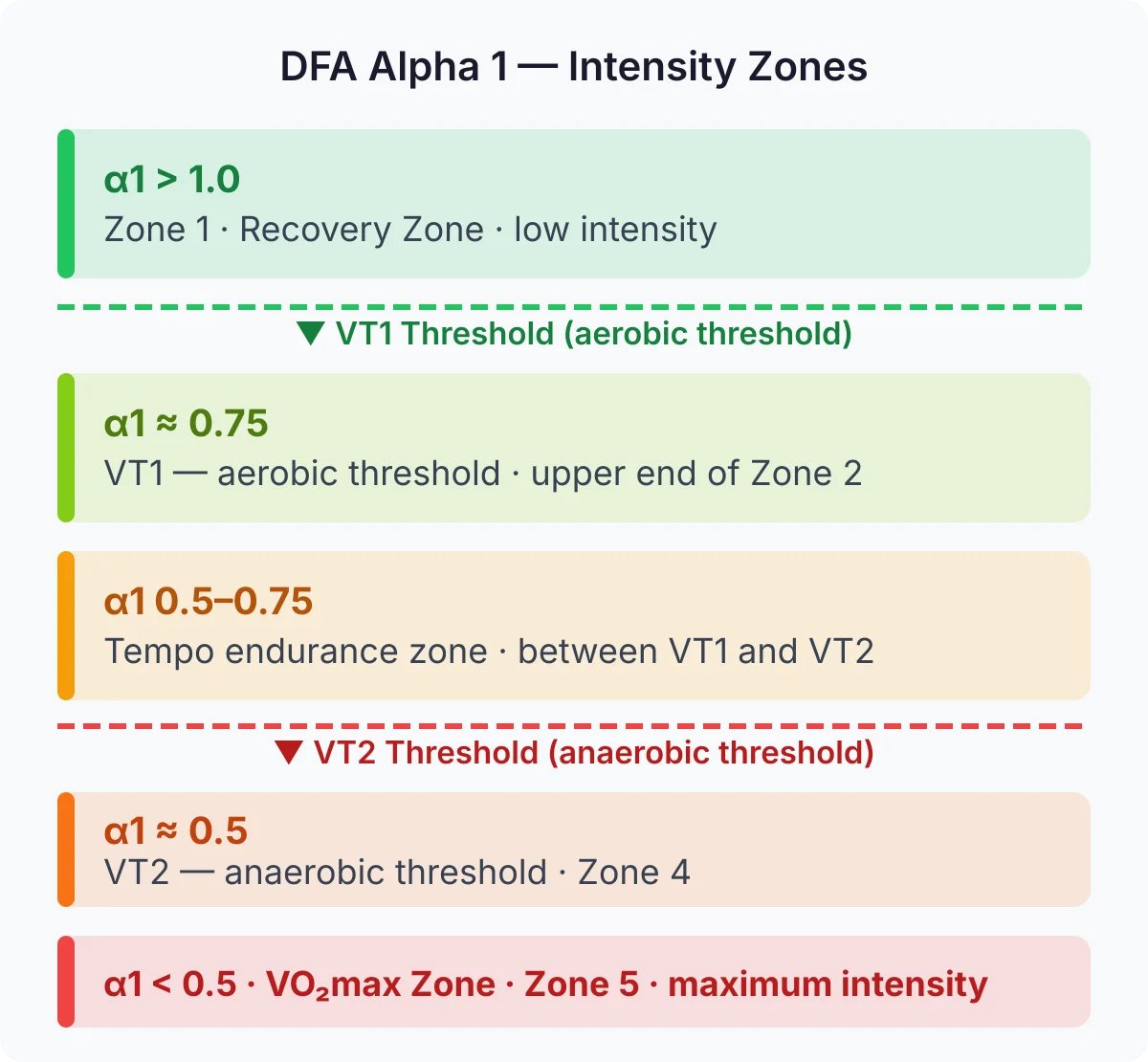
The threshold values of 0.75 and 0.5 are population values, well validated for recreational and hobby athletes. In very well-trained elite-level athletes, α1 ≈ 0.5 may slightly underestimate the anaerobic threshold — Mateo-March et al. (2023) show that the corresponding watt value in elite cyclists deviates statistically significantly. For ambitious hobby athletes, this is not a relevant factor.
The calculation is done by the software. You read the value — and know where you stand.
α1 = 0.75: Why This Exact Value Matters
The threshold of 0.75 lies exactly in the middle of the dynamic range that α1 traverses during training — from ~1.0 to ~0.5. At this point, the fractal correlation structure of the heart rhythm has broken down halfway. Physiologically, this corresponds to the first ventilation threshold (VT1) — the point at which lactate begins to accumulate measurably without yet rising uncontrollably.
This is the upper end of Zone 2 in a polarized training model. And it's the value that a lactate test would also measure — except that DFA Alpha 1 does it without a blood draw, while you run or pedal.
α1 Value | Intensity Range | Physiological Meaning |
|---|---|---|
> 1.0 | Below VT1 | Zone 1 — Recovery range |
~0.75 | VT1 — Aerobic threshold | Upper end Zone 2 / Lactate begins to rise |
0.5–0.75 | Between VT1 and VT2 | Tempo endurance range, moderate to high intensity |
~0.5 | VT2 — Anaerobic threshold | Lactate threshold, Zone 4 |
Above VT2 | VO₂max range | Zone 5 |
What You Need for Measurement
You need a chest strap that records RR intervals — that is, the exact beat-to-beat distances in milliseconds. Optical heart rate measurement at the wrist doesn't work: the sensors round values and produce artifacts that distort the fractal analysis.
For hardware, there are three proven options. The Polar H10 is the most widely used, delivers good data quality via Bluetooth and ANT+, and is the sensor used in most validation studies. The Garmin HRM-Pro or HRM-Dual records directly as a .fit file — you upload it to the calculator without any detour, no extra export needed. The Movesense Medical is more compact with medical data quality, but less common. A Garmin watch can run simultaneously as a heart rate display — it doesn't record RR intervals, you need the chest strap for that.
Software (all free)
HRV Logger (Android) — simplest entry point, direct Bluetooth connection to Polar H10, CSV export with one click
Polar Sensor Logger (iOS + Android) — direct readout of the Polar H10, export as .txt
DFA α1 Calculator — upload .fit, .txt or .csv, threshold calculated automatically, no account needed
Kubios HRV (free version) is suitable for deeper raw data analysis, but is not necessary for the standard test.
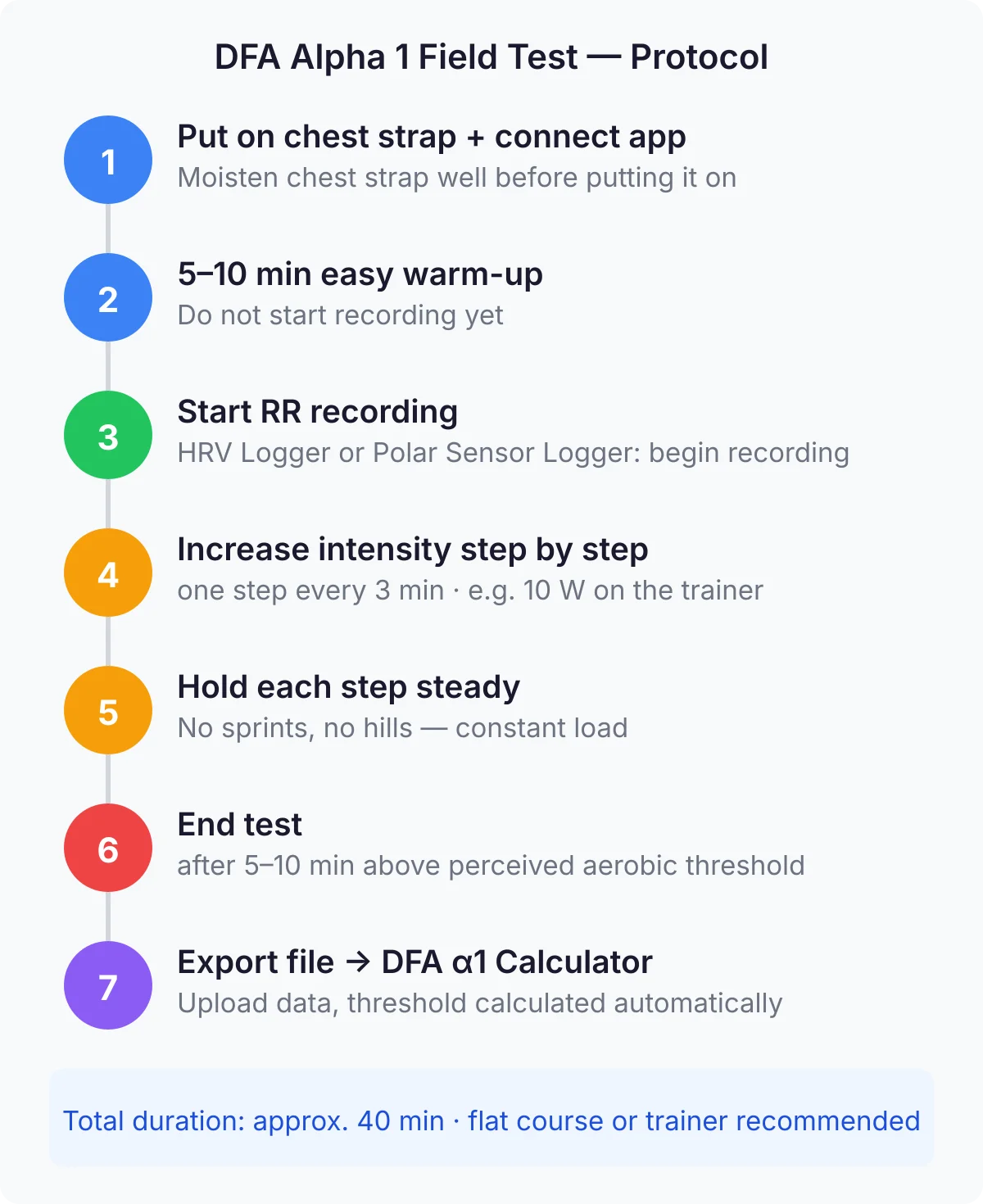
The Field Test: Step by Step
No lab environment needed — but a few framework conditions ensure measurement quality: at least 48h without intensive training, no caffeine on test day, wet the chest strap thoroughly, route as flat as possible.
The TheFitFuturist DFA α1 Calculator for HR Zones — Free and Easy to Use for Endurance Athletes
When the field test is complete and you've exported the recording file, the DFA α1 calculator comes into play. No account, no registration — all calculation runs exclusively in your browser. Your data does not leave your device.
Supported File Formats
The tool accepts recordings from common HRV apps directly:
Garmin HRM-Pro / HRM-Dual →
.fitfilePolar H10 via Polar Sensor Logger →
.txtfileHRV Logger Android →
.csvfileCustom CSV → two columns:
since_start(time in seconds),RR(interval in milliseconds)
How to Use the Calculator — Step by Step
Upload file — drag your recording file into the upload area or select it
Check stages — the tool automatically detects the load stages from the data pattern; you can adjust them manually if needed
Start calculation — the calculator analyzes the RR intervals per stage and calculates the α1 value
Read result — you see a table with α1 value range, zone, and physiological threshold for each stage
The 10-minute warm-up is automatically filtered out — you don't need to manually remove it from the file.
What the Output Shows
α1 Range | Zone | Meaning |
|---|---|---|
> 0.9 | GA1 | Clearly below VT1 |
~0.75 | GA2 / Upper Zone 2 | VT1 — Aerobic threshold |
0.5–0.75 | Tempo endurance range | Between VT1 and VT2 |
~0.5 | Zone 4 | VT2 — Anaerobic threshold |
< 0.5 | VO₂max range | Above VT2 |
The heart rate value at which your α1 first drops below 0.75 is your aerobic threshold — the result you need for training control.
Interpreting Your Results
My own experience: I performed the field test with HRV Logger and Polar H10. The α1 progression was clearly readable: from about 138 bpm, α1 fell below 0.75 — which almost exactly matched earlier lactate tests and a spiroergometry I had done years ago. The deviation was minimal. For training purposes, that's more than sufficient.
Your aerobic threshold is the heart rate or watt value at which α1 rapidly drops from ~1.0 to ~0.75 — this inflection point is clearly recognizable in most cases. For some athletes, α1 runs more evenly without a clear inflection — then take the midpoint of the steep drop as a reference value. If α1 drops below 0.5 very early, this can indicate overtraining or an emerging illness — in that case, stop the test and wait a few days.
One value is a data point, not a verdict. Individual deviations can — depending on the study and context — be up to ±20 bpm. That sounds like a lot, but relativizes itself once you repeat the same test every 6–8 weeks: the trend across multiple measurements is more reliable than a single absolute value. Anyone who notices that α1 = 0.75 appears at a higher heart rate week after week has measurable progress — regardless of whether the starting value was accurate to ±5 bpm.
The value has a direct training output: everything below your α1 = 0.75 heart rate is Zone 2 — the range in which you should complete the bulk of your volume if you train polarized. For those training with a power meter: note the watt range at this heart rate in the field test — then you have HR threshold and power threshold linked in one pass, without a separate FTP test.
DFA Alpha 1 vs. Lactate Test — A Direct Comparison
The real question isn't whether DFA Alpha 1 is as good as a lactate test. The question is: do most endurance athletes even need a lactate test?
Those optimizing at the highest level with the resources — maybe. But for the vast majority of endurance athletes, that's not even the relevant question. The relevant question is: do you have a valid threshold value with which you're currently training? If the answer is "no" or "from a test two years ago," then DFA Alpha 1 isn't a compromise solution — for everyday training, it's the better choice.
Lactate Test | DFA Alpha 1 | |
|---|---|---|
Cost | 150–300 € per test | €0 (with existing chest strap) |
Repeatability | Rarely (costly) | Unlimited |
Lab appointment | Required | Not needed |
Blood draw | Yes | No |
Precision | Variable (protocol- and lab-dependent) | Median ±4–8 bpm at VT1 † |
Everyday usability | Low | High |
† Group median from validated studies. Individual deviations (Limits of Agreement) can be up to ±20 bpm in some studies — comparable to the protocol-dependent variance in the lactate test itself.
The agreement with lactate values is well documented. Rogers et al. (2022) demonstrated good correlation between HRVT1 and first lactate threshold in elite triathletes. Mateo-March et al. (2023) found correlations of r = .66 to .85 in cycling. That's not perfect agreement — but more than enough for everyday training management.
Common Mistakes and Limitations of the Method
The most common mistake: optical heart rate measurement at the wrist instead of a chest strap. That doesn't work — the sensors round RR intervals and produce artifacts that distort the fractal analysis. Second classic: stages under 2–3 minutes, because α1 then doesn't have time to stabilize. Environmental errors include uneven terrain that creates intensity fluctuations, or caffeine and sleep deprivation that measurably shift the HRV baseline.
Fatigue bias is the underestimated source of error. DFA Alpha 1 is only valid in a well-rested state. Under fatigue, α1 systematically shifts downward — the value pretends a lower aerobic threshold than actually present. Rogers et al. have explicitly shown this. The 48h training break before the test is not a comfort tip but a methodological prerequisite. Anyone doing the test after a hard training block gets a different value — and it's not valid.
Another point that many underestimate: the artifact rate in the RR signal. Even 2–3% erroneous intervals can significantly distort α1. Wet the chest strap thoroughly before putting it on, avoid skin lotion, and if strap contact is poor (the sweat film often only forms after a few minutes) briefly wait with the recording until the signal is stable. Most apps show live whether the connection is clean.
The 0.75 cutoff is population-based — in very well-trained athletes, VT1 can be slightly below it. Rogers & Gronwald (2022) discuss this explicitly.
FAQ
Is DFA Alpha 1 Really an Alternative to the Lactate Test?
For most athletes: yes — and not a bad one. The lactate test is considered an established procedure, but has significant weaknesses itself: results vary by protocol, lab, and evaluation model. DFA Alpha 1 delivers a valid VT1 value, is infinitely repeatable, and costs nothing with existing equipment. The correlation with lactate values is documented in several independent studies.
Can I Measure DFA Alpha 1 with My Garmin Watch?
Garmin doesn't calculate α1 itself. You need the Garmin HRM-Pro or HRM-Dual as a chest strap — it records RR intervals and saves them as a .fit file. You upload this directly to the DFA α1 calculator, no extra app needed. The Garmin watch runs simultaneously as a heart rate display.
Does HRV Logger Work on iOS Too?
HRV Logger is Android only. For iOS, Polar Sensor Logger is the best alternative — free, direct readout of the Polar H10, export as .txt. Garmin users can export the .fit file directly from Garmin Connect, no additional app needed.
How Often Should I Repeat the Test?
Every 6–8 weeks makes sense to track training progress. If α1 = 0.75 appears at a higher heart rate or power output, that's measurable fitness gain — an advantage over the lactate test, which rarely allows this rhythm.
Does the 0.75 Threshold Apply to Everyone?
As a population value, yes — for most endurance athletes, 0.75 is a valid VT1 reference value. In very well-trained elite-level athletes, the individual value may be slightly below it. Regular tests show your personal pattern.
Can I Also Use DFA Alpha 1 for Recovery Monitoring?
Yes — α1 also responds to recovery state and overtraining, with its own protocols that differ from the threshold test. How to measure and read it properly is covered in our guide DFA Alpha 1 for Recovery.
Which App Do You Recommend for Android?
HRV Logger is the most straightforward entry point: free, direct Bluetooth connection, CSV export with one click. For iOS: Polar Sensor Logger. For Garmin users: export the .fit file directly from Connect — no intermediate step needed.
DFA Alpha 1 makes the lactate test optional for most endurance athletes — not because it's worse, but because it was never designed for everyday training. Anyone with the necessary equipment can start today: record a field test, upload the file, read the threshold. That's all it takes.