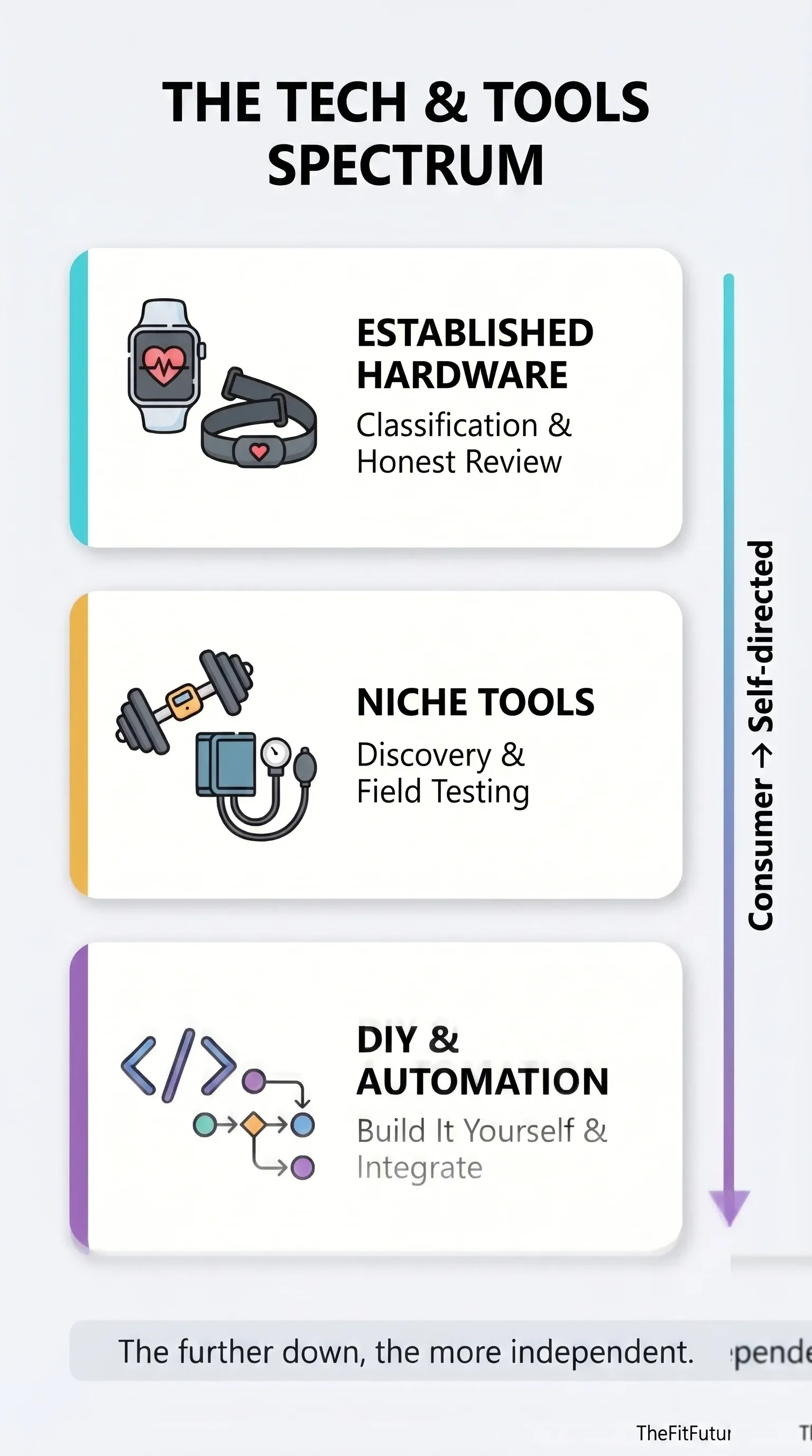
Garmin Forerunner, Apple Watch, WHOOP — everyone knows the big fitness gadgets. There are thousands of reviews for those. Here it's about more: the tools that don't show up in any mainstream comparison, but can change your training or the way you work around training.
Tech & Tools on TheFitFuturist is a mix of hardware classification, software discovery and practical testing. Some articles cover well-known devices — but with questions that are rarely asked elsewhere. Others introduce tools you may never have heard of: velocity sensors for the barbell, automation platforms like n8n for your own fitness dashboard, or hosting services where you can run your self-built training app.
The common thread: technology that makes you more independent. Not the next gadget that locks you into another subscription — but tools that help you take your training into your own hands.
At a glance
Tech & Tools shows you fitness technology beyond the usual suspects: wearables, specialist sensors, AI tools, automation and DIY solutions. Practical assessments instead of feature tables — for people who want to shape their training with technology themselves.
Familiar devices, different questions
Yes, smartwatches and well-known fitness trackers will show up here too. But not as a "Top 10 Smartwatches 2026" list. When we write about a Garmin or a WHOOP band, it's with questions like: how is the Recovery Score actually calculated? What does the optical sensor on your wrist really measure — and where are the physical limits? Does the VO2max estimate match reality, and if not, why not?
No buying recommendations in the classic sense — rather, context. A device can be perfect for a marathon runner and almost useless for someone doing strength training. That can't be reduced to a single score. What we can deliver: enough context so you can decide for yourself.
Niche hardware hardly anyone knows
The most exciting developments in fitness tech often happen outside the mainstream. Velocity sensors like GymAware or Enode that measure barbell speed in real time and enable a completely different kind of training management. Smart BFR cuffs that automatically regulate occlusion pressure. Run sensors that capture ground contact time and running economy — metrics that five years ago were only available in a biomechanics lab.
These devices have one thing in common: they're closer to training science than what dominates the consumer market. And they're rarely covered in the usual comparison tests, because the target group is smaller. On TheFitFuturist they have a permanent spot — because for people who train seriously, they often deliver more than the next smartwatch upgrade.
NOT JUST HARDWARE
Tech & Tools here doesn't automatically mean "device with a display". A script that pulls your Polar data via API and writes it into a custom dashboard is just as much a tool as a smartwatch — and you don't have to program it yourself. LLMs will write the code for you if you tell them what you need. But as with a developer you hire: you have to understand, as project manager, roughly what they're doing, to judge whether the result is what you wanted. Knowing the principles is more important today than knowing the syntax. Equally, n8n as an automation platform, Claude as a training sparring partner, or a VPS at Hetzner where you host your self-built fitness app — they all belong here. Anything that technically supports your training or your work around training belongs here — as classification and assessment. The step-by-step tutorials on how to actually use these tools are under Training & Analysis.
AI tools: more than just asking ChatGPT
Most people know AI in a fitness context as a chatbot you tell "Create me a training plan". That works, especially if you follow my step-by-step guide for your own AI training plan. But the really interesting development is elsewhere: AI as a building block for your own workflows.
Claude with custom instructions that know your training profile. Automated evaluations of your training data via the API. System prompts that turn an LLM into a specialised training assistant. These aren't science-fiction scenarios — they're things that are possible today with manageable effort, if you know which tools exist and how to combine them.
Here we don't just test what LLMs can do — we test how you can concretely use them for your training. Which model gives the best-grounded answers to training questions? Where do they particularly like to hallucinate? And how do you build a workflow that's more than a single chat message?
DIY and automation: your own fitness infrastructure
This is the part that sets TheFitFuturist apart from classic fitness blogs. We don't just show you which apps exist — we show you how to build your own. Or at least: how to combine existing tools so they do exactly what you need.
n8n for automated workflows: pull training data from Garmin Connect, run it through an AI analysis, and write the result into your Notion dashboard. Or: tap the Polar Flow API, extract sleep and HRV data, and visualise it over weeks — without an app maker deciding which graphs you're allowed to see.
That sounds like nerd territory — and yes, a certain technical interest is a prerequisite. But the barrier to entry is lower than most think. You don't need a computer science degree to set up an n8n workflow or talk to an API. You need an hour and someone who explains it understandably. That's exactly what the articles here will deliver.
And sometimes we just build them ourselves. The first result is already live:
DFA Alpha 1 – Aerobic Threshold from HRV Data
Free
Aerobic threshold without a lactate test: the tool analyses your HRV signal during training and automatically finds the Zone 2 intensity boundary.
The category is under construction. The first articles will cover the devices and tools I actually use in my daily training — because I only want to write about things I genuinely use. No press-sample reviews after a week, but honest assessments from real-world use. For example on the Polar Pacer Pro: a watch whose vibration alarm wakes me in the morning without waking my wife next to me — and whose charging mechanism drives me regularly up the wall. You don't find things like that out after a week of testing. And yes, the Pacer Pro isn't the newest model — but that's exactly the point: it doesn't always have to be the newest device. A new one is only worth it when the old one no longer suffices, breaks, or when the new one brings real added value. Everything else is upgrade for the sake of upgrading.
Alongside that, articles on AI tools and automation are coming: LLM comparisons specifically for fitness applications, an introduction to n8n, API basics for training data, and tutorials for anyone who wants to build their own small fitness infrastructure.