AI training plans are only as good as the data you feed them. If you understand the physiological foundations for AI training, you get something different from a plan built for the statistical average person — whether that means lactate threshold and heart rate zones for endurance sports, or 1RM and body-type tendency for strength and fitness. The right parameters decide whether the AI is guessing or calculating. You just need to know what to tell it.

Physiological Foundations for AI Training: Your Data as Prompt Context
 Christopher Klenk15 min read
At a glance
AI training plans only become precise once you feed in your current physiological status. For endurance: lactate threshold, heart rate zones, RPE and VO2max. For strength and fitness: 1RM, training age, body-type tendency and weekly volume. This article covers both worlds — which values really matter and how to translate them into prompts correctly.
Stay on top of AI training & analysis? One click — and Google shows you my articles first.
Add as a preferred source on GoogleWhy AI training plans without physiological context guess — rather than calculate
I have seen it dozens of times in coaching practice: someone feeds an AI the prompt "Write me a 12-week training plan for a half marathon." The response is not bad — structured, progressive, with a taper. And completely detached from the athlete's reality.
The model does not know that the lactate threshold sits at 162 bpm. Not that resting heart rate is 52 bpm. Not that this body reacts to hard interval work in week 1 with shin pain. It guesses. Politely, professionally — but it is guessing.
An experienced coach starts differently. First question: how long have you been training? Second: what is your maximum heart rate? Third: what happens when you stack two hard days in a row? These data points are not a luxury — they are the difference between a plan that fits you and a plan built for the statistical average person.
The good news: you can give the AI exactly these data points. Then the guessing stops.
Don't have these values yet?
You don't need them all at once. Start with what your watch already shows: resting heart rate and HRmax are available on almost every wearable. For RPE you don't need a device — just a brief calibration (more on that in the RPE section). Lactate threshold and VO2max are optional: a Cooper test delivers usable baseline values in 20 minutes, no lab required.
Which parameters actually help — and which tend to generate noise:
Parameter | Useful for AI prompt? | Where do you get the value? |
|---|---|---|
Endurance | ||
HRmax | Yes | Field test (sprint protocol), wearable (limited), 220 − age formula (rough) |
Resting heart rate | Yes | Wearable in the morning, chest strap |
Lactate threshold (HR/watts/pace) | Yes — highly precise | Performance diagnostics, FTP test, Conconi field test |
RPE target range | Yes | Self-perception — no device needed |
VO2max | With caveats | Lab (spiroergometry), wearable estimate (often ±5–10%), Cooper test |
HRV | As day-form context | Polar H10, wearable — use the trend, not individual daily readings |
Strength & Fitness | ||
1RM per main lift | Yes — highly precise | 1RM max test, rep-max estimate (5RM × 1.15) |
Training age | Yes | Self-assess: months/years of consistent training |
Body-type tendency | Yes — for volume + recovery | Self-assessment + observed response to training |
Weekly volume / muscle group | Yes | Training log |
Recovery capacity | As frequency context | Self-assess: days to full recovery after an intense session |
General | ||
Training volume (h/week) | Yes | Training log, wearable |
Sleep quality | Only as a recovery flag | Wearable — too subjective for direct load management |
Body weight / BMI | Useless on its own | Scale — meaningless without context |
Muscle mass / body fat | Irrelevant for planning on its own | DEXA, calipers, bioimpedance |
Heart rate zones: which model you name — and why 5 zones beat 3
The 3-zone model (easy, moderate, hard) is intuitive — but too coarse for an AI that needs to derive concrete intensities from it. The 5-zone model gives the model real anchor points: recovery, aerobic base, aerobic development, anaerobic threshold, maximum intensity.
Short explainer: calculating HRmax
The 220 − age formula gives you a guideline value with substantial variance (±10–20 beats). More accurate: a maximal field test. If you wear a modern GPS wearable — current models estimate HRmax reasonably well, provided you have enough hard sessions on record.
Karvonen instead of a simple percentage — why it makes a difference
Most calculators compute HR zones as a straight percentage of HRmax. It sounds logical, but it ignores a decisive individual factor: your resting heart rate.
The Karvonen formula uses your heart rate reserve instead — the span between resting and maximum:
Prompt
Target heart rate = ((HRmax − HRrest) × intensity%) + HRrestA concrete example with HRmax 188 bpm and resting heart rate 52 bpm for Zone 2 (65% intensity):
Simple method: 188 × 0.65 = 122 bpm
Karvonen: ((188 − 52) × 0.65) + 52 = 140 bpm
18 beats of difference — that is not trivial. Training at 122 bpm, depending on your fitness level, puts you below the aerobic threshold. Training at 140 bpm puts you right in the middle of it. Both follow the "same" plan — with a completely different training stimulus.
The lower your resting heart rate, the larger your HR reserve — and the more pronounced the gap to the simple method. A well-trained endurance athlete with a resting heart rate of 45 bpm ends up with Karvonen zones that simple calculators would significantly underestimate.
So explicitly hand the AI your HRmax, resting heart rate and the calculation method you want:
Prompt
Calculate my 5 HR zones using the Karvonen method. HRmax: 188 bpm, resting HR: 52 bpm. Intensity ranges: Zone 1 = 50–60%, Zone 2 = 60–70%, Zone 3 = 70–80%, Zone 4 = 80–90%, Zone 5 = 90–100% of heart rate reserve.The AI then hands back concrete bpm limits — not percentages you have to convert yourself.
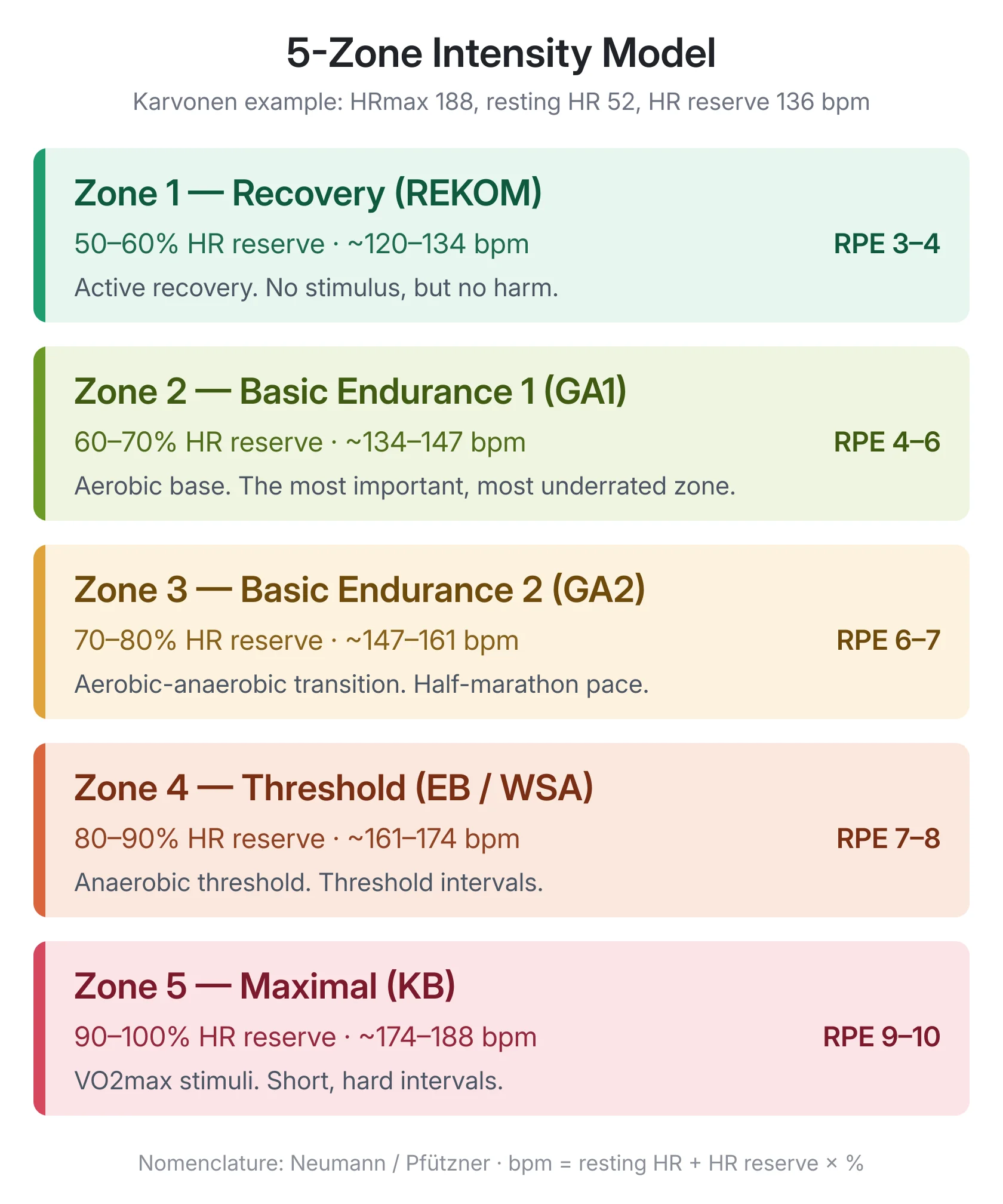
The 5-zone model from German training theory — values calculated via the Karvonen formula (HRmax 188 bpm, resting HR 52 bpm).
Lactate threshold as anchor point: turning a test value into prompt parameters
The lactate threshold marks the transition between purely aerobic and increasingly anaerobic energy supply. Below it, your body clears lactate without trouble — above it, lactate accumulates and the clock starts ticking.
For AI prompts, the lactate threshold is the most precise parameter you can hand over. It can be expressed as heart rate, as watts (cycling) or as pace (running) — whichever you measured. Spiroergometry with lactate sampling gives you exact values. A Conconi field test or a 20-minute FTP test delivers workable estimates.
Tell the AI explicitly whether you are giving a measured or an estimated value — it affects how much tolerance it should build into the plan.
Prompt
My anaerobic lactate threshold is around 162 bpm or 280 watts (FTP estimate, no lab test). Please plan threshold sessions just below it, at 155–160 bpm.RPE: the marker no watch measures — and how to explain it to the AI
RPE — Rate of Perceived Exertion — is your subjective read on load intensity. The Borg scale runs from 6 to 20; the more modern 0–10 version is the practical standard today. In endurance sports just as in strength training.
No sensor measures RPE. That is not a flaw — it is an advantage.
I have seen this hundreds of times in coaching: two athletes, identical heart rate of 155 bpm, an 8 km loop. One says RPE 6 — easy, could run like this for two more hours. The other says RPE 9 — grinding through. Same watch, same number, completely different bodies on that day. RPE captures what no device can: sleep deprivation, stress, day form, motivation. The watch does not know. The athlete does.
For the AI, RPE is meant as a control variable. You specify which perceived load you're targeting for which session — and state your personal reference so the model is calibrated.
Prompt
I use the RPE 0–10 scale. For me, RPE 7 corresponds to a pace I could hold for 30–40 minutes. Please plan base sessions at RPE 5–6 and threshold blocks at RPE 7–8.In strength training: RPE 8 = 2 reps in reserve (RIR 2). That plugs directly into a prompt as an intensity target — more precise than percentages of 1RM, because it factors in day form automatically.
VO2max as a performance baseline: when the value helps, when it misleads
VO2max describes maximum oxygen uptake per kilogram of body weight — a measure of aerobic capacity. Measured in the lab, it is a solid reference value. On a smartwatch it is derived from heart rate and pace over weeks — and can deviate by ±5–10% depending on device and training history.
For AI prompts, VO2max works as a broad classification: how good is the aerobic base, what performance level is the athlete at? A value of 38 ml/kg/min means something different than 58. The AI can scale training norms and periodisation approaches accordingly.
What VO2max does not deliver: it says nothing about intensity distribution, nothing about injury history, nothing about individual trainability. Combined with lactate threshold and HR zones, though, a consistent picture emerges. For recovery planning, it is also worth looking at sleep and training management — VO2max alone never fully explains adaptation responses.
How accurately wearables and LLMs actually hit your VO2max — and when a lab test is the better choice — is covered in AI and VO2max: methods & accuracy.
Strength training: what 1RM, training age and body type tell the AI
If you want to build strength or muscle mass, you need a different context block than an endurance athlete. Nobody cares about lactate threshold here — but bench press 1RM, how long you have been training and whether your body responds to volume with growth or with exhaustion are decisive.
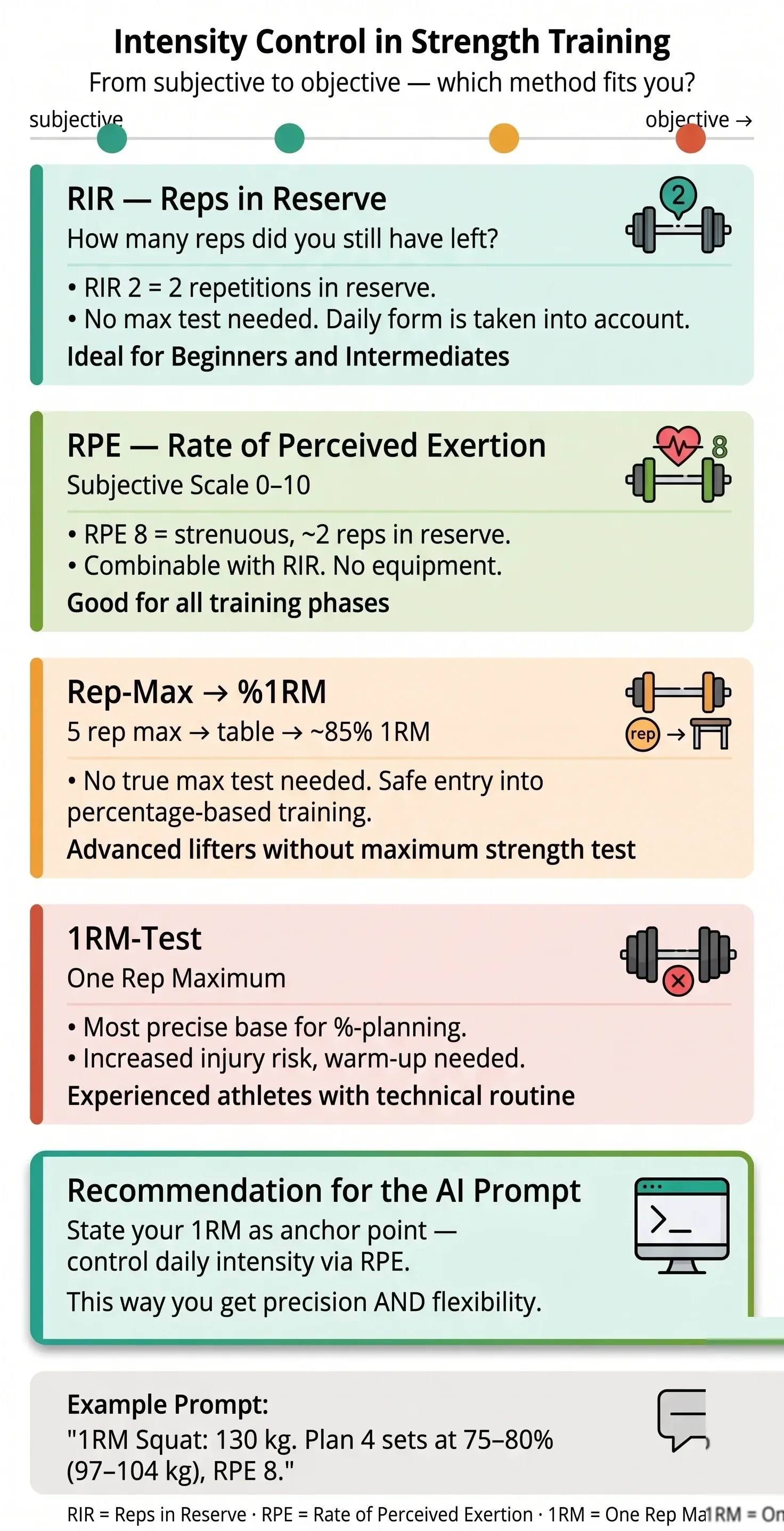
From subjective to objective — which intensity method fits your training level?
The 1RM — the maximum load you can move for a single rep — is the direct intensity anchor in strength training. No plan without this value is precise. The AI needs it to calculate relative intensities: 80% 1RM, 5×5 at 75%, deload at 60%. Running a real max test is worthwhile; if you shy away from it, estimate via a rep-max formula (5RM × 1.15 ≈ 1RM).
Training age influences programme structure more than any other parameter. A beginner (under 1 year of consistent training) needs no periodisation — they grow on almost anything. An intermediate (1–3 years) needs weekly progression. Anyone training for 5+ years needs mesocycle planning and higher volume for further progress. If you give the AI this information, it returns the right programme frame.
Body type is not about the classic ectomorph/mesomorph/endomorph scheme — that is too simplistic. What really helps the AI is the observed response to training: someone who barely gains weight on 3,000 kcal and builds mass only slowly needs different volume than someone who adds muscle and fat quickly on a light surplus. Naming this directly in the prompt gives the AI context it cannot derive from any study.
Prompt
Training age: 3 years. 1RM bench press 95 kg, squat 130 kg, deadlift 155 kg. Body-type tendency: I build muscle relatively slowly, barely put on fat in a surplus (lean type, hard gainer). Goal: hypertrophy. Preferred volume so far: 12–16 working sets per muscle group per week.That is a context block an AI can actually plan training from.
The physiological prompt block: a template for your next AI plan
All the parameters together form a context block you build once — and reuse for every new plan. You only update what has changed in your values. That is the 80/20 of this whole exercise: sharpen the axe once, then cut faster.
Template for endurance sports
Prompt
My physiological profile (endurance):

- Age: [X] years, body weight: [X] kg
- HRmax: [X] bpm (measured / estimated)
- Resting HR: [X] bpm
- Heart rate zones (5-zone model): Z1 up to [X], Z2 up to [X], Z3 up to [X], Z4 up to [X], Z5 above
- Lactate threshold: approx. [X] bpm / [X] watts / [X] min/km (measured / FTP estimate)
- VO2max: approx. [X] ml/kg/min (lab / wearable estimate)
- RPE reference: RPE 7 = pace I could hold for about 30–40 min
- Weekly training volume: approx. [X] hours
Template for strength & fitness
Prompt
My physiological profile (strength/fitness):

- Age: [X] years, body weight: [X] kg
- Training age: [X] years/months of consistent strength training
- 1RM: bench press [X] kg | squat [X] kg | deadlift [X] kg
- RPE reference: RPE 8 = 2 reps in reserve (RIR 2)
- Body-type tendency: [e.g. "lean type, builds mass slowly"]
- Current weekly volume: approx. [X] sets per muscle group
- Recovery: full recovery about [X] days after an intense session
- Goal: [hypertrophy / maximal strength / body composition]
Filled-in example — endurance
Prompt
My physiological profile (endurance):

- Age: 38 years, body weight: 78 kg
- HRmax: 188 bpm (field test)
- Resting HR: 52 bpm
- Heart rate zones (5-zone, Karvonen): Z1 up to 134, Z2 up to 147, Z3 up to 161, Z4 up to 174, Z5 above
- Lactate threshold: approx. 162 bpm / 5:05 min/km (FTP estimate)
- VO2max: approx. 54 ml/kg/min (wearable estimate)
- RPE 7 = pace I could hold for 30–40 min
- Training volume: ~6h/week, goal: half marathon sub 1:50

Write me an 8-week build block for this goal. Periodise based on my lactate threshold, and express intensities in HR zones and RPE.
The AI output with this block is a different beast. Instead of "3× easy runs per week + 1× tempo run" you get concrete intensity targets (Zone 2 at max 147 bpm, tempo runs at 158–165 bpm), a weekly progression built on your volume, and deload weeks that match your recovery capacity. If you want to go deeper, here is how to build your own 5k, 10k, half marathon or marathon AI training plan.
I now use a block like this for every AI query that goes beyond "what should I eat today". The difference is immediately noticeable.
What if the parameters are right — but progress stalls?
A profile block on its own does not break a plateau. This is the point where many people give up — and draw the wrong conclusion: the AI is useless. Usually the problem lies deeper.
The most common causes
Intensity distribution. The most common mistake: too much training in the middle zone (Zone 3, RPE 6–7), too little real aerobic base work (Zone 2) and too few genuinely hard interval stimuli. It feels strenuous but lacks polarisation. The AI reproduces this pattern if you do not tell it that it is not working — so give it not only your current context but also what you have done over the past weeks and why you think it is not working.
Training stimulus. If you have been running the same programme with the same weights, the same zones and the same weekdays for months, you are giving the body no reason to adapt. The AI can help you build in variation systematically — but only if you tell it what you have done most recently.
Recovery. A profile block without a recovery status is half the truth. If you are sleeping worse, carrying more stress or pushing volume beyond your current recovery capacity, no plan in the world will compensate. Add temporary context to your profile block: "currently sleeping 6h instead of 8h, stress level high — plan conservatively."
If after 8–12 weeks of consistent training with correct zones you see no measurable change, a lactate test is worth it — not to collect new numbers, but to understand where the system is jamming. Incorrectly calibrated zones (lactate threshold out of date?) are more common than people think.
When the AI hits its limits
When everything is in place — and it still does not click — the AI has reached the end of its capabilities. Not because the tool is bad, but because some problems require human expertise: an injury history that is hard to describe in a prompt, psychological factors that affect training quality, or real-time feedback only a coach in the session can give. A good AI prompt does not replace a good coach — it makes you a better athlete in self-coaching mode. That is the difference.
How to turn these profiles into complete training plans with AI is shown step by step in the linked article. Or go directly: generate a personalised training plan for free.
FAQ
What is the lactate threshold and why does the AI need this value? The lactate threshold marks the transition from aerobic to anaerobic energy supply — the point at which lactate is produced faster than it can be cleared. For the AI it is the most precise intensity anchor in endurance sports: it defines where base training ends and threshold work begins.
Which heart rate zone model should I use for AI training plans? The 5-zone model. It gives the AI enough granularity to assign concrete intensities. The 3-zone model is too coarse — "moderate" can mean many things.
How do I integrate RPE correctly into an AI prompt? Name the scale (0–10) and provide a personal reference. In endurance: "RPE 7 = pace I could hold for 30 min." In strength: "RPE 8 = 2 reps in reserve." Define target ranges per session — the AI can then set subjective load targets instead of only heart rate or weight ranges.
Is the VO2max value from my smartwatch enough for AI-supported training? As orientation, yes. As a precision value, no. Wearable estimates can deviate by ±5–10%. For the AI it is enough to roughly classify performance level — not for threshold determination.
What is the most important parameter for AI strength training plans? The 1RM in your main lifts — it is the direct intensity anchor from which the AI derives all training weights. Combined with training age (beginner/intermediate/advanced), the AI gets enough context for a sensible programme structure.
What physiological foundations do I need to give the AI planner at a minimum? Endurance: HRmax, resting HR, lactate threshold and RPE reference. Strength: 1RM of the main lifts, training age and body-type tendency. In both cases these values cover 80% of planning quality.