Yes, you can build a running plan yourself with ChatGPT, Gemini or Claude — one that outperforms a generic app-based solution. But not if you type "Write me a marathon plan". A usable AI running plan only emerges when you feed the AI the right data, understand the training principles and know where the limits lie. For ChatGPT in particular: the ChatGPT training plan with prompt and follow-up questions.
You have a concrete goal — 5k, 10k, half marathon or marathon — and you need a plan that fits you, not the average runner. This article shows you the four paths to a plan, detailed blueprints for every distance and the prompt patterns that let you adjust the plan weekly — instead of merely ticking it off.
At a glance
An AI running plan is only as good as your inputs and your understanding of the training principles. This article shows you how to use Claude, ChatGPT or Gemini to build periodized plans from 5k to marathon — with four possible paths to a plan, detailed blueprints per distance and prompt patterns for weekly adjustment. And it tells you where even the best AI plan collapses against reality.
Stay on top of AI training & analysis? One click — and Google shows you my articles first.
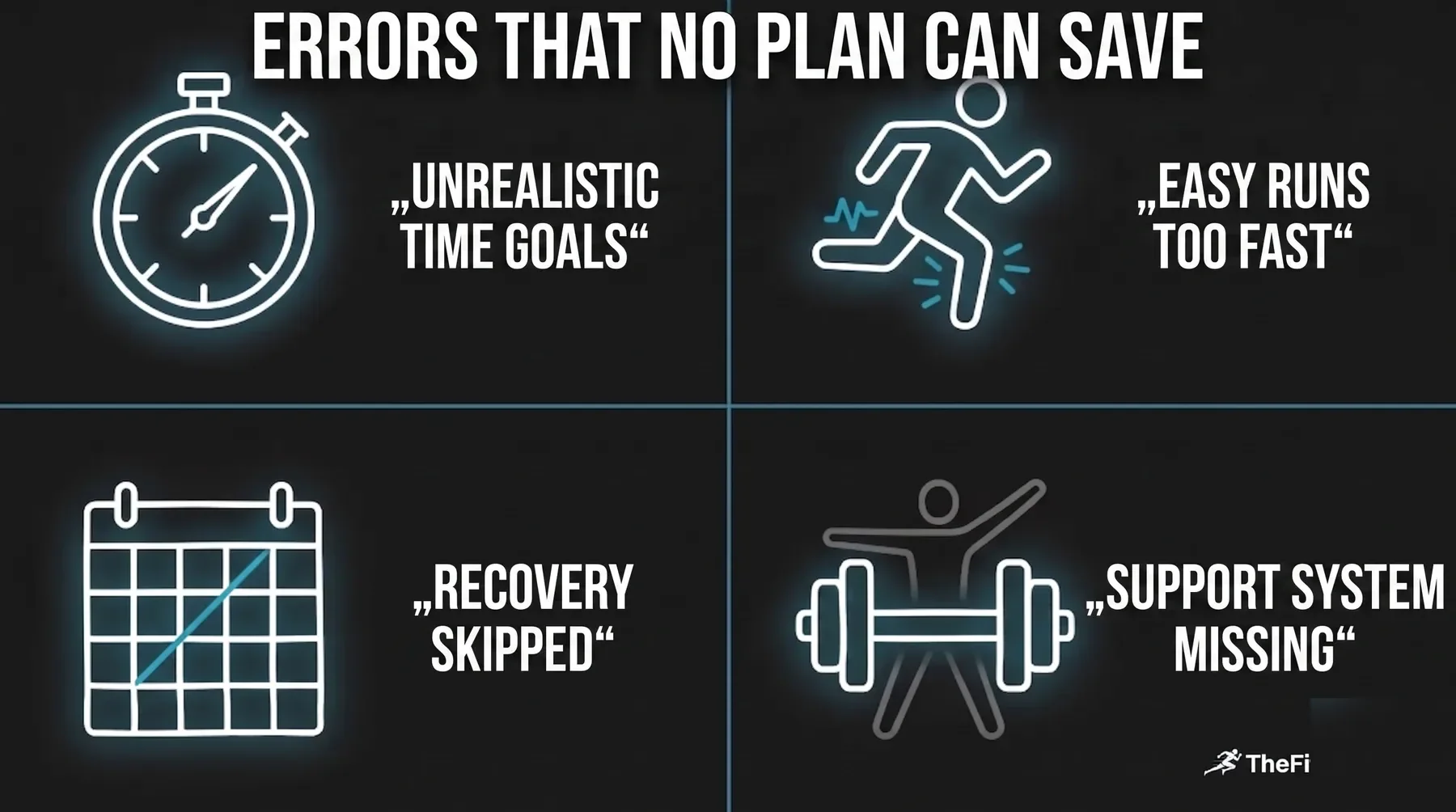
Before we talk about AI, we have to talk about what AI can't fix. From my coaching practice I see the same patterns over and over in self-coached runners — regardless of whether their plan comes from a book, an app or an LLM.
The first and most common pattern is unrealistic time goals. "Sub-40-minute 10k in eight weeks starting from the couch" doesn't work, no matter what Instagram claims. The running marketing industry lives off selling unrealistic timeframes — and physiological adaptations simply take time. The first honest question for your LLM should therefore not be what your goal is, but whether that goal is even achievable in the given time window.
The second pattern is by far the biggest performance leak among hobby runners: the easy runs are run too fast. An easy run really should be easy, feeling almost "too slow". The current research on training intensity distribution is clear here — successful endurance athletes spend around 75 to 85 percent of their training time below the first lactate threshold (Oliveira et al., 2024, Sports Medicine). Anyone who runs every session in the grey zone between easy and hard violates this principle and stays below their potential in the long run.
The third pattern is skipping recovery weeks. A scheduled deload week every three to four weeks is not a sign of weakness but the moment when adaptation actually happens. Many runners skip it because they feel good right now — and tip over into overtraining or injury two weeks later. The training stimulus doesn't make you strong, recovery makes you strong.
The fourth pattern is the most underestimated: strength training, mobility and stretching are completely missing in most hobby runners' weeks because they "don't count as kilometres". Yet this very surrounding work is the real trigger behind almost every overuse injury I encounter in my coaching practice. I'll return to this in detail later — at this point it's enough to know: a running plan without a strength and mobility component is not a complete plan.
An AI plan amplifies these patterns if you don't know the underlying principles — because the LLM generates exactly what you tell it to. Principles first, plan second.
The training principles your plan has to respect
The following principles are the language your LLM needs to understand in order to build usable plans. The foundation is individualization: the plan has to fit you, not you the plan. Age, training age, life circumstances, injury history and sleep quality shape how much load your body can currently handle. A generic sub-3:30 marathon plan from Kipchoge's coach is no more useful to you than a generic plan from an app — neither of them knows you.
Specificity builds on individualization. You train what you need in the race. A 5k runner needs a lot of VO2max work, a marathon runner needs many long sessions at marathon pace. Anyone who wants to run a 10k but only does long, slow runs will never unlock their potential because they've never practiced the load that's specific to the distance.
Progression and overload mean giving your body a stimulus that goes beyond the familiar — but not too far. The classic rule of thumb: weekly volume increase of at most five to ten percent, and never increase volume and intensity at the same time. If an LLM suggests a plan that doubles your weekly volume in two weeks, the plan is wrong.
Periodization structures your plan into phases instead of uniform weeks: base, development, specific preparation, taper. Each phase has its own focus — volume in the early phase, intensity in the specific phase, reduction in the taper. This block logic is the reason plans from books like Jack Daniels' Running Formula or Pete Pfitzinger's Advanced Marathoning work, and why a naively generated AI plan without explicit periodization instructions often fails.
The central intensity principle is called polarization. Roughly 80 percent of your training should happen at low intensity, below the first lactate threshold, where you can comfortably hold a conversation. The remaining 20 percent belong at high intensity: threshold work, VO2max intervals, tempo runs. The zone in between — the grey middle — is wasted time for most hobby runners. The meta-analysis by Oliveira et al. in Sports Medicine 2024 confirms this distribution as superior to threshold-heavy approaches. A caveat: the advantage shows most clearly in well-trained athletes and in shorter intervention blocks. Across the broader hobby population, slightly more pyramidal distributions also work, as long as the low-intensity share stays high — the 80 percent base is more decisive than the exact split of the remaining 20 percent.
Recovery and supercompensation close the list. Adaptation happens during recovery, not during training. Deload weeks every three to four weeks with reduced volume are mandatory, not optional. And sleep is the most important training session you never train — seven to nine hours, ideally consistent.
Your inputs — what the LLM has to know before the first prompt
The quality of your AI plan stands and falls with the quality of your inputs. Bullshit in, bullshit out. Before you type your first prompt you need an honest dataset about yourself — without sugar-coating.
The most important input is your current race time or a test-run pace, ideally over 5k or 10k within the last eight weeks. From this single number your LLM derives all pace zones via the VDOT or Tinman model. Without this anchor every plan is guesswork. Additionally you need the weekly kilometres of the last four weeks listed individually, not as an average — "week 1: 32 km, week 2: 38 km, week 3: 35 km, week 4: 28 km" shows the LLM your starting point and trend. Race time and volume yield your pace zones (Easy, Steady, Threshold, VO2max); if you already know them, state them explicitly — that's more precise than letting the LLM re-estimate them.
Then comes the goal side: which race, which date, which goal time — realistically assessable from current form and typical adaptation rate. Plus your injury history, because chronic Achilles issues, plantar fasciitis or IT-band syndrome change training decisions. And finally the context no plan from a book knows: your life circumstances. Work, family, sleep, travel. A plan with six sessions per week is not realistic for someone with two small children and shift work. Make it explicit: "Monday, Wednesday, Friday mornings 60 minutes, Saturday two hours, Tuesday and Thursday never, Sunday only irregularly." If you also do strength training, include it too — frequency and intensity — so the LLM can estimate the total load.
The more precise these inputs, the more usable the output. An important side note: your first prompt doesn't have to be perfect. Iteration is part of the process, and I'll come back to the prompt patterns at the end of the article that let you adjust a plan after the first week.
Tracking apps and watches — which data to get into the prompt and how
Almost every ambitious runner tracks their sessions today — with Garmin, Polar, Apple Watch, Coros or through Strava as an aggregator. The question isn't whether you have data, but which data you can sensibly get into the prompt. Too much data dilutes the plan just as much as too little.
Ecosystem
Core data for the prompt
Export path
Watch out
Garmin (Forerunner, Fenix, Epix)
VO2max estimate, training status, pace and HR zones, weekly kilometres
Garmin Connect web → export activities (CSV/TCX), read zones directly
Body Battery is nice, but secondary for planning
Polar (Vantage, Pacer, Grit X)
Training Load Pro, Orthostatic Test, zones, Nightly Recharge
Polar Flow → diary export as CSV
Use HRV4Training integration if available
Apple Watch and Health
HRV, distance, VO2max estimate (from Series 3)
Apple Health → export data (XML), or third-party apps like Runalyze
VO2max estimate less precise than Garmin
Coros (Pace, Apex, Vertix)
EvoLab Training Load, running efficiency, zones
Coros app → training export
Youngest ecosystem, API depth still maturing
Strava (aggregator)
Fitness-freshness curve, weekly volume trends, all linked devices
Strava web → own activities, deeper integration via API
Separate deep-dive article to follow
Phone app only
GPS pace, rough HR only with chest strap
Export usually limited, manual entry
An honest estimate beats false precision
The core message: five to seven structured metrics beat 50 unfiltered data points. For a good running plan, current race time, weekly volume, pace zones, HR zones, resting-pulse trend and an honest assessment of training availability are usually enough. Anything beyond that is optional.
Which path to your AI running plan to choose
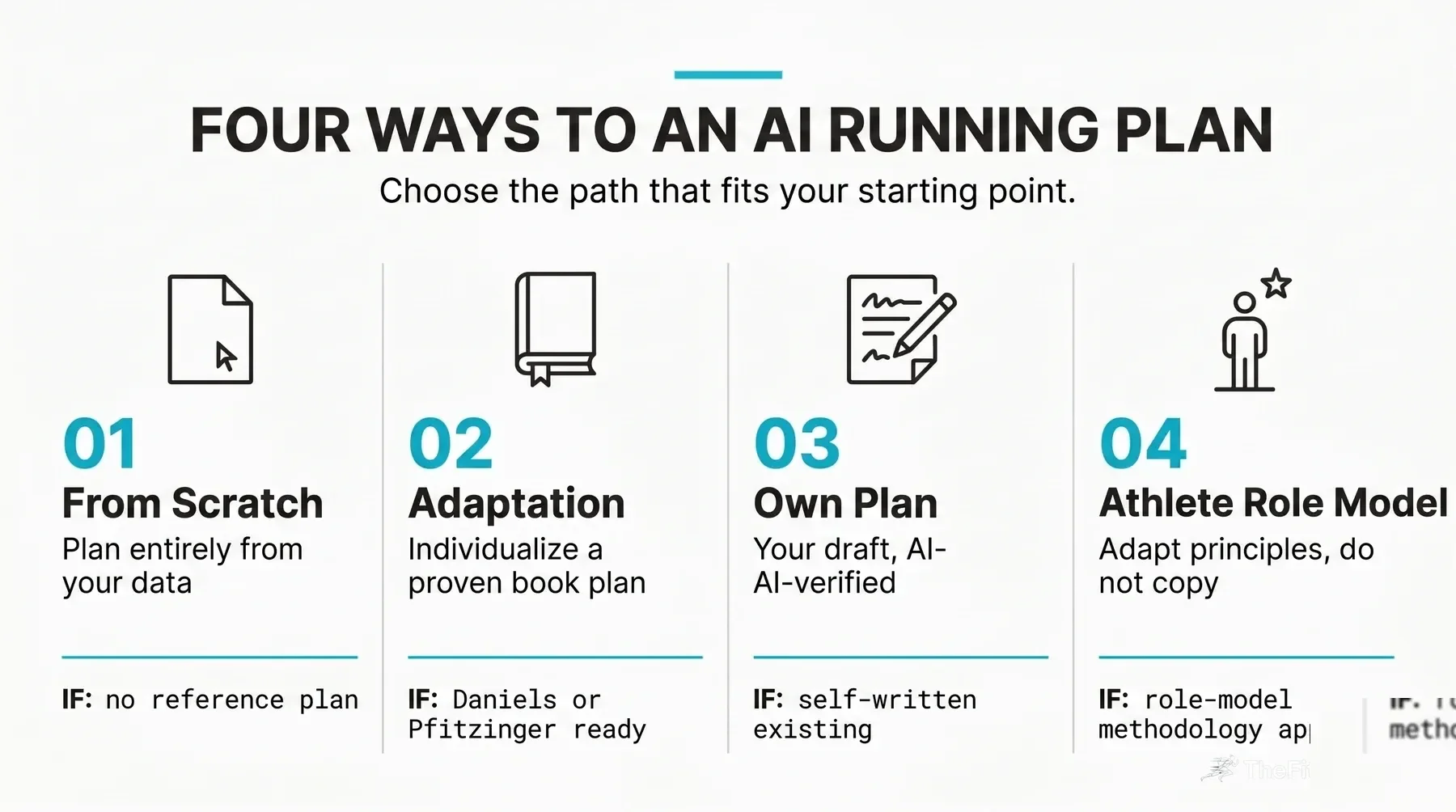
Most articles on AI training plans assume you want to generate your plan entirely from scratch. In practice that's often not the best route. The underlying logic of how to build a training plan with AI we've covered tool-agnostically in a dedicated article — the following four paths are the running-specific application of that. Choose the path that matches your starting point. Prefer not to prompt yourself: generate a running plan for free — the generator handles the data input.
From scratch — generate a plan from your data
The classic route. The LLM builds the complete plan based on your inputs. Works well if you don't have a reference plan or want to switch between systems. Downside: the LLM has to make every decision from scratch, which can lead to generic plans when inputs are patchy.
Prompt
Build me a 12-week training plan for a 10k on [DATE].
Current 10k time: 48:30. Goal time: 45:00.
Weekly kilometres of the last 4 weeks: 32, 35, 38, 30.
VDOT pace zones: Easy 5:40, Marathon 5:10, Threshold 4:45, Interval 4:20.
Available training days: Mon/Wed/Fri 60 min, Sat 90 min, Sun 30-45 min.
Strength training: 2x per week 40 min.
No acute injuries, mild Achilles susceptibility.
Include polarized intensity distribution (80/20) and deload weeks
every 3-4 weeks. Give me the plan as a table per week.
Adapt a proven plan
You already have a plan from a book (Daniels, Pfitzinger, Magness, Hansons), from an app, from a running course or as a PDF. The LLM becomes the translator and adapter. Often the better route, because proven plans have functioning periodization logic baked in — the LLM doesn't have to invent it, only individualize it. Modern multimodal models like Claude, ChatGPT and Gemini can also process photos of books or PDFs as input.
Prompt
Here's a photo of Pfitzinger's 12/55 marathon plan from "Advanced Marathoning".
Adapt it for me:
- Current marathon time: 3:52. Goal: 3:35.
- Realistically I can do 4-5 sessions per week, not 6.
- Which session would you drop and why?
- Convert all pace targets to my VDOT zones:
  Easy 5:50, Marathon 5:05, Threshold 4:40.
- Long runs max 28 km (previous peak 24 km).
Have your own plan optimized
You've written a plan yourself — on the kitchen table, on a piece of paper, in an Excel spreadsheet. The LLM checks it for consistency, polarization and progression and evolves it further. This is perhaps the most underestimated path: you know your body best, the LLM catches the systematic gaps.
Prompt
Here is my self-built 10-week plan for a half marathon.
Check it for:
- Polarization distribution (80/20)
- Progression of the long runs and the total volume
- Placement of hard sessions (enough spacing?)
- Deload weeks present?
- Taper logic in the last 2 weeks
Give me an assessment per point and 2-3 concrete improvements,
not a complete rewrite.
Train after an athlete role model
"I want to train like Jakob Ingebrigtsen with his double-threshold methodology, like Eliud Kipchoge with marathon-pace blocks or like Sifan Hassan with her multi-distance training." The LLM knows the publicly documented training philosophies of these athletes and can break the principles down to your level.
Practitioner warning, explicit: you are not Kipchoge. Plans from a world-record holder who has been running 200 kilometres per week at 2,400 metres of altitude in Kenya for 30 years are not directly transferable. A role model is not a training plan. This path works as a transfer of principles — not as copy-paste. Anyone trying to rebuild a Kipchoge training week on 60 weekly kilometres ends up on the couch with a stress fracture within two weeks.
Prompt
Explain the training philosophy of the Ingebrigtsen brothers (double threshold)
and derive a set of principles I can apply as a hobby runner at my level.
My numbers: 10k time 42:30, 50 km/week, 5 sessions possible.
Show me what from the methodology is sensibly transferable — and what
deliberately isn't, because volume, genetics or life circumstances don't allow it.
Then: one example week for me in the style of the methodology.
5k training plan — where intensity beats volume
The 5k distance is regularly underestimated by hobby runners. It's the distance with the highest proportional VO2max share — around 95 to 100 percent of your maximal oxygen uptake, sustained over 15 to 25 minutes. Physically that hurts more than marathon pace, just for shorter. Accordingly the training is different from longer distances: less volume, more high-quality VO2max work.
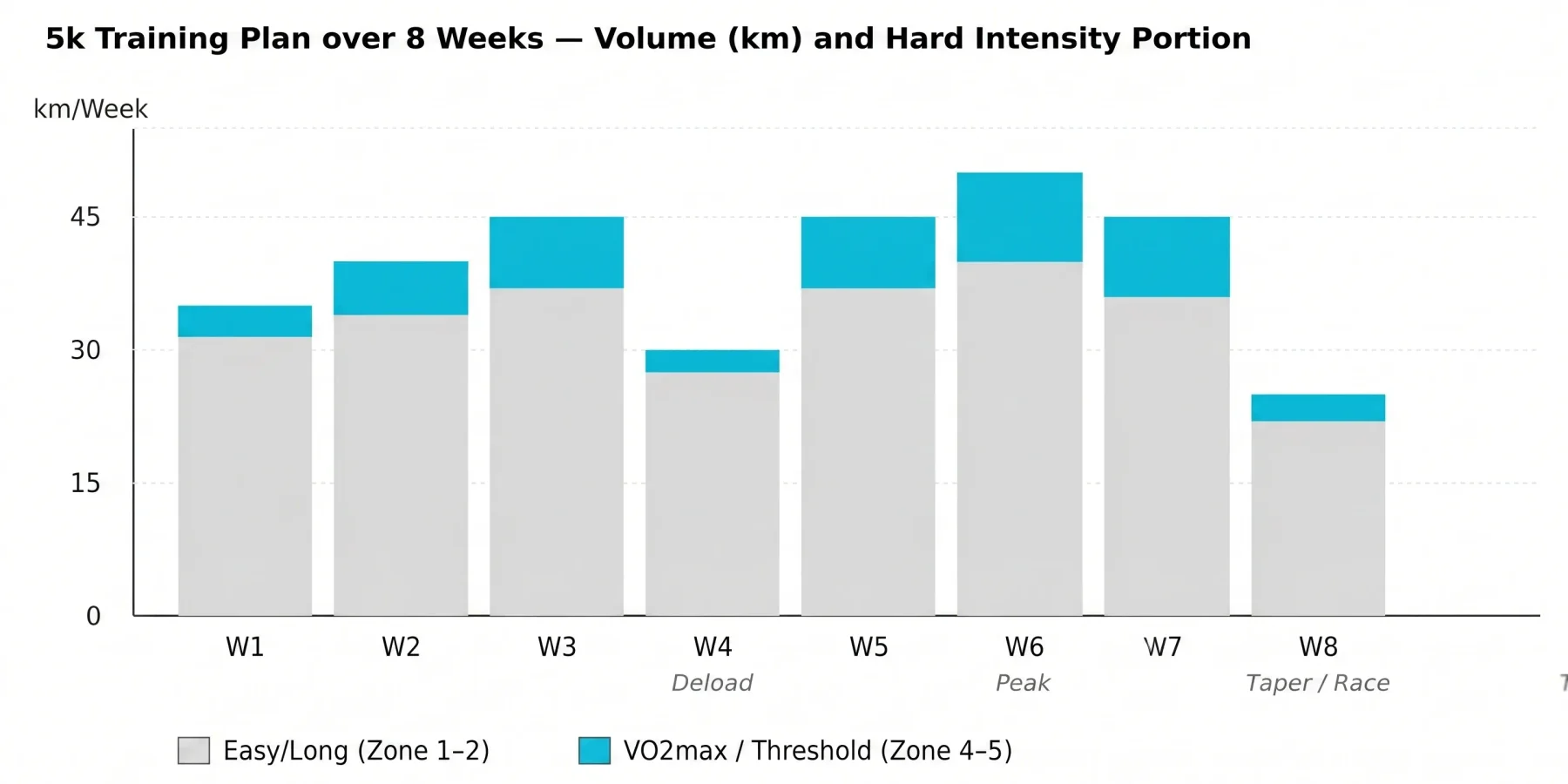
Periodization over 8 to 10 weeks
The classic 5k structure: three weeks of base building with progressive volume, one deload week, three development weeks with a peak in week six or seven, taper week to the race. Hard sessions are two per week with at least 48 hours between them. Typical workouts are 6×800 metres at interval pace with 90 seconds rest, 5×1000 metres at threshold pace or fartlek variants like 10×(1 min hard / 1 min easy).
Typical mistakes
Too much pace on the easy runs, too little total volume. A 5k plan must not consist of five moderately hard sessions per week — the 80/20 pattern applies here too. Anyone who wants to improve their 5k time runs the easy runs especially consistently slow so they're fresh for the two hard sessions.
5k prompt template
Prompt
Build an 8-week 5k training plan for [DATE].

Current numbers:
- 5k time: [e.g. 24:30]
- Goal time: [e.g. 22:30]
- Recent weekly kilometres: [e.g. 35, 38, 40, 32]
- Pace zones: Easy [e.g. 5:40], Threshold [e.g. 4:50], Interval [e.g. 4:25]
- Training days: [e.g. Mon/Wed/Fri/Sat plus 1 optional]
- Strength training: [e.g. 2x/week 40 min]
- Injury history: [e.g. none acute, mild Achilles susceptibility]

Requirements:
- Polarized intensity distribution (approx. 80% zone 1-2, 20% zone 4-5)
- Maximum 2 hard sessions per week, at least 48h apart
- Weekly kilometre progression max. 8-10% per week
- Deload in week 4 (volume -25%)
- Peak in week 6
- 7-day taper in week 8 (volume -50%, intensity maintained)

Give me the plan as a table per week with:
Day | Session | Distance | Pace | Purpose

At the end: notes on executing the 3 most important workouts.
How to read the output critically
After the first output you check three things. First, the intensity distribution: if more than 25 percent of your sessions fall into zone 3 to 5, there's a polarization violation — then explicitly ask for it and have the share of hard sessions reduced to 20 percent of weekly volume. Second, the progression: if your weekly volume jumps by more than ten percent in any week, that's an injury risk. Third, the spacing between hard sessions — under 48 hours is an overload candidate.
10k training plan — lactate threshold as the training focus
The 10k is the distance where the second lactate threshold — the anaerobic pace you can just about hold for 40 to 60 minutes — becomes the decisive factor. A good 10k plan differs from a 5k plan primarily in more threshold work and longer tempo runs, less in short VO2max intervals.
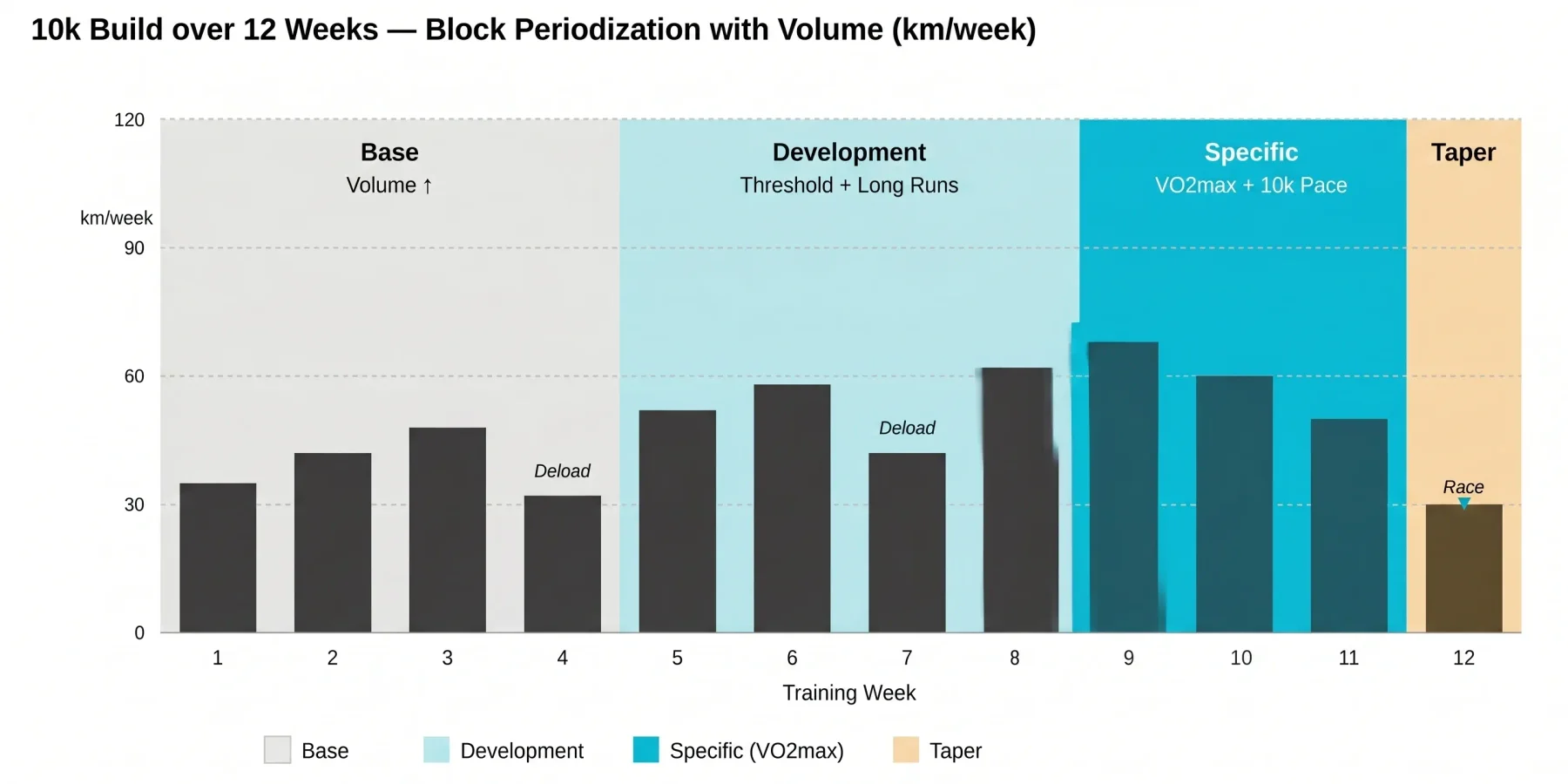
Periodization over 10 to 12 weeks
Three weeks of base building, deload, three weeks of development, deload, three weeks of specific preparation, taper. The characteristic workouts are cruise intervals (3–4×2000 metres at threshold pace with 90 seconds rest), tempo runs (20 to 40 minutes at threshold pace) and progression runs, where the last 5 to 8 kilometres of a longer run are completed at half-marathon pace.
The difference from the 5k plan
More volume, typically 50 to 80 km per week for ambitious hobby runners. Longer hard sessions, less max-interval work. The long runs become more important — 18 to 22 kilometres on the weekend is standard, with occasional progression to half-marathon pace at the end.
10k prompt template
Prompt
Build a 12-week 10k training plan for [DATE].

Current numbers:
- 10k time: [e.g. 48:30]
- Goal time: [e.g. 45:00]
- Recent weekly kilometres: [e.g. 35, 40, 42, 38]
- Pace zones: Easy [e.g. 5:35], Marathon [e.g. 5:00], Threshold [e.g. 4:40], Interval [e.g. 4:20]
- Training days: [e.g. 5 sessions/week]
- Strength training: [e.g. 2x/week, of which 1x heavy]
- Injury history: [e.g. old patellar tendon issues, now asymptomatic]

Requirements:
- Polarized distribution (80/20)
- 2 deload weeks (week 4 and 8)
- Focus on lactate threshold: cruise intervals and tempo runs
- Long runs progressive 16 → 22 km
- 14-day taper with volume reduction 50%, intensity maintained
- Peak week in week 10 or 11

Give me the plan as a table per week.
Mark the 3 key workouts of the preparation.
After week 6 schedule an intermediate test (5k time trial).
Half marathon training plan — the long run becomes the training anchor
For the half marathon the long run becomes the central training anchor. The challenge is no longer geared toward pure speed as with the 5k or 10k — the challenge is sustaining 21.1 kilometres at an ambitious pace that lies below the anaerobic threshold but clearly above marathon pace. Specificity here means: you have to practice half-marathon-pace work in training, not just fast intervals.
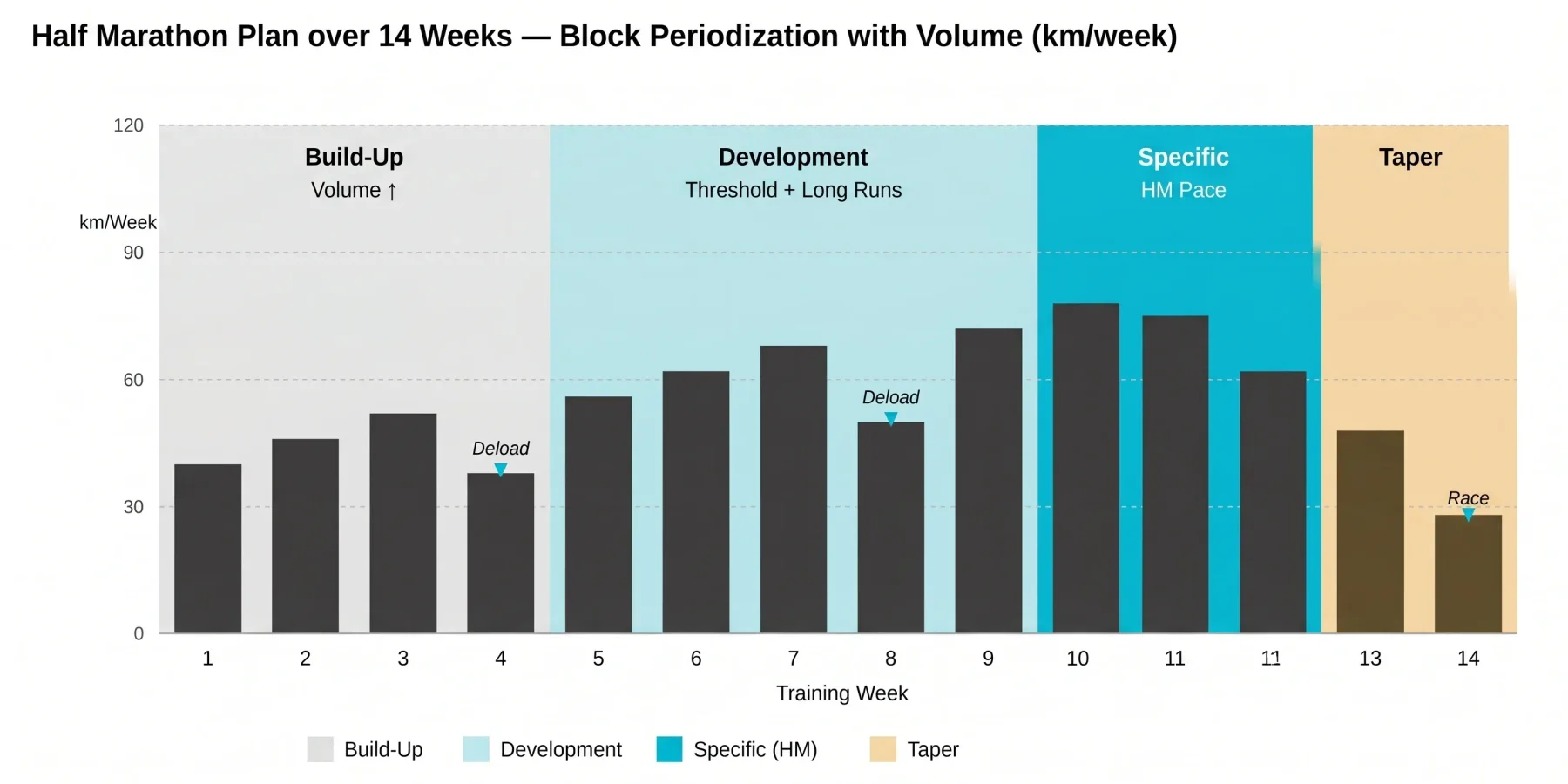
Periodization over 12 to 14 weeks
Three build-up phases of three weeks each with a deload between them, followed by a specific phase with half-marathon-pace work and a two-week taper. The long runs grow progressively from 14 to 22 kilometres, with a peak in week eleven or twelve. Key sessions are the long run with embedded half-marathon-pace work (e.g. in week 10: 18 km easy plus 6 km at HM pace), classic tempo runs and 5×2000 metres at threshold pace.
Fueling — relevant for the first time
At the half marathon you start to feel the energy question. From long runs of 90 minutes onward you should practice gels or carbohydrate drinks in training, not only on race day. One gel every 30 to 40 minutes is common practice. What you've never tested does not belong on race day.
Half marathon prompt template
Prompt
Build a 14-week half marathon training plan for [DATE].

Current numbers:
- Current 10k time: [e.g. 50:00]
- Last HM time: [e.g. 1:52, 8 months ago]
- Goal HM time: [e.g. 1:45]
- Recent weekly kilometres: [e.g. 30, 35, 38, 32]
- Pace zones: Easy [e.g. 5:45], Marathon [e.g. 5:15], HM pace [e.g. 5:00], Threshold [e.g. 4:50]
- Training days: [e.g. 4-5 sessions possible]
- Strength training: [e.g. 1-2x/week]
- Longest recent long run: [e.g. 18 km]
- Fueling experience: [e.g. none yet]

Requirements:
- Progressive long runs 14 → 22 km
- From week 8: integrate half-marathon-pace work in 2 long runs
- Polarized distribution 80/20
- Deload every 4 weeks
- Fueling protocol for long runs from 90 min
- 14-day taper
- Peak in week 11 or 12

Output as a table per week, with a separate section on:
- Fueling strategy in training and on race day
- The 3 key long runs of the preparation
Marathon training plan — the distance that doesn't forgive training mistakes
The marathon is the distance where most hobby runners hit their limits — and not on race day, but in training. A marathon plan is not a six-week affair, it's a four- to five-month project that structures your everyday life. Anyone who underestimates this ends up with a knee injury in week ten.
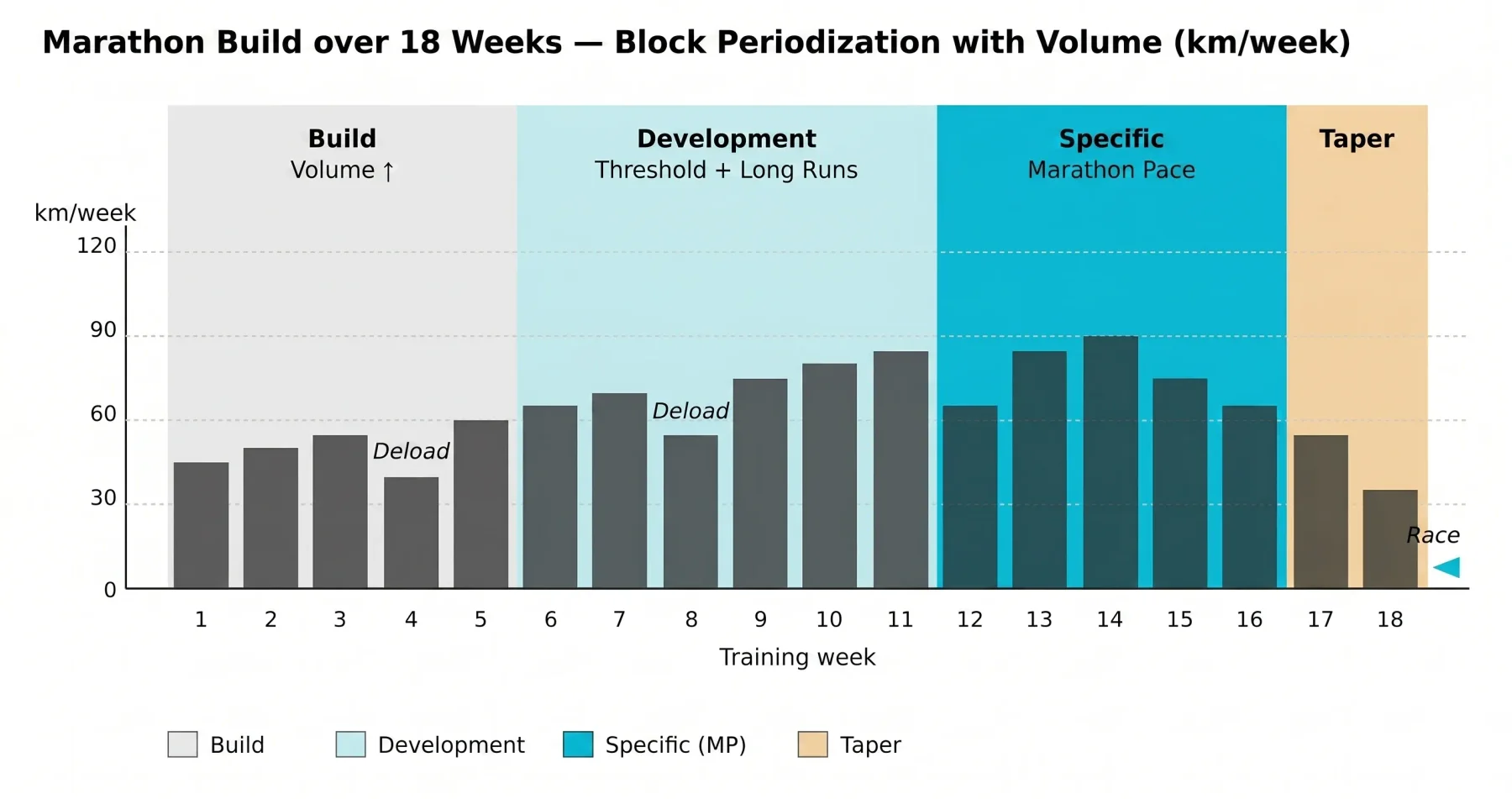
Block periodization over 16 to 20 weeks
The marathon plan breaks down into four blocks: base with volume as the primary focus, development with threshold and long-run work, the specific phase with marathon-pace work at its heart, and the taper. Classic sessions are long runs with 12 to 16 kilometres at marathon pace at the end, endurance long runs of 30 to 35 kilometres at easy pace and threshold repeats like 3×4 kilometres at threshold pace.
The long-run types
In marathon training the long run has three faces. The endurance long run is long and slow, 28 to 35 kilometres at easy pace, and targets mitochondrial adaptation, glycogen utilization and fat metabolism. The marathon-pace long run is 25 to 32 kilometres in total, of which 12 to 20 at marathon pace — its job is specificity and mental preparation for race pace. The progression long run runs 25 to 28 kilometres with progressive pace increase, the last 8 kilometres at half-marathon pace, and trains fatigue resistance. A good AI plan rotates these three types — a bad one only repeats the endurance long run.
Taper
The evidence on optimal taper strategy is by now clear. A meta-analysis in PLOS One from 2023 recommends a taper duration of up to 21 days with progressive volume reduction of 41 to 60 percent while maintaining training intensity and frequency. This is often done wrong in the hobby realm — volume reduced too little or, more frequently, intensity removed completely. Both cost performance.
Marathon prompt template
Prompt
Build an 18-week marathon training plan in block periodization for [DATE].

Current numbers:
- Last marathon time: [e.g. 3:52, 12 months ago]
- Current 10k time: [e.g. 47:30]
- Goal marathon time: [e.g. 3:35]
- Recent weekly kilometres: [e.g. 40, 45, 48, 42]
- Pace zones: Easy [e.g. 5:45], Marathon [e.g. 5:05], HM [e.g. 4:55], Threshold [e.g. 4:45]
- Training days: [e.g. 5-6 sessions/week realistic]
- Longest recent long run: [e.g. 24 km]
- Strength training: [e.g. 2x/week]
- Life circumstances: [e.g. 2 kids, full-time job, Sat morning fixed for long runs]
- Injury history: [e.g. plantar fasciitis 2023, symptom-free for 18 months]

Structure in 4 blocks:
- Block 1 (W1-5): base, volume progressive 45 → 65 km, primarily easy/steady
- Block 2 (W6-11): development, threshold work, long runs up to 28 km, volume up to 85 km
- Block 3 (W12-16): specific, marathon-pace work, long runs up to 34 km
- Block 4 (W17-18): taper, volume -41 to -60%, intensity maintained

One deload week per block. Three long-run types (endurance, MP, progression) rotating.
Polarized distribution 80/20.

Output:
- Table per week with day/session/distance/pace/purpose
- Fueling strategy separately
- The 5 key workouts of the plan
- Red flags: at what signs to reduce volume
Who should not run a marathon from an AI plan?
Honest assessment from coaching practice: anyone who hasn't run at least one half marathon in the last twelve months, anyone consistently training under 40 weekly kilometres, anyone without realistic time for four to five sessions per week or carrying acute overuse symptoms — should postpone the marathon, not have an AI plan generated for it. The distance doesn't forgive training gaps. The LLM can help you honestly here: ask it whether your goal is realistic, and take the answer seriously.
Pace zones — the language for your LLM
Pace zones are the language in which training plans are written. Without clear zones, sessions like "tempo run 30 minutes" are meaningless — which tempo exactly? The most widespread and reliable derivation is VDOT according to Jack Daniels: from your current race time over any distance the system calculates all training paces. If you don't have a current race, an LLM can alternatively help you estimate VO2max from your training data — with the methodological limits we've broken down in detail in the piece "Can AI estimate my VO2max?".
Zone
Intensity
Feel
Example: runner with 45-min 10k
Typical use
1 — Recovery
< 65% HRmax
Very easy, conversation easy
> 5:50 min/km
Regeneration, warm-up
2 — Easy
65–75% HRmax
Easy, conversation possible
5:20–5:45 min/km
Bulk of volume, long runs
3 — Steady / Marathon
75–84% HRmax
Focused, short sentences only
4:50–5:10 min/km
Marathon-pace work
4 — Threshold
84–90% HRmax
Demanding, conversation barely possible
4:25–4:45 min/km
Tempo runs, cruise intervals
5 — VO2max
> 90% HRmax
Very demanding, no conversation
< 4:20 min/km
Interval training 800–1200m
Practical tip: when you ask your LLM for a plan, state your zones explicitly. "Easy pace 5:30 min/km, Threshold 4:40, Interval 4:20" is better than giving only a race time — because it lets you account for any physiological peculiarities (for instance an above-average lactate threshold combined with a below-average VO2max).
What most running plans forget — strength, mobility, stretching
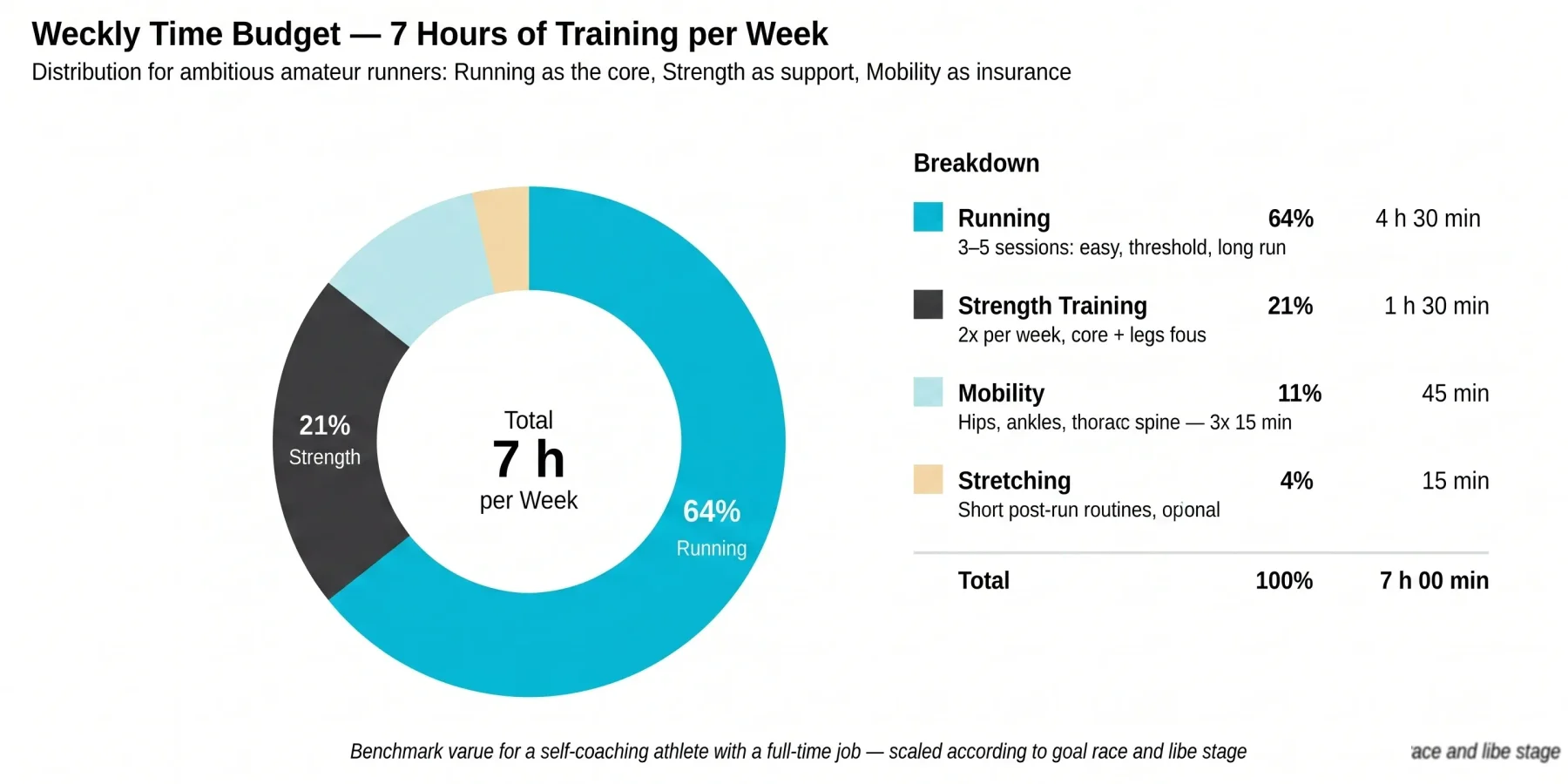
Here's the point where most AI plans stay silent: the surrounding work. Not because it's unimportant — but because nobody writes it explicitly into the prompt. A runner who runs four times a week and does two focused strength sessions is better set up than one who runs six times without strength. The evidence is clear: a meta-analysis in Sports Medicine 2024 shows moderate effects of high-load strength training on running economy in middle- and long-distance runners — and thus directly on race performance.
Strength training for runners
One to two sessions per week of 30 to 45 minutes, full-body with focus on core, hips, glutes and eccentric calf work. Effective are heavy sessions (80 to 90 percent of 1RM, three to five reps) in combination with plyometric training — not the classic light circuit with many reps. The purpose is not muscle mass but neuromuscular efficiency and injury prevention.
Exercise
Focus
Sets/reps (heavy strength)
Back squat (low bar)
Glutes, quadriceps, core
4 × 5 @ 80–85% 1RM
Romanian deadlift
Hip extensors, hamstrings
3 × 6 @ 75–80% 1RM
Single-leg calf raise
Calf, Achilles tendon
3 × 8 eccentric-emphasized
Note on the evidence: the cited meta-analyses rest predominantly on studies with well-supervised protocols — with technique instruction, clean progression and regular supervision. Anyone training heavy on their own has to actively plan technique, gradual load progression and existing limitations (back, knees, Achilles). 80 to 90 percent of 1RM is not an entry-level load but the result of a build-up phase over several months — if you're not there yet, start with lower loads and clean execution before the weight goes up.
Mobility and stretching
Ten to 15 minutes of mobility daily, ideally as a warm-up routine before running — focused on hip openers, ankle mobility and thoracic spine. Static full-body stretching before running is counterproductive, after running neutral to slightly positive for range of motion. A dynamic warm-up of easy jogging, knee and heel lifts and lunges beats both.
Integrate into the prompt
The trick: the LLM has to know whether and how you strength train — otherwise it plans running load that doesn't match the total load. Add to your prompt: "I do 2× per week 45 minutes of strength training (full body, heavy, including back squats and deadlifts). Account for this when distributing hard running sessions — avoid a heavy squat session the day before interval training or a long run."
What AI structurally can't do in running training
Now the honest other side. An LLM is a first-rate planner and a good sparring partner — but there are things it structurally can't deliver. Anyone who doesn't understand this lands in a deceptive sense of security.
The LLM doesn't see how you run. Overpronation, cadence that's too low, overstriding with the foot — only a human eye or a video analysis can recognize all that. If you develop pain, that's often not a planning mistake but a technique mistake the LLM can't diagnose by definition. Similarly it lacks the pain context: "My knee twinges on the stairs" is, to an experienced coach, a clear warning — to the LLM just text. It can give you hints, but it can't decide whether you should run today.
The LLM also doesn't know how your last session actually went, unless you tell it. A human coach sees the fatigue on you, an LLM needs your structured feedback — otherwise it recognizes neither plateaus nor overload. And the polarization check is something the LLM only does on request: without an explicit check question it often dilutes the required 80/20 split in favour of "more interesting" sessions — which AI models hit training principles like this most reliably in testing, I took a closer look at.
And finally the plan doesn't know your life. Kid with a fever, colleague sick, unplanned business trip — all of that turns your plan into waste paper. You have to decide yourself which session to drop and which to keep priority. The consequence of all this: The LLM is your assistant, not your coach. You remain responsible for decisions — especially the uncomfortable ones.
The prompt patterns for your running training
A plan is not the end but the beginning. You'll need the following prompt patterns again and again during training — regardless of the distance. The first is the setup prompt, i.e. the initial prompt that generates the plan; the detailed versions are with the blueprints above. Decisive are structured inputs, explicit requirements for periodization and polarization and a clear output structure.
The weekly review
Prompt
Review week [X] of my [DISTANCE] plan.

Planned was:
[Insert planned sessions here]

Actually run:
- Mon: 8 km easy, avg HR 142, pace 5:45, felt good
- Wed: planned 5x1000m interval — only managed 4, last rep
  pace dropped from 4:20 to 4:32, HR peak 182
- Fri: skipped due to illness (cold)
- Sat: 18 km long run, pace 5:40, felt more demanding than usual
- Sun: 45 min easy

Assess:
1. Trends compared to week [X-1]?
2. Warning signs (overload, loss of form, polarization violated)?
3. How do I adjust the coming week — given the missed session
   and the long run that felt demanding?
The workout debrief
Prompt
Debrief of a hard session.

Planned: 3x3 km at threshold pace (4:40 min/km), 3 min rest

Executed:
- Rep 1: 4:38 / 4:41 / 4:42 — HR peak 175
- Rep 2: 4:40 / 4:43 / 4:47 — HR peak 179
- Rep 3: 4:45 / 4:50 / aborted after 1800m — HR peak 182

Feel: legs leaden after rep 2, breathing too heavy from km 1 of rep 3.
Previous session: 22 km long run yesterday (progression).

Questions:
1. Was the pace too high or the recovery window too tight?
2. What do I learn for the next threshold session?
3. Volume too high for this phase? How do I recognize that?
This debrief logic is the difference between a plan you tick off and a training process in which you learn. That is exactly what makes this approach more valuable than any app — you remain the coach of yourself.
My take
AI is not the better coach — it's the assistant that helps you become a better coach of yourself. Anyone who internalizes the training principles, structures their inputs, chooses the right path to a plan and iterates weekly with review and debrief builds a training process that is systematically superior to a generic app-based solution. At the same time you remain responsible for the decisions AI can't make: pain assessment, everyday adjustment, the honest confrontation with your own goal.
This works for ambitious hobby runners between 5k and marathon who are willing to invest a few hours of thinking into the training principles. For absolute beginners without any prior experience, a human running-club coach in the first season is still the better choice — not because of the plans, but because of the eye on technique and load. For everyone in between, the path via LLMs is by now the most sensible one I've seen in my coaching practice.
Frequently Asked Questions
Which LLM is best for running plans?
<p>Currently Claude (from Sonnet 4.5), ChatGPT (from GPT-4o) and Gemini 2.5 Pro deliver comparably usable plans when the inputs are good. Differences show up in details: Claude tends toward more conservative progression, ChatGPT toward "more interesting" workouts, Gemini toward heavily structured output. The real lever is not the model but your prompt and the review loop. If you want to test the workflow with a preconfigured tool instead of free-text prompts, you can use the <a href="https://www.thefitfuturist.com/training-analyse/gemini-gem-trainingsplan/">TheFitFuturist Training Coach as a Gemini Gem</a> or the <a href="https://www.thefitfuturist.com/training-analyse/claude-trainingsplan-skill/">Claude training-plan Skill</a> — both bundle the principles described here into a reusable system instruction.</p>
Can I import the AI plan into Garmin Connect or Polar Flow?
<p>Yes — via TCX files for Garmin, via TrainingPeaks for Polar Flow, via iCal for Apple Calendar. The technical details are in a separate article on <em>importing AI training plans into wearables</em>.</p>
Does this also work without a wearable?
<p>Yes, but with limitations. You then at least need a current race time or test-run pace as an anchor. HR zones drop out, in exchange your LLM works more with pace and RPE data. For 5k and 10k this works well, for marathon it gets harder.</p>
How often should I review the plan with AI?
<p>Weekly with the review pattern, plus after every hard or aborted workout with the debrief pattern. That's the real added value over a static plan from a book — adjustment happens continuously on the basis of your real data.</p>
What do I do if a workout was too hard?
<p>Don't "compensate" with more volume the next day — that's the classic overload pattern. Instead, debrief, and if several sessions in a row feel harder than planned: build in an additional rest day or pull a deload week forward. The LLM helps you interpret the signs — the decision is yours.</p>
Why doesn't this article talk about running shoes?
<p>Because running shoes are their own, independent entity — with their own physiology (cushioning, drop, carbon plates), their own product cycles and their own debate. It doesn't belong in a training-planning article. Anyone who wants to write about shoes should do so separately — and in depth.</p>