High training volume worsens sleep quality – and too little sleep slows down the next session. That is what a year-long study of 224 Chinese Garmin runners shows. The finding is plausible and well supported. The caveat: Garmin is not the most accurate wearable on the market when it comes to sleep stage detection – and that hits the core of the study.
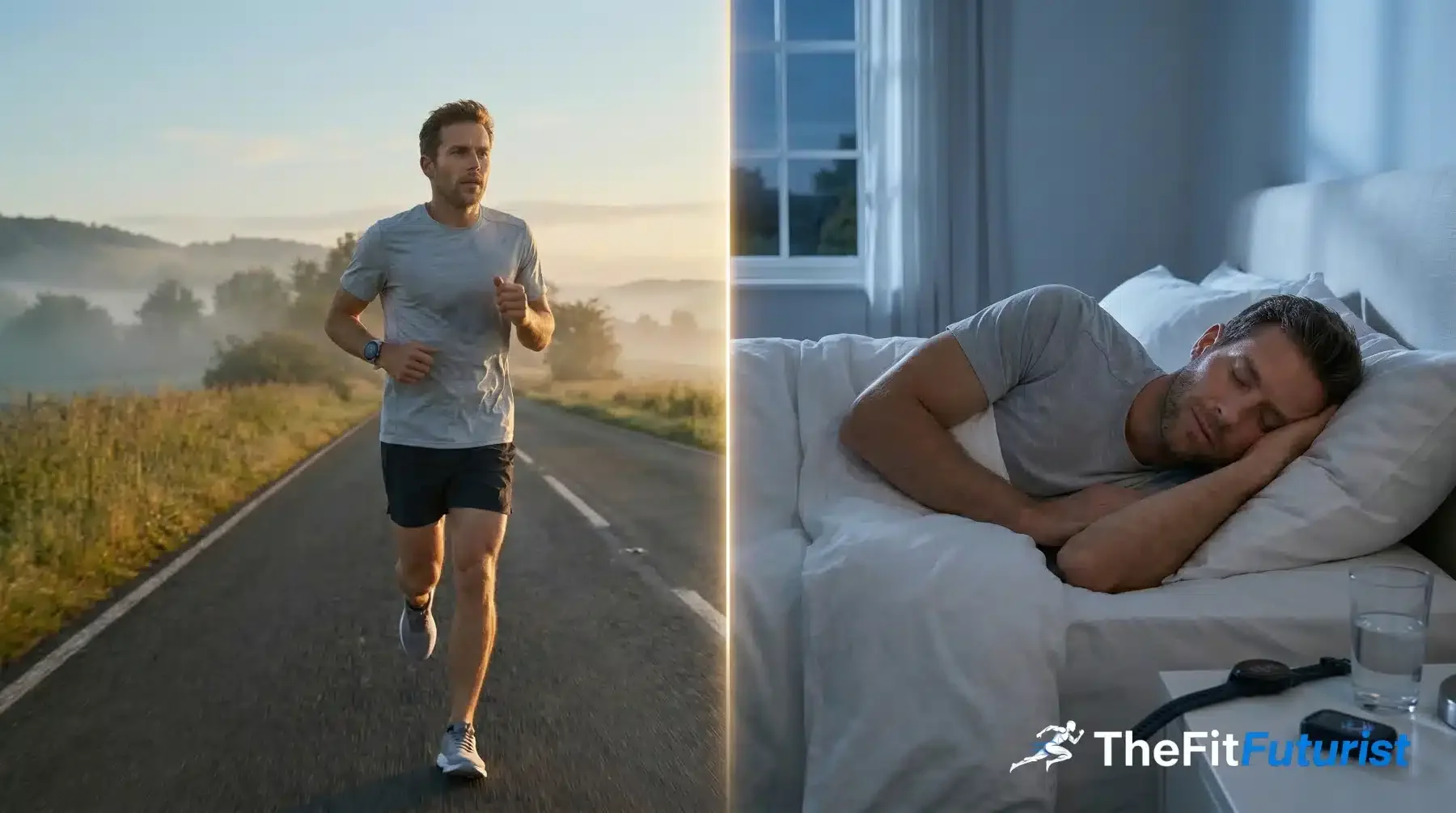
More training, worse sleep, even more training – what 224 Garmin runners reveal
 Christopher Klenk9 min read
At a glance
A year-long study of 224 Chinese Garmin runners shows: high training volume worsens sleep quality despite longer total sleep duration, poor sleep slows the next day's pace – and runners unconsciously compensate by running longer. Limitations: Garmin is not the accuracy leader in sleep stage detection, daytime naps were not recorded, and athletes generally sleep too little.
Our take: The data suggest a vicious cycle that the study does not measure directly: high load → worse sleep → slower pace → longer run duration to compensate → even higher load. Slower-but-longer is not a strategy. HRV and sleep quality belong in training monitoring as equal parameters – not as a footnote.
Stay on top of AI training & analysis? One click — and Google shows you my articles first.
Add as a preferred source on GoogleWhat the study did
The study design is methodologically interesting because it is not a lab study. The research group around Xiaofeng Xu continuously collected training and sleep data from 224 recreational runners between June 2024 and June 2025 – exclusively via the Garmin API, i.e. the data the watch records anyway. Training data included pace, distance, duration and heart rate; sleep data included sleep stage duration and nocturnal heart rate variability (HRV – a measure of autonomic nervous system recovery).
Statistical analysis used linear mixed models (LMM), which account for individual differences between participants. The researchers analysed differences by sex, performance level, season and day of the week, as well as the lagged effects in both directions: training → next day's sleep, and sleep → next morning's training.
What came out of it
The group's training profile: an average of 12.10 km per session at a pace of 6:02 min/km. Men ran faster and longer than women, and elite runners dominated across all metrics as expected. In summer, pace and distance were lowest – which surprises no one who has ever set off in 35 degrees Celsius.
For sleep: on average, participants slept only 6.61 hours per night – less than the generally recommended 7–9 hours for adults. Women recorded significantly more deep sleep than men; elite runners showed a more pronounced early rhythm when falling asleep and waking up.
The most interesting finding: high training volume the day before led to a longer total sleep duration, but to less deep and REM sleep (deep sleep = the regenerative phase during which growth hormone is released; REM sleep = critical for cognitive recovery and memory consolidation), more light sleep, more wake phases and lower nocturnal HRV. In other words, those who train a lot sleep longer – but worse. And poor sleep slowed pace the next day, with runners unconsciously compensating by running longer.
A possible vicious cycle
The study shows two isolated effects: training worsens sleep, poor sleep worsens training. What it cannot measure directly is whether these effects compound into a cycle over several days. But the data point exactly in that direction – and that is the point that really matters for day-to-day training.
The logic behind it: high training load worsens sleep quality. Worse sleep leads to slower pace the next day. Runners with a target distance in mind simply run longer to reach it. That raises total load – which in turn burdens the next night's sleep. This self-reinforcing dynamic is not a direct study finding, but a reasoned conclusion drawn from the measured individual effects. That is how it should be read – and still taken seriously.
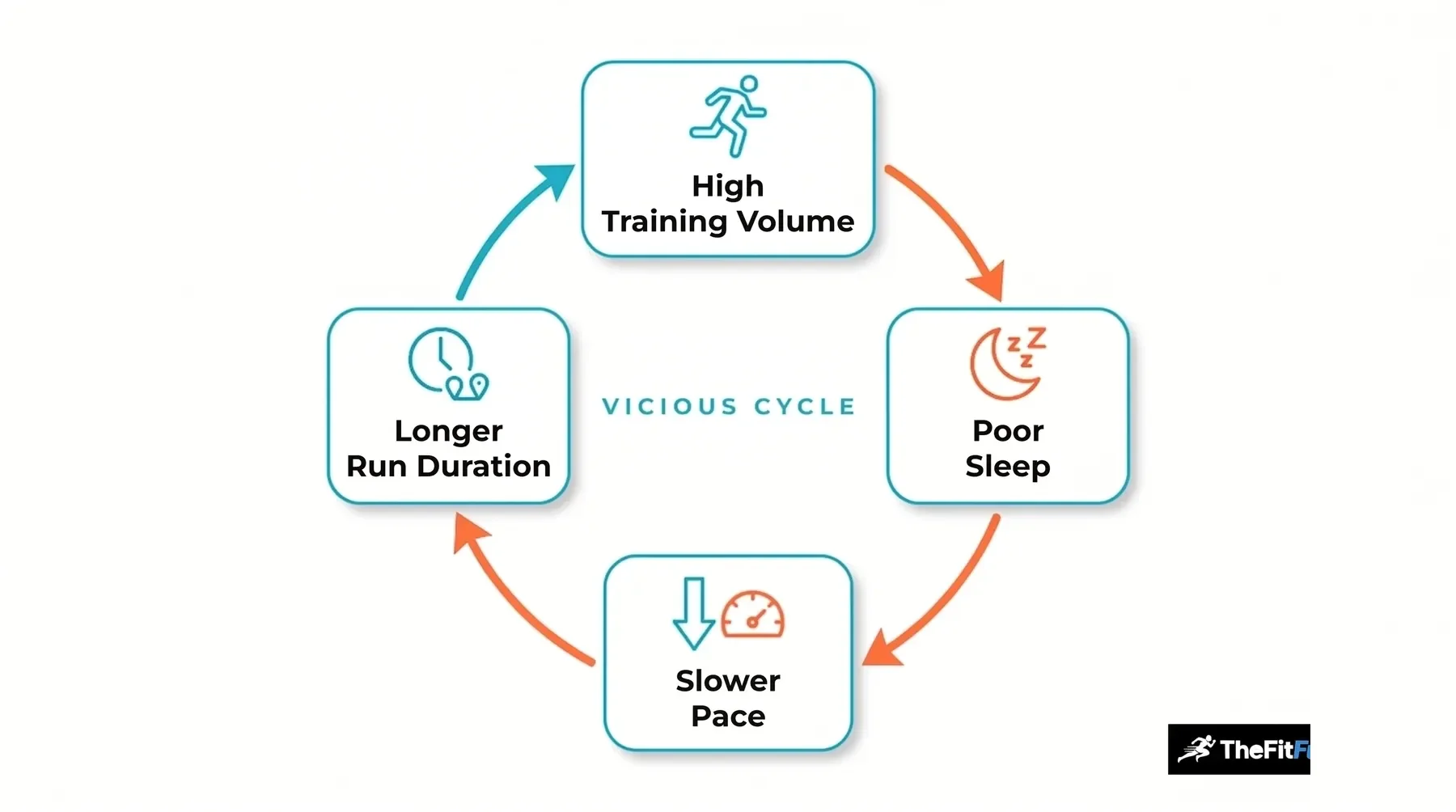
The possible vicious cycle – inferred from the study findings, not measured directly
More training in response to worse performance is not a strategy. It is the opposite of one.
What the study directly shows is telling enough: anyone who runs slower after a bad night and still completes the same distance is not making a sensible training decision. They should have run shorter. That sounds trivial but runs counter to the instinct of many recreational runners, who use volume as the primary measure of progress.
Three limitations that put the finding in context
The results are plausible and backed by a solid dataset. Three points qualify them nonetheless.
First: athletes generally sleep too little. The 6.61 hours of sleep among the study participants sounds like a recreational-runner problem – but it is not exclusive to them. A study by Sargent et al. (2021) with 175 elite athletes from 12 sports shows: professionals also sleep only 6.7 hours per night on average, although they themselves report needing 8.3 hours. 71 percent of these athletes fail to reach their sleep need on most nights – on average, they are 96 minutes short per night. The recommendation for athletes with high training volume is 9 to 10 hours. The widespread image of the pro athlete who takes long naps at midday and thus hits their hours is more wishful thinking than data.
Second: daytime naps were not recorded. The 6.61 hours refers exclusively to nocturnal sleep. Garmin has had a nap detection feature since September 2023, but it is limited to newer models (Venu 3, Fenix 8, Forerunner 965 and a few others) and was not widely available at the time of the study. On top of that, the study did not include this data. Also: Garmin does not record sleep stages during naps, since deep and REM sleep rarely occur in short rest periods. Participants' actual sleep duration could therefore be slightly higher in reality – although athlete studies show that napping only marginally improves the overall balance.
Third: Garmin has specific weaknesses in the metrics most relevant to this study. The gold standard for sleep stage measurement is polysomnography (PSG) – EEG recording in a sleep lab, manually scored by trained scorers. PSG is precise, but simply not feasible for 224 people over a year. All wrist wearables therefore estimate sleep stages from accelerometer and optical heart rate measurement – the only practical approach for a field study of this size, and none of them comes close to PSG accuracy. To put the Garmin data in context: a validation study from Antwerp University Hospital (2024, six wearables, 62 participants, simultaneous PSG) showed that the Garmin Vivosmart 4 overestimates total sleep duration by about 47 minutes and light sleep by almost 28 minutes – which means the 6.61 hours from the study would have to be adjusted slightly downward. On top of that: wake specificity was 29 percent, the lowest value of all devices tested. For context: Fitbit also overestimated light sleep by around 38 minutes – no wearable is error-free here. The decisive point for this study is HRV accuracy: in a 2025 validation, Garmin reached a Concordance Correlation Coefficient of 0.87, while Oura reached 0.99. HRV is one of the core findings – and that is exactly where Garmin is weakest.
Why Garmin is still worth a study
Garmin is by far the most widespread wearable platform among recreational runners worldwide. A study that uses Garmin data exclusively therefore has high ecological validity for exactly this target group. At the group level and for trend observations over weeks, wearable data – despite its limitations – is far more valuable than no data at all. The limitations qualify the findings – but they do not make them worthless.
Disclosure
Two of the six co-authors work for commercial running tech companies (Nanjing Huipao Network Technology and Nanjing Paodao Network Technology). This is not unusual in applied sports science and does not automatically mean the results are biased – but it is a fact worth knowing. The study appeared in Frontiers in Physiology, an open-access journal with an open peer-review process.
What this means for you in practice
Four approaches that follow directly from the study findings – not lifestyle advice, but consequences drawn from the data.
Read HRV and sleep score daily, not weekly. If your HRV drops for three days in a row and your sleep score is in the cellar, that is not a psychological signal – it is physiologically measurable. That is exactly what the study shows: poor sleep quality translates into pace the next day. Your Garmin delivers this data every day. If you don't use it, you are only tracking kilometres.
Treat pace as a daily-form indicator. If the first pace reading after one kilometre is noticeably worse than usual, that is not a motivation problem – it is a measurement. Cut the session short. A 6 km run in good condition creates more training stimulus than 12 km run half asleep. That sounds like less, but it is more.
Break distance compensation deliberately. The pattern from this study – slower, but the same distance – is the classic among ambitious recreational runners. If you notice that you are pushing through your target despite miserable daily form, ask yourself why. The answer is usually habit or ego, rarely a sound training reason.
Pair intense training blocks with more sleep – don't try to catch up afterwards. One extra hour of sleep before a hard training block changes how well you tolerate it. That is not slacker logic, it is physiology: the study shows that high load actively worsens sleep structure. Starting an intense week with a sleep deficit multiplies the effect. Sargent et al. (2021) show that even elite athletes average 96 minutes short of their sleep need per night – that is not an edge case, it is structural.
Your data, your analysis
The data in this study comes from the Garmin API – the same source you have access to as a Garmin user. Anyone who systematically analyses their sleep and training data can make the pattern visible for themselves: on which days was my pace worse than expected? How does that correlate with sleep duration in the previous week? An LLM-supported analysis workflow using your own Garmin data does not require programming knowledge – a separate tutorial on that will follow.
Sources
Xu X, Lin J, Xu K, Gu Z, Gu X, Zheng J, Chen G and Dai J (2026): Exploring training-sleep characteristics and bidirectional lagged relationships in Chinese recreational runners. Front. Physiol. 17:1730135. doi: 10.3389/fphys.2026.1730135
Sargent C, Lastella M, Halson SL, Roach GD (2021): How Much Sleep Does an Elite Athlete Need? Int J Sports Physiol Perform. 16(12):1746–1757. doi: 10.1123/ijspp.2020-0896
Schyvens AM et al. (2024): Accuracy of Fitbit Charge 4, Garmin Vivosmart 4, and WHOOP Versus Polysomnography: Systematic Review. JMIR Mhealth Uhealth. 12:e52192. doi: 10.2196/52192