A research team has built a smart textile with sweat-biomarker sensors that reads lactate, electrolytes and more straight from your sweat, no prick, no lab. Sounds like a lab in a T-shirt. And that is exactly where a second look pays off: the idea of measuring markers contactlessly in the fabric is strong. But this is research, not a product. Of all things, lactate — the value ambitious athletes watch most closely — is biochemically the shakiest. Here is what the study can really do, where its limits are, and what you as a self-coaching athlete get from it today.
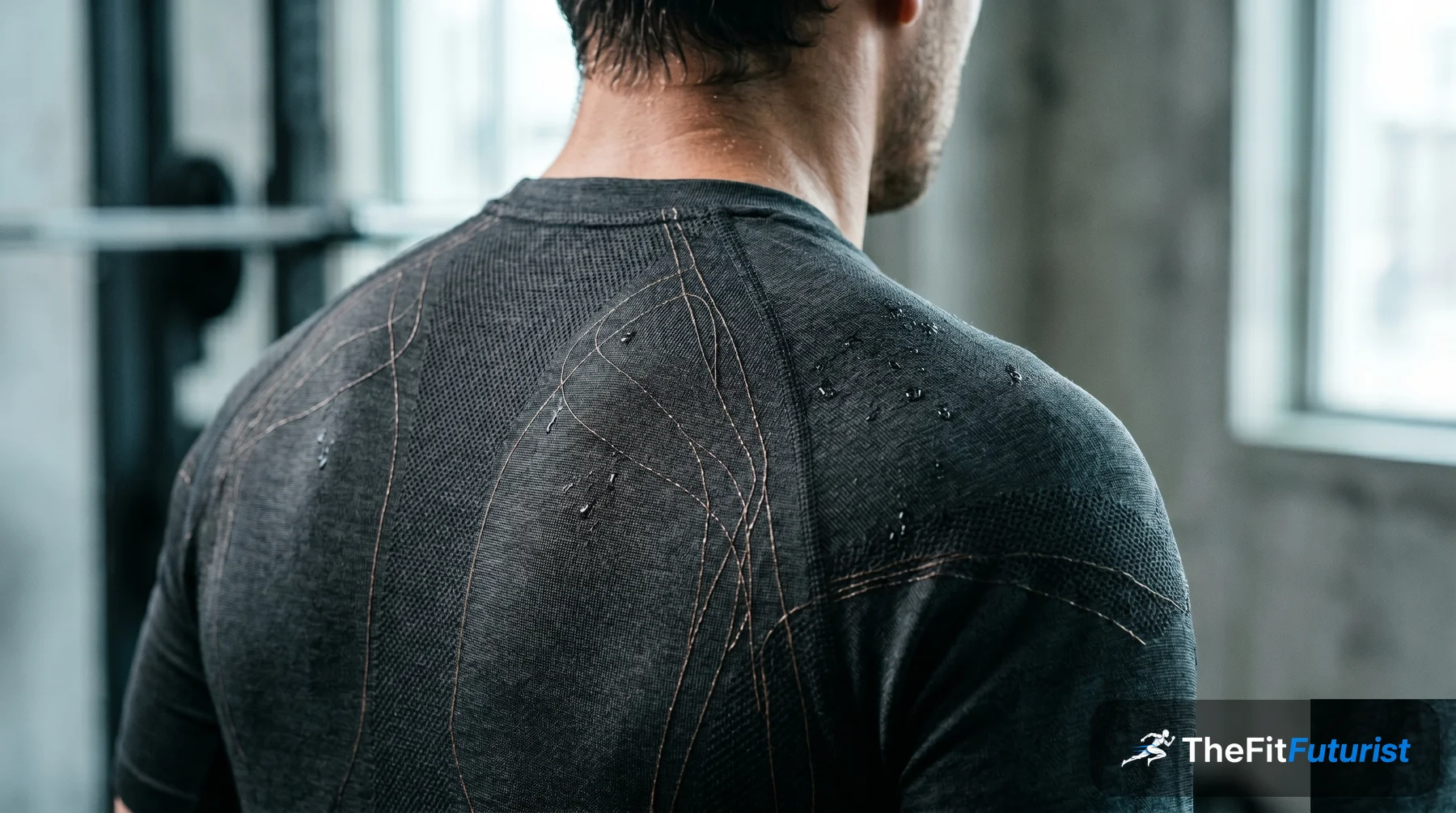
AI-generated image
Sweat Biomarkers in Smart Textiles: Lab Values Without Blood?
 Christopher Klenk7 min read
At a glance
A new study shows a breathable smart textile with woven-in sensors that measures several sweat biomarkers at once: lactate, sodium, potassium, pH, uric acid, plus heart rate and oxygen. The real draw: values you would otherwise need blood or a lab for, without a single prick. The catch: it is a lab prototype, tested on five people, and the AI fatigue model was trained on a single person. And sweat lactate is biochemically uncertain. For your training today: fascinating to watch, but nothing to base decisions on.
Stay on top of AI training & analysis? One click — and Google shows you my articles first.
Add as a preferred source on GoogleWhat the smart textile actually measures
It measures lactate, electrolytes, pH and uric acid in sweat via woven-in fiber sensors, plus temperature, heart rate and oxygen saturation, in real time over Bluetooth to your phone.[1] That is more than any smartwatch can do today. Smartwatches mainly read physical signals; chemical markers in sweat stay out of reach.
How the measurement works — in principle
Sweat on the skin
▼
Fiber sensors woven into the fabric
▼
Chemical markers
LactateSodiumPotassiumpHUric acidPhysical signals
Heart rateSpO₂Temperature▼
Bluetooth →phone in real time
Lactate in sweat is biochemically uncertain — read it as a rough trend, not a fixed threshold value.
The real technical leap, though, is not in the sensors alone but in the fabric. The material is breathable, wicks sweat outward and reflects over 96 % of sunlight, so it actively cools instead of trapping heat.[1] The researchers report air permeability close to normal functional fabric, not to a glued-on sensor.[1] That is exactly where most on-body sensors fail: they are rigid, stick uncomfortably, the sweat pools. Anyone who has ever sweated under a chest strap that chafes after an hour knows why this matters. Here, wearability is the real achievement, and the reason a sensor in the fabric could be more practical than any patch.
The basic idea is not new. Just recently a sweat patch that measures inflammation markers ran here: different build, different markers. The textile goes a step further: away from the patch, into the clothing, and several markers at once.
Why "without blood" is the real appeal
Markers that normally need a lab or a blood test, the fabric captures contactlessly, and that is the point that makes this interesting. Not "yet another wearable." But: values you have so far needed a lab or special equipment for, without any blood.
For self-coaching athletes the real lever here is less lactate than electrolytes and hydration. How much sodium and potassium you lose through sweat is a practical question with a clear consequence for drinking and re-salting, and almost nobody measures it day to day. Instead it gets guessed: rules of thumb, a bit of feel, an electrolyte drink on suspicion when in doubt. But how strongly people lose sodium through sweat varies enormously from person to person. A blanket formula matches your need only by chance. A marker right on your body would be genuinely useful here. Lactate, on the other hand, plenty of ambitious recreational athletes already use. If it were accessible without lab costs, more people would simply put it to work. A low barrier beats lab precision for a few, provided the value is any good. And that is where the catch comes in.
The catches: prototype, five subjects, one person for the AI model
The AI fatigue model learned from a single person; only five tested the sensors. You have to keep that in mind behind the "92.9 % accuracy" the study reports for its model. It sounds like a device that reliably detects fatigue. In reality the number rests on 168 data sets collected over seven days from exactly one volunteer.[1] What works for one person does not automatically work for you. For comparison: a fatigue model from football was trained on 48 players over twelve weeks.
On top of that: the "fatigue" the model predicts is labeled against the Borg scale, that is, against the subjective sense of effort the subject reported himself.[1] The model learns to reproduce a self-assessment, not an objective exhaustion gold standard. The on-body sensor tests ran on five people. This is an early-stage lab prototype, not a field-ready product.
That is no criticism of the researchers; feasibility studies run exactly like this. It is just the reason you cannot transfer the number to yourself. Sweat composition and sweat rate differ widely between people, and a model from one person simply cannot have seen that spread. Before something like this works reliably for you, it would have to be calibrated on many different bodies, ideally your own.
That fits the sober picture from the review of 188 wearable studies: good data, but no coach replacement. A single study with an impressive percentage does not change that. Which is exactly why you need to understand the values and their pitfalls, so you do not fall for ad copy or good-sounding studies.
Why even the "gold standard" lactate wobbles with daily form
Even blood lactate swings around 16 % per day at the same workload. So the absolute value alone misleads.[2] The interesting part is the split behind it: the derived threshold as a load anchor (the pace or watts where your threshold sits) is remarkably stable from day to day.[2][3] The bare lactate number at that point wobbles much more. The anchor holds, the reading swings.
There is a second blur on top: depending on which method you use to calculate the threshold from the same raw data, you get a different value.[2] So there is not one lactate threshold but several definitions that differ by a few percent. If even the lab blood test scatters that much, sweat lactate is all the more not an absolute threshold value. Sweat lactate and blood lactate are only loosely linked biochemically; the transfer is uncertain. Treat such a value as a rough trend indicator, whether it is going up or down, not as a fixed number you build training zones on.
Does that make the sensor class worthless? No. The optical pulse on your watch is also less accurate than a chest strap, and it gets compensated in software, through motion correction and combining several signals. On hard intervals it still stays worse. Inaccuracy early on is expected, not a death sentence. Anyone looking for their threshold without a lab today already has an option that does not hang on sweat, with DFA Alpha 1 as a lab-free threshold method.
What self-coaching athletes get from it now and soon
Today you have nothing to steer your training with, but a path worth watching. The textile is not for sale, and even if it were, sweat lactate would not be a basis for your zones right now. That is the honest read, not a dismissal.
Where I see real value soonest, once fabrics like this mature: electrolytes and hydration. That is a concrete everyday problem with a clear action, and the measurement is less delicate than the lactate transfer. Fatigue scores from a one-person model, by contrast, I would only take seriously once they are confirmed on many different people.
For a textile like this to become a real tool, three things would have to come together: sensors that measure stably over hours and through the wash; validation that does not end at a handful of people; and honest communication about what the value can and cannot do. Only then is it worth letting the thing into your training decisions. Until then it is a fascinating prototype, and a good example of how early you have to separate feasibility from everyday usability with training tech.
Concretely for you, today: keep steering your training by what is proven (heart rate, perceived effort, watts), and take every single reading with caution. Tech should support you, but the brain stays on, and you weigh it up. When these smart textiles turn into real products in a year or two, read their promises with the same eye: ask how well a value is validated, on how many people, against which reference, before you trust it with your training.
Sources
Sweat and air permeable electronics enabled by engineered hierarchical fabric system for exercise management. Microsystems & Nanoengineering (2026). Article at Nature
Validity and Reliability of Ventilatory and Blood Lactate Thresholds in Well-Trained Cyclists. PLOS One. Full text at PubMed Central
Reliability of maximal lactate steady state. PubMed entry