Trying to detect fatigue from a single metric misses more often than you would think. A study at Guizhou Normal University followed 48 university soccer players in China for twelve weeks, using GPS trackers, heart rate monitors and a daily wellness questionnaire. The combined data was used to train a machine learning model that detects fatigue with an AUC of 0.895. The best single measure, the questionnaire, reached 0.786.
This is a study on university players. The basic logic of the three most important markers carries over well to your own training, though, and you can track all three yourself with a watch or a few questions in the morning.
What the study measured
The study (Xu, Frontiers in Physiology, February 2026) analysed 536 training sessions and 24 matches. It recorded external load such as total distance, Player Load and high-speed running, plus internal load such as TRIMP (a heart-rate-weighted load score) and RPE (how hard a session felt). A player counted as fatigued on a given day if at least two of four criteria applied: jump height (CMJ) clearly below his usual value, a clear drop in morning HRV, a wellness score below 15 out of 25, or an RPE of 8 or higher on two days in a row.
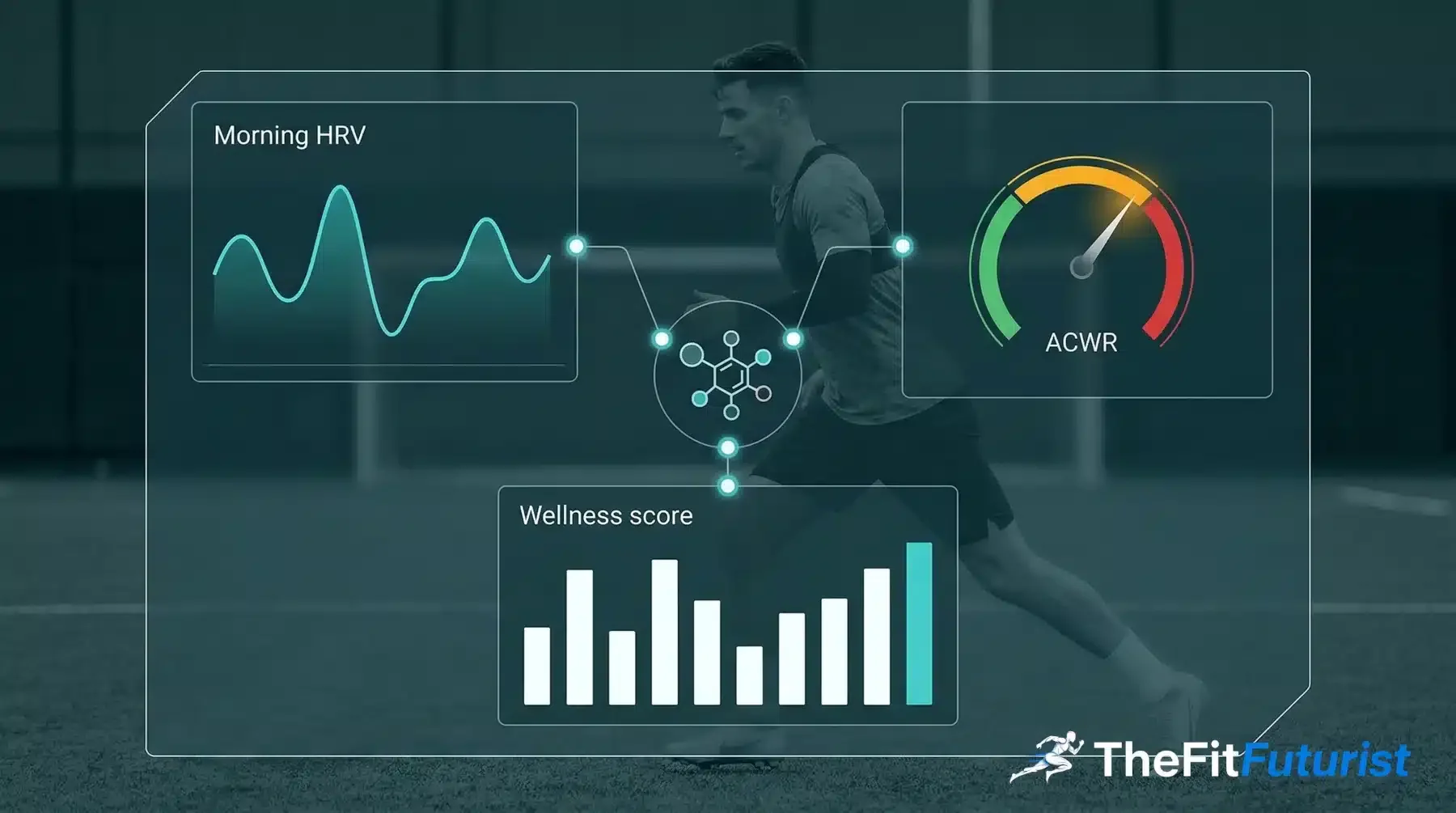
Three methods were compared: XGBoost, Random Forest and logistic regression. XGBoost came out on top with an AUC of 0.895. That figure comes from cross-validation in which data from the same players can end up in both training and testing. For players the model had never seen, the AUC was 0.847, and that is the more realistic number for you. According to a Random Forest ranking, the most weight went to the wellness questionnaire (18.5%), ACWR (16.2%) and morning HRV (13.8%). The analysis of the XGBoost model shows the same order. I looked up how fatigue was defined, and there is a catch: the questionnaire and HRV are both model inputs and part of the fatigue definition. Their top spots are therefore partly built in, and the study does not address this. Player Load and TRIMP were closely linked (r = 0.81). Only sRPE, ACWR and the questionnaire were tested on their own, though, and all three scored well below the combined model.
ACWR and AUC in brief
ACWR (acute:chronic workload ratio) compares your load in the current week with your load over the last four weeks. The study used a weighted version (EWMA) in which recent days count more. Older research links 0.8 to 1.3 with a lower injury risk, and the risk rises clearly from about 1.5. In the study, almost one in three player days above 1.3 was a fatigue day (32.6%). The ratio is disputed in research, though, and the study says so itself. AUC (area under the curve) measures how well a model separates two groups: 0.5 is chance, 1.0 would be perfect. 0.895 is a strong value. For a different way of managing load, see a reinforcement learning system that tries out training strategies on a digital twin.
WHAT IS XGBOOST?
XGBoost (Extreme Gradient Boosting) is an established machine learning method that combines many weak prediction models step by step into a strong one. The study author did not develop it; it is one of the most widely used tools in data analysis, open source since 2014. That this kind of approach can also build training plans is shown by a study using tests and machine learning instead of a chatbot.
Which of these markers you can already measure today
The three most important markers in the model are not reserved for pros. Many newer Garmin watches give you morning HRV, Polar does it through Nightly Recharge and Whoop through its recovery scores. The Apple Watch only measures HRV now and then and with a different method, so for a clean morning value a chest strap with an app is the better choice. The wellness questionnaire takes you 30 seconds: fatigue, sleep, muscle soreness, stress and mood, each on a scale from 1 to 5. Garmin and Polar (Training Load Pro) show a similar ratio of short-term to long-term load.
NO WEARABLE? YOUR MORNING PULSE HELPS
Without a watch, count your pulse for 60 seconds in the morning while lying down and write it down. If it sits about 5 to 8 beats above your usual value for several days, I take that as a sign to train easier that day. This comes from my experience as a coach, not from this study. Counting for ten seconds and multiplying by six is not good enough, because you then only measure in steps of six.
Marker | What it measures | Device / source |
|---|
Morning HRV | Recovery of the autonomic nervous system | Garmin, Polar (Nightly Recharge), Whoop, Elite HRV + chest strap; Apple Watch only to a limited extent |
ACWR | Acute vs. chronic training load | Garmin (Training Load), Polar Training Load Pro |
Wellness score | Subjective state: fatigue, sleep, soreness, stress, mood | Manual; HRV4Training, TrainingPeaks, Notion |
RPE | Perceived exertion after training | Manual (Borg scale); Garmin and Polar can ask for it after training |
CMJ height | Jump power, how fresh your legs are (fatigue criterion in the study) | Polar Vantage V3 (built-in), MyJump Lab 2.0 (smartphone app) |
CMJ as a fatigue marker: who it suits
The study uses the jump test as one of four fatigue criteria, although according to the methods it was only measured on Mondays. For football players, who sprint and jump all the time, that is a sensible choice. What the study does not address, and what I flag here as my own take: the jump test is not equally useful for every athlete.
For strength athletes planning heavy compound lifts that day, CMJ makes sense as a daily check. It shows how fresh your legs are, which is what maximal strength training needs. In my experience, a clear drop below your usual value can be an early sign of fatigue. For endurance athletes it is less clear. Running fatigue is more about metabolism, and after easy sessions jump height often stays the same or even rises briefly. There I consider morning HRV and the questionnaire the more reliable signals.
You can measure CMJ with the MyJump Lab 2.0 app using your phone camera, or directly with the Polar Vantage V3, which has a built-in jump test. Researchers at the University of Konstanz tested the previous V2 against force plates (Gruber et al., 2022). One co-author works for Polar, and Polar supplied the watches. On average the watch was only 0.3 cm off, but around 1.5 cm for a single measurement (the mean of three jumps) and up to about 4 cm in individual cases, tested on 15 people. That is enough for trends over several days, but I would not read much into one bad jump. Whether the Polar V3 and MyJump give the same results side by side is something I have not tested yet. That would be worth its own article.
LIMITS OF TRANSFERABILITY
48 male university soccer players in China, one sport, twelve weeks during the season. Whether the questionnaire, ACWR and HRV are also the most important fatigue markers in other sports, the study leaves open. My guess: for endurance or strength athletes, other measures could carry more weight.
What remains open
Three things remain open for me. First, the built-in lead of the questionnaire and HRV, since both also define fatigue. Second, the paper has a single author and contradicts itself in one place: the discussion ranks ACWR third, the results rank it second. Third, there is no hard reference measure for fatigue, such as a blood test, which the study itself lists as a weakness. What I still take away: a short questionnaire in the morning costs nothing and carried more weight in the model than any GPS metric.
Sources
Xu X (2026). Multi-sensor fusion outperforms single indicators for fatigue prediction in university soccer players: a machine learning approach. Frontiers in Physiology, 17:1775906. DOI: 10.3389/fphys.2026.1775906. PMC: PMC12956510.