
A patch that detects inflammation in sweat
Current fitness wearables measure heart rate, HRV and blood oxygen. What they do not measure: whether your body is currently running an inflammatory response. Researchers at Shenzhen University have now presented a patch that can do exactly that – at least in the lab.
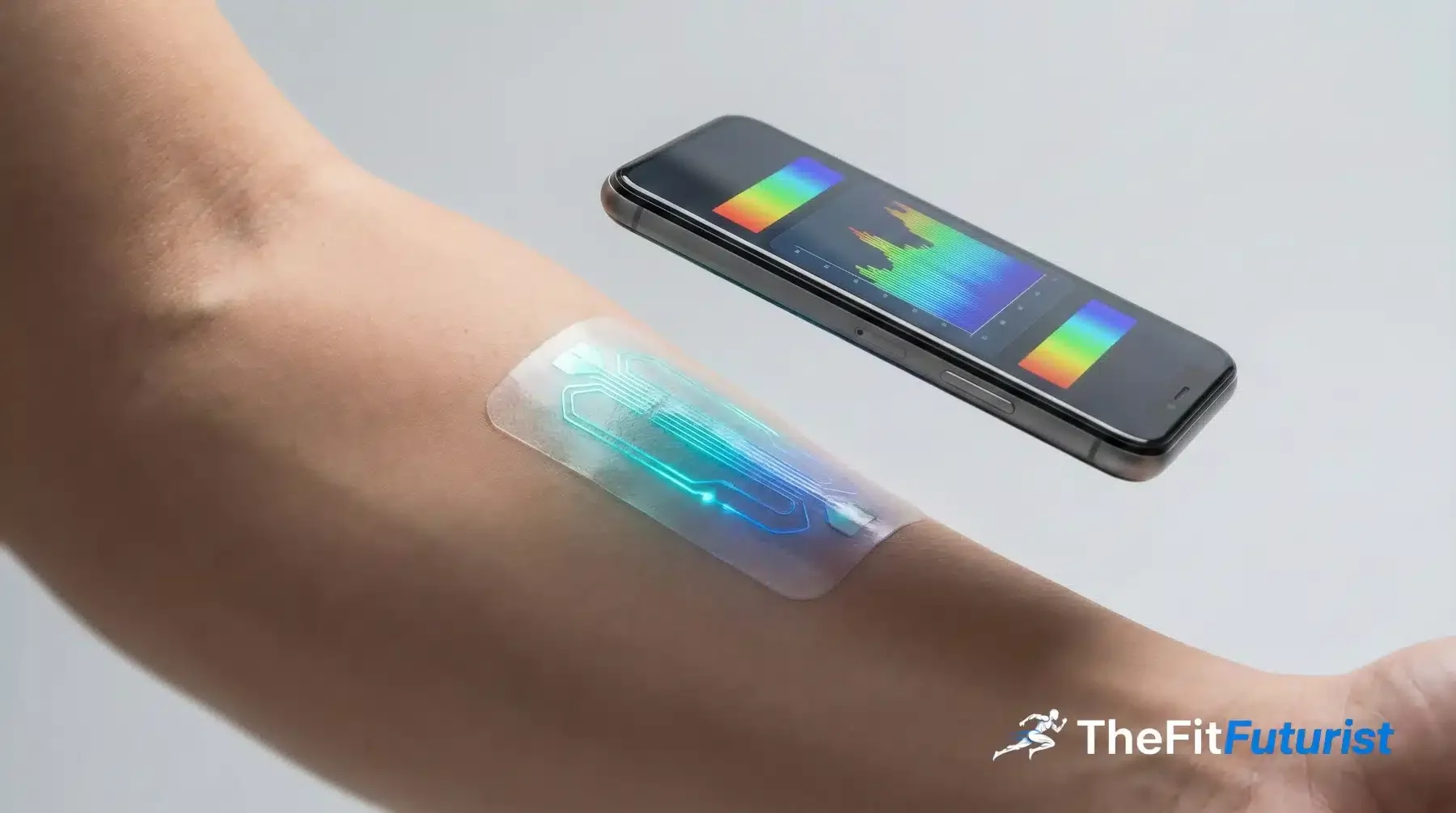
The so-called WSSP (Wearable Sweat Sensing Patch) measures C-reactive protein (CRP) directly in sweat. CRP is an established inflammation marker that, until now, could only be determined by drawing blood. The patch combines three technologies: an integrated heating layer that triggers sweat production even at rest, microfluidic channels to transport the sample, and a lateral flow immunoassay – in principle the same test-strip method used in a pregnancy test. A smartphone camera reads out the colour result, and a machine-learning algorithm interprets the value (Ji et al., 2026, ACS Sensors).
Why proteins in sweat are so difficult
Previous sweat wearables could only measure small molecules – electrolytes like sodium, metabolites like lactate or glucose. Proteins like CRP are much larger, more complex molecules with lower concentrations in sweat. That is why a different detection approach was needed: instead of electrochemical sensors, an immunoassay based on antibody reactions.
Still lab stage – but the potential is concrete
The study is a proof of concept. No finished product, no clinical validation, no large participant numbers. The correlation between CRP in sweat and CRP in blood has not yet been comprehensively established. This needs to be said clearly: it will likely be years before such a patch sits on your wrist.
Even so, the study shows that the technical hurdle – measuring proteins in sweat reliably and non-invasively – can in principle be overcome. And that is precisely what makes it interesting for the fitness field. Because CRP is a marker that could answer several questions no wearable addresses today.
What CRP could mean in a fitness context
Recovery timing. CRP rises after intense training and typically falls back to baseline within 24 to 72 hours. Continuous monitoring could show objectively whether the inflammatory response has subsided – a more direct recovery indicator than HRV or resting heart rate, which only work indirectly via the autonomic nervous system.
Detecting overtraining. Chronically elevated CRP that does not return to baseline even after sufficient recovery could be an early warning sign of overreaching or overtraining. That would be a signal before performance drops or injuries manifest themselves.
Avoiding training during existing inflammation. CRP responds not only to training stimuli, but to any inflammation – whether infection, stress or poor sleep. An elevated value before training could be an indication that the body is already under load and that additional training stress would be counterproductive.
Sport science assessment
CRP also rises after strength training due to microtrauma in muscle tissue. But that does not mean: more inflammation = more muscle growth. The primary driver for hypertrophy is mechanical tension, not muscle damage. The inflammatory response is part of the repair process, but not a reliable indicator of the quality of the training stimulus. CRP works as a recovery signal – not as a „did my training work?“ score.
What is missing today – and could arrive tomorrow
Current wearables like Whoop, Oura or Garmin estimate recovery via HRV, sleep quality and resting heart rate. These are not only indirect proxy values derived from the autonomic nervous system – they are also based on optical sensors (PPG) that measure pulse waves rather than electrical heart activity. The gold standard for HRV is the ECG, and the deviations with wrist or finger sensors can be considerable depending on device, fit and measurement conditions. A sweat-based CRP value would map a different biological layer – and could complement existing metrics, not replace them.
Clinical validation studies are needed to show how well sweat CRP correlates with blood CRP for this specific patch. Early studies with other CRP sweat wearables do show a promising correlation, but a broad, sport-related deployment setting is still missing. Individual baselines are needed because CRP values vary strongly between people. And an interpretation is needed that is context-dependent – because an elevated CRP value after a marathon means something different from the same value on a rest day.
Still: the direction is right. If, in a few years, wearables can read not only your nervous system but also your inflammation markers, recovery monitoring will become considerably more concrete. This is not a product of tomorrow – but it is research worth keeping on your radar.
→ Deep dive: AI in fitness – what exists and what actually works?
Source
Ji, Y., Zhou, Z., Su, B., Chen, L., Wang, J., Xu, T. & Zhang, X. (2026). Wearable Lateral Flow Patch for Noninvasive Sweat Protein Monitoring. ACS Sensors. doi:10.1021/acssensors.5c03500