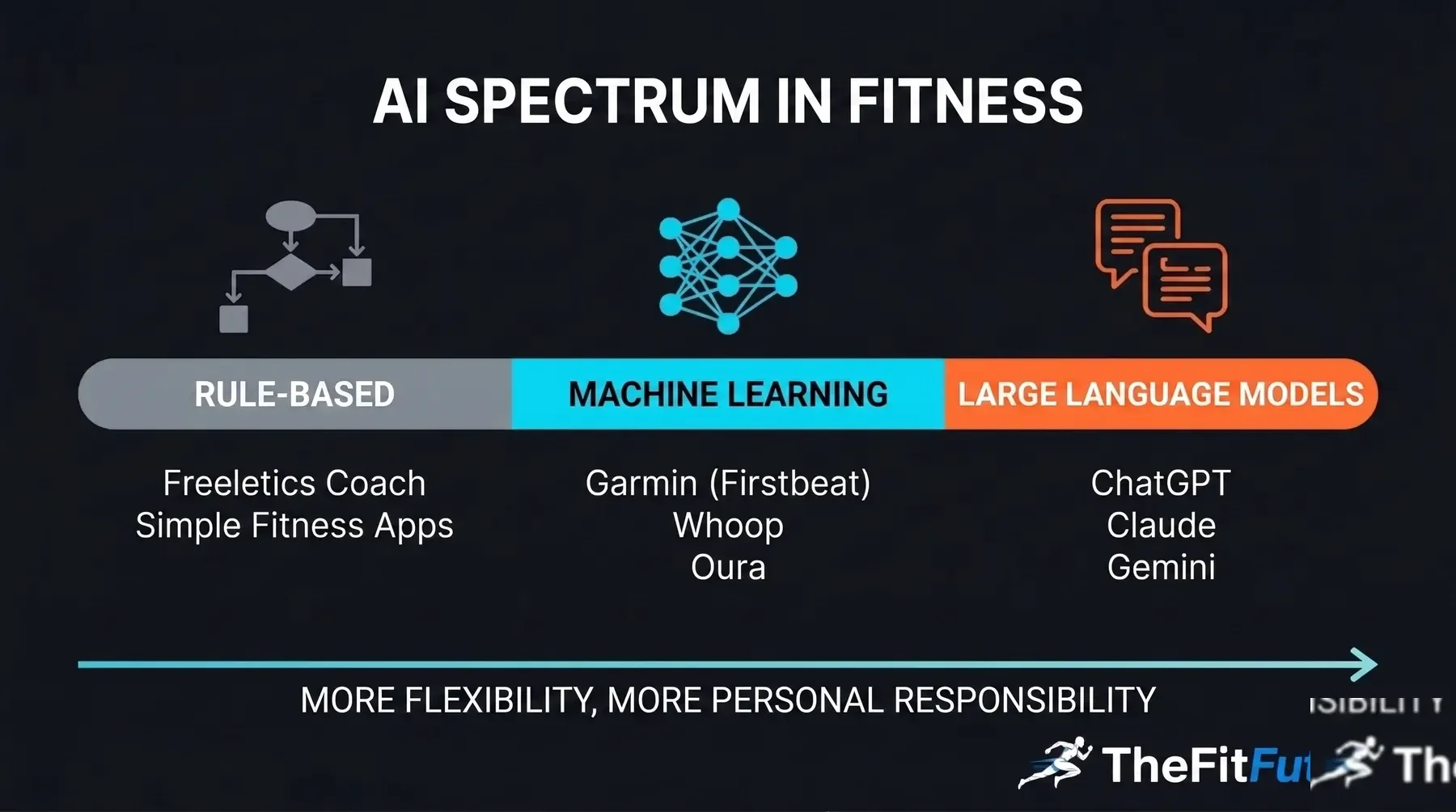
„AI coach“, „intelligent adaptation“, „AI-powered training“ — almost every fitness app uses these terms today. What they actually mean is rarely the same thing. Some apps use real machine learning. Others sell if-then rules as intelligence. And LLMs like ChatGPT or Claude are yet another category — with different strengths, different limits, and a fundamental problem that is rarely communicated openly.
This article is the honest inventory: where AI is actually being used in fitness today, what of it really works — and what is coming next.
At a glance
AI is used in fitness training across five areas: training planning, nutrition, data analysis, recovery, and movement analysis. The technology behind each varies widely — from simple algorithms to large language models. The biggest problem: if you don't bring your own training knowledge, you won't notice when the answer is wrong. That is the prompt paradox — and it applies to all five areas.
Stay on top of AI training & analysis? One click — and Google shows you my articles first.
AI in fitness is not a single product. The term covers technologies that function in fundamentally different ways — with different strengths, weaknesses, and use cases.
2. What AI in fitness really can do — and where it fails systematically
AI is strong at structure, language, and pattern recognition in large datasets. It is weak at anything that needs current context, body awareness, and real individualisation. An experienced coach can tell from your body language that you're not up for a hard session today. The algorithm sees your resting heart rate — if you enter it.
What works: Explaining and classifying training concepts, structuring plans, calculating macros, spotting patterns in datasets that emerge over weeks and months, automating routine tasks. AI democratises knowledge that used to be accessible only through a personal coach — if you know how to use it.
What doesn't work: LLMs have a knowledge cutoff and were trained on whatever was available on the internet — including generic forum advice and outdated recommendations. Women and older populations are systematically underrepresented in the training data of language models. Injury risks get understated. And if you can't ask good questions, you'll still get confident-sounding answers.
If you know little about training, you can't write good prompts — but you still get a confident-sounding answer. LLMs generate plausible-sounding text based on statistical probabilities. Whether the content is actually correct is a separate question. That holds just as much for training planning as it does for nutrition recommendations and recovery analysis. Training knowledge is therefore the prerequisite — not the bonus.
The prompt paradox is most visible in training planning — the area with the highest search volume and the most mistakes. How to build an AI training plan that actually works — with concrete prompts, common mistakes, and the difference between a usable and a dangerous result.
3. What's coming next
Some of this is already visible in real products. Other pieces are still in research labs or early prototypes. The difference matters — and reporting on AI in fitness rarely separates the two clearly.
Already emerging: Camera-based movement analysis is getting more precise and works under less controlled conditions. Computer vision models can now be integrated into custom apps — what used to require sports scientists with specialist software is becoming accessible. The first commercial apps are using this for real-time feedback on strength exercises.
Foreseeable, but not here yet: Genuinely personalised nutrition recommendations based on biomarkers — glucose wearables combined with LLMs. Injury prevention through gait analysis over longer time windows. LLM agents that chain several tools together: feeding wearable data straight into a planning workflow, without manual exports.
Promises with big question marks: Fully automated training management without human input. AI that replaces genuine body awareness. These narratives are out there — but they're a long way from what current technology can actually do. Anyone presenting them as fact has an interest in you not looking too closely.
4. The data question
AI in fitness needs data — training data, sleep data, heart rate, sometimes body composition and nutrition. What apps and platforms do with that data isn't always transparent. With health data, that is no small matter. What fitness apps do with your data — and what that means for AI features.