AI training plans do not fail because ChatGPT, Gemini or Claude are bad. They fail because a plan that has no knowledge of your injury history, your current training level and your recovery capacity is not individual training planning – it is structured guessing. Deload weeks are missing. Progression is generic. The plan does not know your equipment. What that looks like case by case is shown in the ChatGPT training plan step by step.
The result usually sounds plausible. Four training days, deadlifts, squats, bench press – it is all there. But the plan does not know you. And you notice that at the latest after two weeks, when your knees start hurting, progression stagnates or the third upper-body session in a row lands exactly when you are already exhausted.
AI plans have structural limits that have nothing to do with your prompt – no access to your current training data, a knowledge cutoff frozen at some point in the past, and a data base pulled from the internet: forums, articles, generic programs that are not equally representative for every body type.
What AI in fitness can do in principle and where it systematically fails is covered in detail here. This article is about a different question: how to recognise a bad plan when it is sitting in front of you.
At a glance
AI can hand you a training plan within minutes – but it cannot know how you felt last week, what your left knee is doing, or how much training experience you really have. The result often sounds better than it is. Here are the patterns that give it away – and a verification prompt you can use to quickly check any finished AI plan.
Stay on top of AI training & analysis? One click — and Google shows you my articles first.
The plan does not know you – and that is the real problem
Every AI plan is an answer to what you wrote – not to who you are. "Hypertrophy training plan 3x a week" tells the model the frequency and the goal. It does not reveal how long you have been training, what your actual one-rep maxes are, whether you have equipment constraints, what your recovery status is right now – and above all: what you specifically mean by "hypertrophy".
An experienced coach first takes a history – and then decides what the plan should deliver. Hypertrophy or strength, full-body or split, eight weeks or long-term build-up: those are not questions to the athlete, they are decisions based on an assessment. ChatGPT, Gemini or Claude skip this step and fill the gaps with whatever statistically fits most often. For an average person that is okay. For you it is often wrong.
The same goes for the goal itself. "Hypertrophy" is not a target, it is a category. An AI plan needs a timeframe, a priority and a starting point – otherwise it is optimising for nothing concrete. If you do not supply that in the prompt, you get a plan that is theoretically correct and practically aligned with no one.
On top of that comes the data base AI plans are built on: text from the internet – forums, articles, generic training programs. That is not a bad foundation for basic principles. But this data is not evenly distributed.
Certain training approaches, demographics and body types are overrepresented, others barely covered. A 25-year-old man doing strength training in a fully equipped gym is well represented in this data. Anything that deviates from that – other age groups, other training goals, home gym with limited equipment – gets served with the same underlying patterns, even when the data is thin. You can see it in the output once you know what to look for.
Then there is the choice of model. Generating a complex training plan with a base model that has no reasoning mode gives you a different quality than using a thinking model. GPT-5.2 with thinking mode enabled, Claude Opus 4.6 with Extended Thinking or Gemini 3.1 Pro actually reason through contradictions in the prompt – for example when the requested training frequency and the recovery time do not match up. Simpler models quietly smooth such conflicts over. The result still sounds coherent – but it is not.
How LLMs generate answers
LLMs do not choose their output by "understanding" – they choose by statistical probability: which word, which structure most often fits this input? Thinking models insert an internal reasoning step before that – the model checks for contradictions before it answers. Without that mode the plan runs through even when training frequency and recovery time mutually exclude each other.
This is not just theory: a study in the journal Biology of Sport (Yang et al., 2025) had GPT-4 generate training plans using simple and detailed prompts – blind-rated by eleven sport scientists. Detailed prompts scored better in every category, most clearly on the safety rating. And even with an identical prompt the model delivered a structurally different plan every single time. Full analysis here: Study on prompt quality in AI training plans.
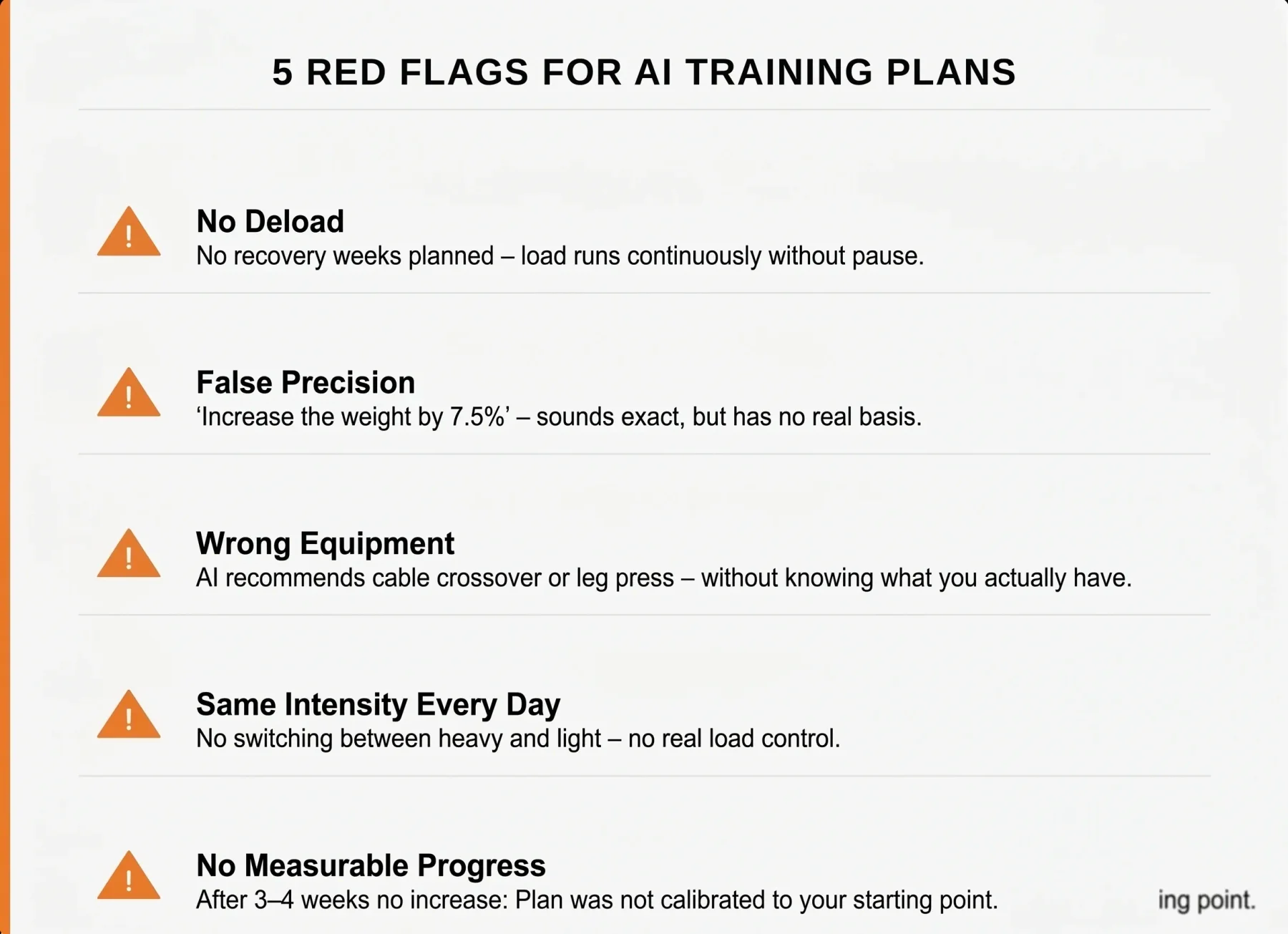
There are patterns that quickly expose an unusable AI plan. No sport science degree required.
Warning sign
What it means
No deload
No 8- or 12-week plan should go without a recovery week. If it is missing, load management has not been thought through.
False precision
"Increase the weight by 7.5%" sounds exact – but has no real basis. AI does not know your current working weights.
Wrong equipment
Cable pulls, leg press or lat pulldown in a home-gym plan: happens whenever you do not state your equipment explicitly in the prompt.
Same intensity every day
No alternation between heavy and light, no buffer day. A plan without intensity waves is not load management.
No progress after 3–4 weeks
Measurable progress is mandatory. If it is not there, the plan's starting point was not calibrated to you.
Persistent joint pain
Muscle soreness is normal. Pain lasting more than 48h, in joints, or getting worse every session: cut the load, do not push through.
Beginner = advanced
Identical exercise selection and structure, only different weights: the experience level was not processed.
The 7 most common warning signs – quick to check before you start the plan.
The last pattern – beginners and advanced athletes getting structurally identical plans – is empirically documented. A study in the British Medical Bulletin (Montaruli et al., 2026) tested eight AI models on marathon training plans for three performance levels. In several of the models, the differentiation between intermediate and advanced was practically non-existent. Full analysis including methodology critique: AI marathon training plan study – analysis.
Pre-existing conditions & injuries
AI does not know about medical contraindications. Whatever you do not spell out does not feed into the plan – and even when you do, AI has no way to assess your situation clinically. If you have pre-existing conditions, chronic complaints or a relevant injury history, talk to a physician or physiotherapist before you start. An AI plan is not a substitute for a medical history.
Injury risk: why it happens structurally
A static AI plan has no awareness of the consequences of its recommendations. Training volume, recovery capacity and individual load tolerance are not fixed numbers – they change every day depending on sleep, stress and training history.
Sport science uses the concept of the Acute:Chronic Workload Ratio (ACWR) for this: it relates the short-term load of the last seven days to the chronic load of the last 28 days. If this ratio climbs too fast, injury risk rises. A static LLM plan cannot compute or adjust this ratio – it simply does not know what you trained in the last four weeks.
Overreaching – a load that sits permanently above your recovery capacity – often creeps up gradually. An AI plan that prescribes five training days a week without knowing you are currently sleeping badly due to stress and already pushed hard through the last four weeks is optimising for nothing. It just gives you more. The result is not progress, but stagnation or injury.
On top of that comes a structural problem: the plan is generated once and then runs. It does not know in week 5 what happened in week 2. Whether you missed two sessions, whether one exercise keeps giving you trouble, whether your squat numbers collapsed – the plan does not care.
Autoregulation, meaning adjusting the load to your actual daily status, is not built into static AI plans. RPE values only help if you know how to interpret them and steer accordingly – that is the prompt paradox again, this time on the execution side rather than at the creation stage.
Then there is exercise selection. A squat at high training volume is a bread-and-butter movement for an experienced athlete. For someone with limited hip mobility or an old knee injury, the same exercise at that dosage is a problem.
The AI does not know this – unless you tell it. And even then it has no way to watch your technique or correct your form. Apps that spot form errors via the smartphone camera now cover that, but that is a different tool from the language model writing your plan. Whatever you do not write into the prompt does not exist for the plan. Wearables like Garmin, Polar or Whoop deliver exactly the real-time data – HRV, sleep quality, recovery status – that a static AI plan structurally ignores.
How to check a finished plan
Three questions are enough to quickly assess an AI plan.
Is there a deload structure? At 8 weeks: no later than week 4. At 12 weeks: at least two recovery weeks. If it is missing entirely, load management has not been thought through.
Do the exercises match your equipment and level? Go through the list. Anything you cannot execute – missing equipment or a technique you have not nailed yet – is not a training stimulus, it is an injury risk. Look up any unfamiliar exercises before you start: "sumo deadlift" and "conventional deadlift" are technically very different movements.
Is the progression concrete or vague? "Increase the weight" without a condition is not a method. Concrete would be: "When you finish all sets at RPE 8, add 2.5 kg in the next session." RPE (Rate of Perceived Exertion) describes on a 1–10 scale how close you are to your limit – RPE 8 means: two more reps would have been possible.
The most direct route: let the AI check its own plan. With the right prompt you get a structured assessment within minutes. If you would rather start fresh and build a better plan from scratch, the full guide is in Create a training plan with AI. Or go straight to the free strength training plan generator — it asks for context before generating.
Prompt – review the plan
Prompt
Role: You are an experienced strength coach with a sport science background.

I received this training plan from an AI:

[Insert plan here]

My profile:
- Training experience: [e.g. 2 years of strength training]
- Goal: [e.g. upper-body hypertrophy, 8 weeks]
- Equipment: [e.g. full gym / only dumbbells and a pull-up bar]
- Limitations: [e.g. none / old herniated disc L4/L5]

Review the plan on the following points:
1. Is the training frequency and volume appropriate for my experience level?
2. Is there a deload structure? If not – where should it go?
3. Does the exercise selection match my equipment and level?
4. Is the progression concrete or vague?
5. What would you change, and why?
What AI still delivers in training
AI is not a good coach. As a planning tool it is useful – provided you know what to expect from it and what not.
Explaining training concepts, building periodisation structures, suggesting exercise alternatives, calculating macros, delivering a first draft plan you refine yourself – all of that works. Well, even. In doing so, AI democratises base knowledge that used to be available only through a personal trainer. If you know what to ask, you get usable starting points in minutes instead of hours.
What does not work: replacing body awareness, spotting technique errors, reacting to daily form, judging recovery status. An algorithm does not see that you climbed out of the car stiff today. It does not notice your squat caving on the left side. It does not know you slept badly last night. That does not make it worthless – but it clearly defines where its usefulness ends.
Who benefits most: experienced athletes who can judge AI suggestions and want a plan framework they steer themselves. Beginners benefit from the base knowledge, but they need more guidance in assessing the results – not less. A pilot study on the ChatGPT-based fitness app FysBot showed this concretely: participants' self-efficacy – their confidence in their own ability to exercise – dropped during use, it did not rise. Passively consuming AI output does not replace your own judgement. Full analysis: ChatGPT fitness app usability test.
AI gives you a plan in 30 seconds. A good plan only appears when you know what to feed in – and whether what comes out actually fits you.