When an app promises you a "personalised training plan", more is happening behind the scenes than you might think. Or less — depending on the technology it uses.
The same label hides fundamentally different approaches: fitness apps that collect your data for weeks on end. And LLMs like ChatGPT that have never touched a weight but have read millions of texts about training. Both are called "AI training plans". Both work differently.
Two worlds: fitness apps vs. Large Language Models
Adaptive fitness apps like Freeletics, Garmin Coach or Whoop collect your personal data over weeks and months. They know how you train, how you recover, when you break down. Their algorithms derive recommendations from that — automatically, and without you understanding why.
Large Language Models like ChatGPT or Claude have no idea who you are. They were trained on billions of texts — including sports-science textbooks, research papers and fitness blogs. What that training knowledge of the models is made of and where it has gaps, I have broken down separately. When you ask for a plan, they generate text based on statistical probabilities. That sounds like a clear disadvantage. It isn't always. Both approaches fall under the umbrella term AI in fitness — even though the technology behind them is fundamentally different.
How fitness apps get their data
Adaptive apps build your profile from five sources.
Direct inputs form the baseline: age, weight, goal, experience level. You enter them at sign-up. That isn't personalisation yet — it's a questionnaire.
Sensor data delivers the objective layer. Heart rate, steps, sleep and GPS data flow in via wearables or smartphone sensors. The more sensors, the denser the picture — but also the more you give up.
Training feedback trains the algorithm directly. Too easy, too hard, just right? Your rating after each session is the most valuable data point — because it captures subjective perception that no sensor can measure.
Behavioural analysis reads between the lines. When do you train? How often do you bail out? Which exercises do you skip? The app learns from your behaviour — especially from what you don't say.
Aggregated user data is the real lever. Apps don't just use your data, they use the data of millions of users. They spot patterns: people with a similar profile respond better to certain training stimuli than to others. So your "individual" plan is based partly on statistical averages — not on you.
How LLMs generate training plans
ChatGPT and co. work completely differently. No sensors, no tracking, no history.
The knowledge base consists of huge amounts of text: sports-science textbooks, fitness guides, Reddit threads, research papers. The model has "read" how periodisation works, what progressive overload (the systematic increase of training load) means and which exercises are recommended for which goals. It has the knowledge — but not the experience.
The generation process is statistical at its core. The LLM produces text word by word, based on probabilities. It doesn't "think" about training. It generates text that fits your query. The result can still be good — if the training literature it was trained on was good.
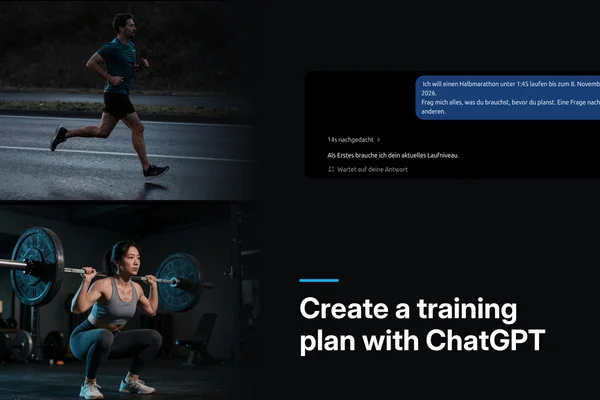
Your prompt is everything. Because the LLM knows nothing about you, your query determines the quality. "Give me a training plan" delivers a generic plan for an imaginary average person. A detailed prompt with age, experience, equipment, time budget and limitations delivers something far more usable. The LLM doesn't invent personalisation — it reacts to the information you provide. How to build such a prompt is shown in the step-by-step guide to AI training planning.
The head-to-head comparison
Aspect | Fitness apps | LLMs (ChatGPT etc.) |
|---|
Data source | Your tracking data + millions of user profiles | Trained text knowledge + your prompt |
Personalisation | Automatic, based on behaviour | Only as good as your input |
Adaptation over time | Continuous via feedback loops | Only with a new prompt or chat |
Transparency | Black box — you don't know why | Explains the logic on request |
Data ownership | Data sits with the provider | Data stays with you (with opt-out) |
The table shows the dilemma: fitness apps offer more automation but less control. LLMs offer more flexibility but demand more from you. Neither approach is categorically better — it depends on what you prioritise. Especially on data ownership it pays to take a closer look at what really happens to your data in fitness apps.
Fitness apps: strengths and weaknesses
The biggest advantage of adaptive apps: they learn from your behaviour automatically. You train, the app observes, the algorithm adapts — without you having to craft a new prompt every time. On top of that you get objective sensor data instead of self-assessment, plus access to millions of aggregated user profiles.
The flip side: you depend on the provider's logic. Why does Freeletics recommend exactly this workout today? No idea — black box. Your data isn't with you, it's on someone else's servers. And if you have a specific wish that doesn't fit the template, you hit the limits.
LLMs: strengths and weaknesses
LLMs score on flexibility. You can ask any conceivable question, define arbitrary constraints and have the logic behind the plan explained to you. The knowledge across different training methods is broader than in any single app. And the cost? Free, or clearly cheaper than an app subscription.
The weaknesses are fundamental: the LLM knows nothing about you beyond what you say. No automatic adaptation over time. And — this is the critical point — it can produce plausible-sounding errors. A training plan that looks scientifically correct but is completely unsuitable for your level. The prompt paradox in action: whoever knows little about training can't ask good questions — but still gets a confident answer.
Garbage in, garbage out — for both
The decisive factor is the same for both approaches: data quality.
For fitness apps, good data comes from regular training with a wearable, honest feedback and consistent use. The app then has an accurate picture of you. Bad data comes from sporadic tracking, skipped feedback entries or training without a wearable. The algorithm works with gaps — and fills them with average values. Your "personalised" plan is then based on assumptions, not on facts.
For LLMs, good input means: you deliver relevant information. Training experience, current performance data, available time, equipment, limitations. The LLM can work with that. Bad input means: "Give me a training plan." The model invents an average person and plans for them. The result is generic — and in the worst case counterproductive.
Where the two approaches converge
The lines are already blurring — and the most interesting developments sit exactly in the overlap.
LLMs with data access: ChatGPT and Claude can read files. You export your Garmin or Polar data and have the LLM analyse it. The model gets context it wouldn't otherwise have — your actual training history instead of generic text knowledge.
Apps with LLM integration: the first fitness apps are integrating ChatGPT for natural-language interaction. You ask "Why was my training so hard today?" and get an explanation instead of just numbers on a dashboard.
Self-built solutions: with a bit of technical know-how you export your training data, analyse it with Python and pass it to an LLM for interpretation. That combines objective sensor data with the explanatory power of a language model — and the data stays with you.
Your data, your decision
AI training planning isn't magic. These are algorithms reacting to data. For fitness apps that's your tracking data and the behaviour of millions of others. For LLMs it's trained knowledge from texts plus whatever you tell the AI.
Both approaches work — if the data foundation is right. The question isn't which approach is "better". It's: do you want to trade convenience for control? Or do you invest a bit more effort and keep data ownership? For an overview of the whole field — from rule-based systems to machine learning — see the AI in fitness guide.