A new study compares three ways to set your load in strength training: a fixed percentage of your max, the feel of reps in reserve, and barbell velocity. Most of the attention afterwards goes to which method adds two more kilos on the bench — but the practically more useful finding sits elsewhere: two of the three methods work without any 1RM max test at all, and just as well. For you as a self-coached lifter that means one thing: you don't need to know your true max to get stronger the right way.
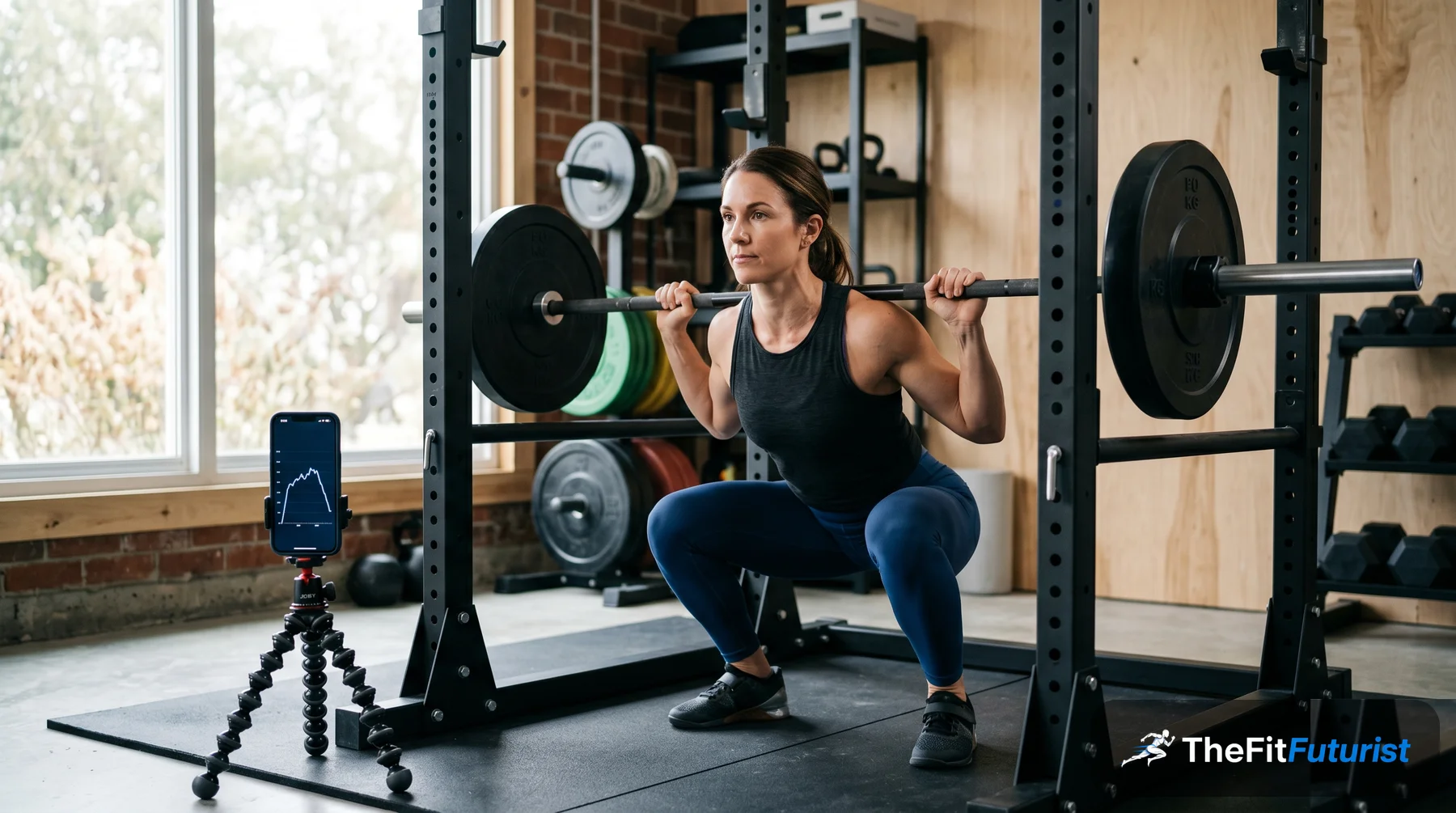
AI-generated image
Strength Training Without a Max Test: Three Ways to Set Your Load
 Christopher Klenk7 min read
At a glance
A pilot study with 36 older adults compared three ways to prescribe load — fixed percentage of max, reps in reserve, and movement velocity. Velocity was clearly ahead only on the bench press; for the squat, everyday strength and muscle growth, all three were equal. The practical core: the two methods that skip the max test matched the percentage approach. So you don't need your exact 1RM to keep progressing.
Stay on top of AI training & analysis? One click — and Google shows you my articles first.
Add as a preferred source on GoogleWhat the study compared — and what came out
Three ways to set the load went head to head — and velocity was clearly ahead only on the bench press. 36 men and women averaging around 62 years trained for twelve weeks in three groups. The first got a fixed percentage of their max, the second steered by reps in reserve — how many reps they would have had left at the end of a set — and the third followed the velocity of the last repetition.
In plain terms: reps in reserve (RIR) Reps in reserve is the number of repetitions you would still have managed at the end of a set. Two reps in reserve means: stop when two clean reps would still have been there. It lets you steer effort without going to muscular failure.
On the bench press the velocity group gained the most: roughly 12 kilos versus just under 7 in the percentage group. For the squat, power, muscle growth and the everyday tests — sit-to-stand, gait speed, stair climb — all three groups improved equally. This is a small pilot study, so not the final word. But it lines up with the broader evidence: a 2025 review puts autoregulated load at least on par with fixed percentages, and if anything slightly ahead.
Method | How the load is set | Needs a 1RM test? | Result in the study |
|---|---|---|---|
Percentage of max | A fixed share of your max | Yes — no known max, no percentage | Solid, weakest on the bench press |
Reps in reserve | By felt distance to failure | No | On par with the others |
Barbell velocity | By measured rep speed | No | Ahead on bench press, equal elsewhere |
The point that actually matters: you do not need a max test
All three methods worked — and two of them require no 1RM max test at all. That is what gets lost in the usual coverage, because the argument there is about which method "wins". The percentage method needs a reference point: without a known max, you cannot work out 70 percent of it. Reps in reserve and velocity do not need that number — they set the load straight from what happens inside the set.
This is how a coach reads the study, not a statistician: if two routes without the test get you just as far as the route with it, then the test is the weakest link, not the foundation. That is my whole point — you do not strictly need a max test, and it is a fiddly thing anyway. Tellingly, even the researchers did not measure strength with a true 1RM but with a four-rep maximum. A nod to safety that underlines the whole thing.
Why the max test is questionable for self-coached lifters anyway
Testing a true max is risky, day-form dependent and rarely needed in everyday life. With a 1RM you go for the one load you can move cleanly exactly once — full effort, with the technique that fails first under maximal load. For untrained or older people that is the most error-prone situation there is. It is exactly why serious beginner programs prefer rep ranges over true max attempts.
And the honest question: does anyone who is not a competitor ever actually use their maximal strength? In daily life what counts is "enough strength, safely available", not the single heaviest load you ever moved. Readers here are not chasing Olympic gold — so they do not need Olympic precision in load prescription either. The last one or two percent a perfectly calibrated max might squeeze out, you get in real training through consistency, not decimal places. In elite sport and in research the max test has its place; for your training at home it is effort with a poor risk-to-reward ratio.
Can you do this with a phone app? What the data says
The right app measures barbell velocity almost at lab level — the wrong one measures junk. Velocity sounds like expensive equipment, but it is not necessarily anymore. A 2024 validation study from the University of Vienna tested three smartphone apps against a professional linear transducer and a 3D camera system as the gold standard. Two tools — the app Qwik VBT and the RepOne sensor — delivered reliable numbers; two other apps fell short.
What this means for you: app velocity works reasonably well, but the app choice decides it, not the phone itself. If you are into tech anyway, you get an objective signal — much like the idea behind the strength-training tracker with velocity data, only without extra hardware. Two honest caveats remain: it was validated on trained lifters, not beginners with shaky technique — there the spread is likely bigger. And it measured mean velocity, not exactly the figure from the strength study. For rough day-to-day steering it is enough; for lab accuracy it is not.
What this means for your training in practice
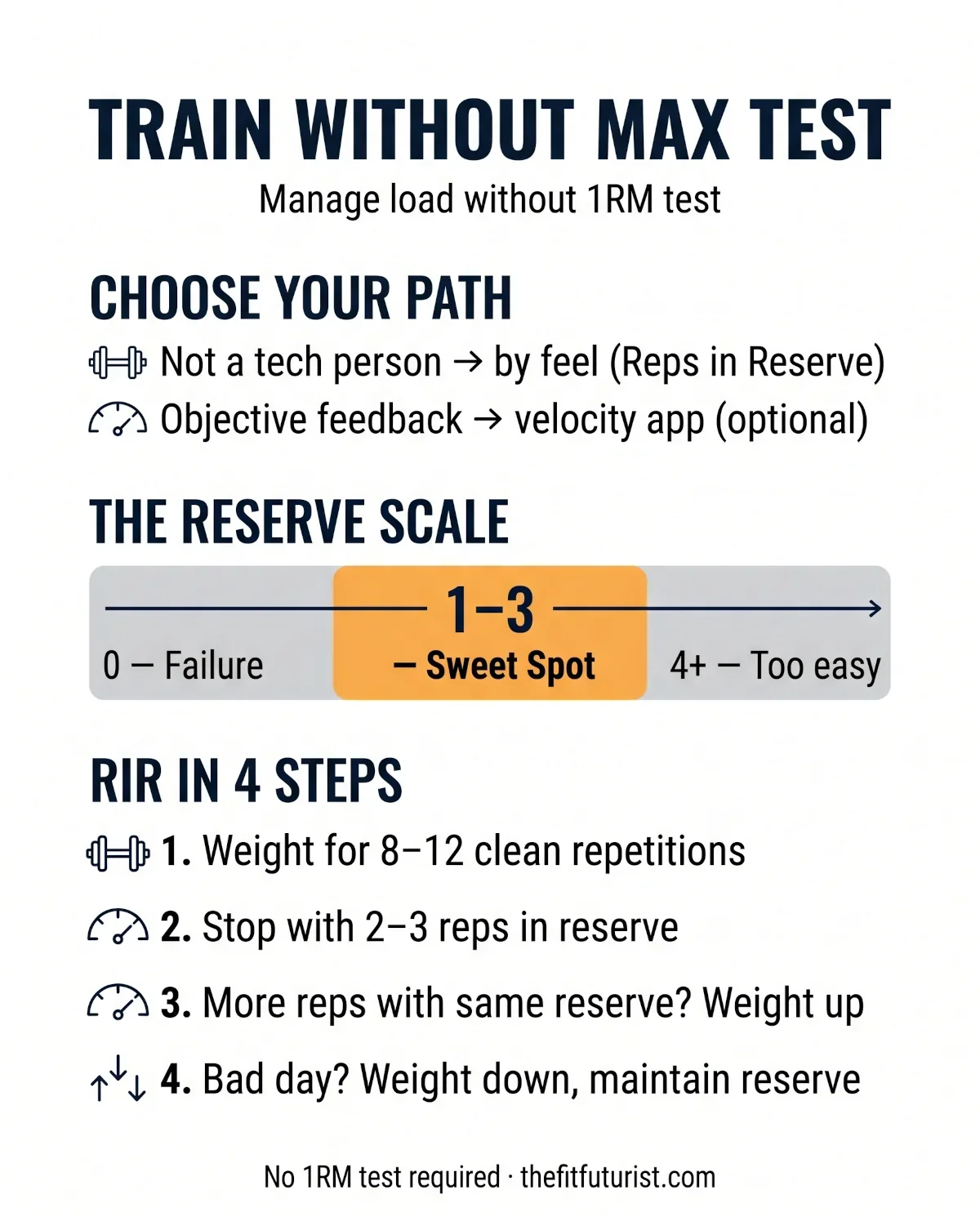
Steer your load by reps in reserve or a fixed rep range instead of a tested max. That is the route with no tech at all — and for most people the best starting point. Instead of "today 80 percent of max", the cue is: pick a weight that would have left you two to three reps at the end of the set. It adjusts itself to sleep, stress and day-form — on a bad day you land a little lighter without your plan breaking.
Velocity is the optional upgrade on top, not a must. If you are not a tech person, the feel of reps in reserve works perfectly well; not everything in the setup has to be perfect. One caveat belongs here: judging the reserve is rough at first — for the first few weeks almost everyone overestimates how close they are to failure. It calibrates with experience, faster than you would think. If you want to go deeper into how your own data takes over the steering, the physiological foundations for AI training are worth a look, along with how accurately you can steer deadlift intensity without a 1RM test.
So skip the max test. For each main lift pick a rep range — say 8 to 12 clean reps — and choose the weight so that two reps stay in reserve at the end. Add load once that reserve grows. It is safe, it fits everyday life, and it gets you just as far as the version with a test.
Sources
Hickmott LM, Bristol AR, Davidson CE, et al. A Comparison of Fixed Percentage of One-Repetition Maximum, Rating of Perceived Exertion, and Last Repetition Velocity-Based Training Load Prescription on Muscular Adaptations in Older Adults. Journal of Strength and Conditioning Research, 2026. PubMed
Renner et al. Concurrent validity of novel smartphone-based apps monitoring barbell velocity in powerlifting exercises. PLOS One 19(11), 2024. PLOS One
Autoregulated resistance training for maximal strength enhancement: A systematic review and network meta-analysis. 2025. PubMed