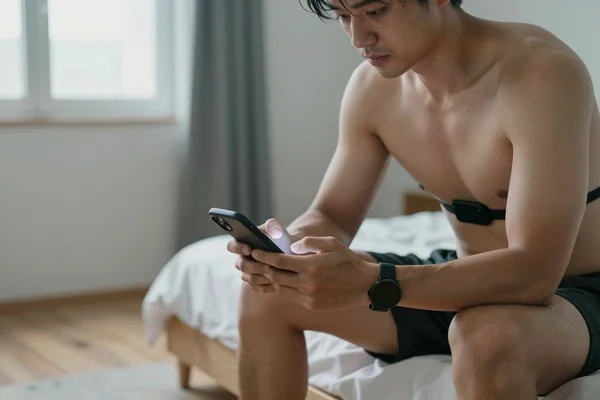
To measure your HRV properly, you need to measure under the same conditions every day. Either at night with a watch, ring or band, or in the morning right after waking up with a chest strap and an app. Which device you use matters less than sticking with it.
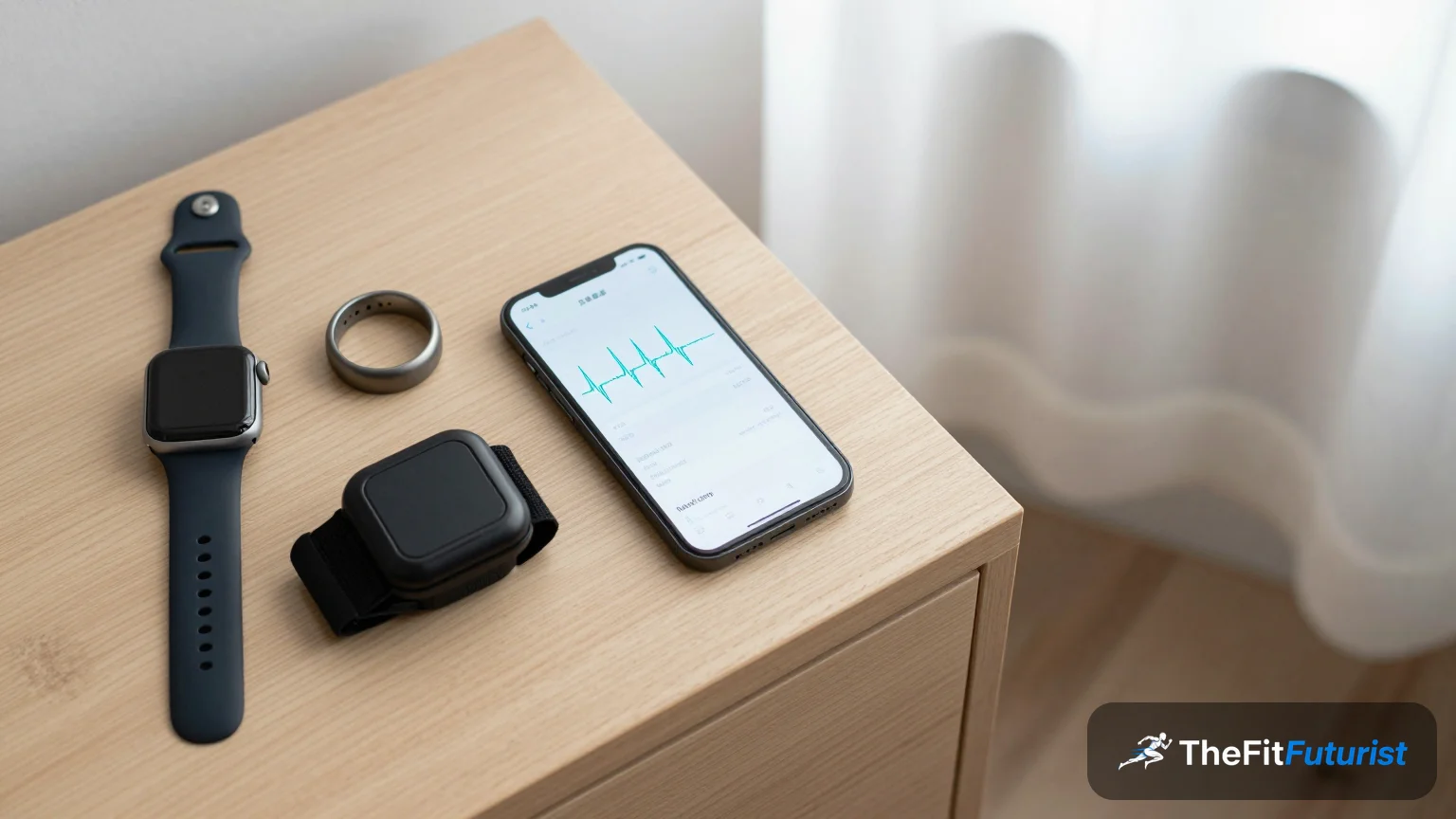
AI-generated image
How to measure HRV: watch, ring or chest strap?
 Christopher Klenk13 min read
At a glance
Measure your HRV either every night with a watch or ring, or every morning right after waking up with a chest strap and an app, but don't mix the two.
Plan for at least five measurement days per week. From three days on, the weekly average is almost as meaningful as with seven.
Only compare against your own values. There is no generally good HRV value.
For night-time measurement, a good watch or ring is enough, as long as you stick with the same device.
For measuring while sitting, during exercise and with an Apple Watch, a chest strap is the better choice. Without any device, you can also use your phone camera while lying down.
Alcohol, an oncoming infection or hard training lower the value noticeably, so it pays to jot down such confounders.
Stay on top of AI training & analysis? One click — and Google shows you my articles first.
Add as a preferred source on GoogleWhat HRV measures
HRV, heart rate variability, describes how much the intervals between two heartbeats fluctuate. Sometimes there are 950 milliseconds between two beats, sometimes 1,010. This is mainly controlled by the parasympathetic nervous system, the part of your nervous system responsible for rest and recovery.
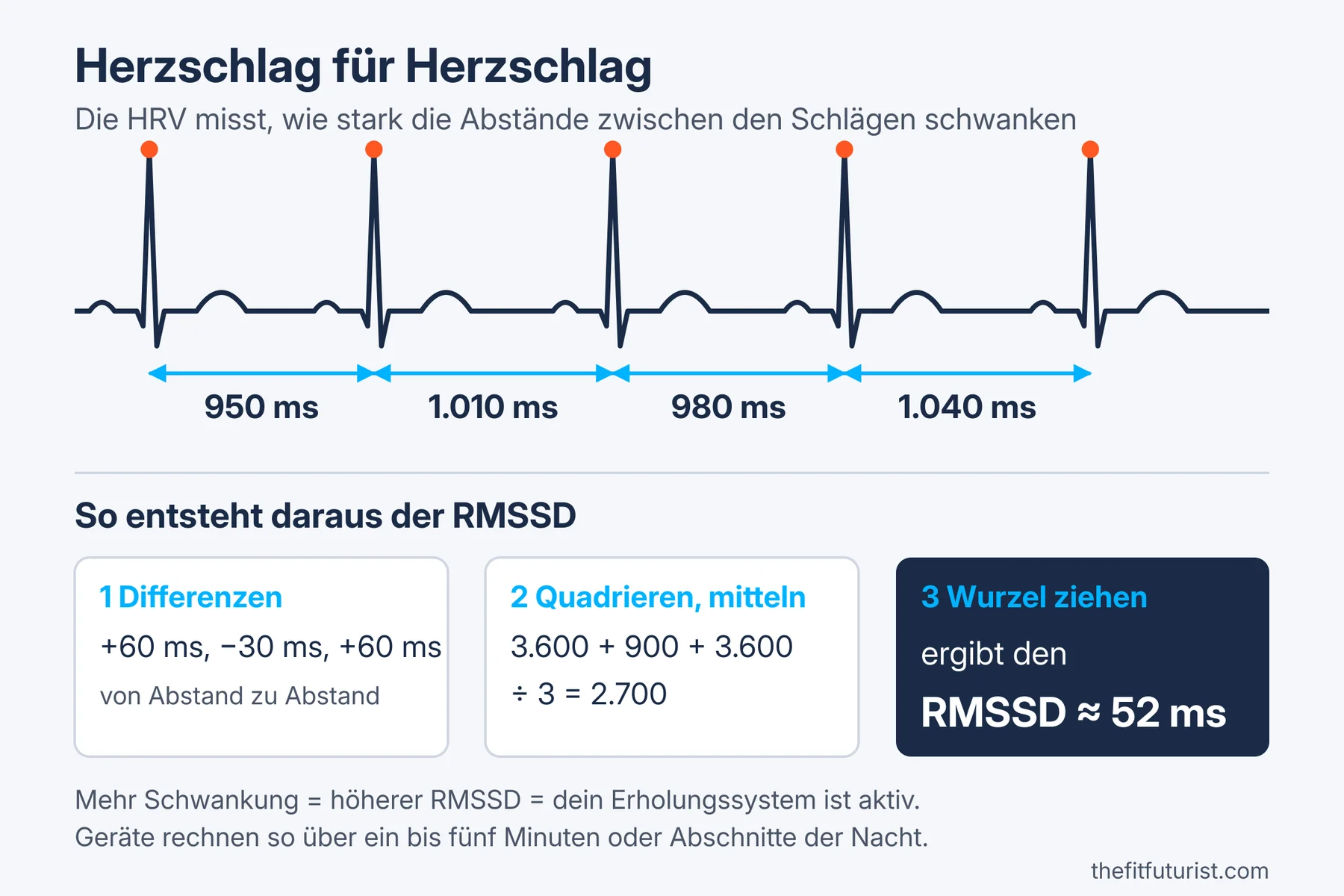
When your recovery system is active, the intervals vary more and HRV goes up. After hard training days, after alcohol or with an oncoming infection, they become more even and the value drops. From day to day, HRV is therefore mainly a recovery marker. In the long run it is also linked to your fitness, and regular training raises it [14]. How to use the value in your training is covered in our guide to HRV-guided training.
Several metrics can be calculated from the same beat-to-beat intervals [15]. Only a few of them matter for your training:
Metric | What it measures | Where you see it | For your training |
|---|---|---|---|
RMSSD | How much successive beat-to-beat intervals differ from each other. Reacts mainly to the parasympathetic system. | Garmin, Polar, Oura, Whoop, HRV4Training, Kubios | Very important. The standard value in devices and training studies. |
lnRMSSD | The same value, log-transformed so it is easier to calculate with | Studies, HRV4Training, your own spreadsheet | Very important if you calculate your normal range yourself |
SDNN | The variation of all beat-to-beat intervals in a measurement | Apple Watch | Medium. Useful for your own trend, but not comparable with RMSSD. |
HF and LF | Shares of the variation in certain frequency bands | Kubios, analysis software | Low. Strongly dependent on breathing. |
LF/HF | The ratio of the two, often shown as "stress balance" | Some apps and chest strap software | Low. Interpreting it as a balance of the nervous systems is disputed [16]. |
DFA α1 | How the pattern of beat-to-beat intervals changes under load | Specialised apps, chest strap only | Important for training intensity, not for the morning measurement |
For daily measurement, RMSSD is the number that counts.
Measuring at night or in the morning
There are two ways. The only thing that matters is that you don't mix them, because night-time and morning values are not the same quantity.
Aspect | Night-time measurement | Morning measurement |
|---|---|---|
Device | Watch, ring or band | Chest strap and app, or just your phone |
Effort | None, just wear the device at night | One to three minutes every morning |
Advantage | The data series breaks off less often | You control the conditions yourself |
Disadvantage | You often don't know which part of the night the device analyses | You have to remember it every morning |
Cost | Nothing if you already wear a suitable device | Chest strap around €60 to €100, Kubios free, HRV4Training €9.99 |
If you already wear a Garmin or Polar watch, an Oura ring or a Whoop band, start with night-time measurement. Next to their score, the devices also show you the HRV value in milliseconds, and that is the number you work with. Morning measurement with a chest strap is more accurate and worth it if you already own a strap or use an Apple Watch.
I measure at night with my Polar watch myself. Putting on a chest strap first thing in the morning is too much hassle for me in everyday life. A measurement that runs on its own every night is worth more to me than a more accurate one that I then don't do regularly.
A study with trained triathletes compared how many measurement days per week are needed. A single day showed a hard training phase only about half as clearly as the average of three or more days. From three randomly spread measurement days on, the weekly average was practically as meaningful as with seven [1]. Still plan for five, because in everyday life a day will drop out now and then.
Guide: measuring HRV at night with a watch or ring
With night-time measurement, the device does the work. You only need to keep a few things in mind so the data series stays clean:
Wear your watch, ring or band every night, tight enough for the sensor to touch your skin, but without constricting.
Always use the same wrist or the same finger.
Check the battery in the evening so the measurement doesn't stop in the middle of the night.
In the morning, look at the HRV value in milliseconds, not just the score. The score mixes HRV with heart rate, sleep or breathing, and with Polar, heart rate even has the biggest influence [8]. The table shows where to find the value.
Note confounders such as alcohol, travel or feeling ill. Most apps offer a journal or tags for this.
Device | Score | HRV value in milliseconds |
|---|---|---|
Garmin | HRV status and training readiness | Last night's average and 7-day average under HRV status, plus your baseline range |
Polar | Nightly Recharge with ANS charge from −10 to +10 | HRV (RMSSD) in the Nightly Recharge details |
Oura | Readiness score | Average HRV of the night under Readiness |
Whoop | Recovery in percent | HRV in the Recovery view |
Apple Watch | No score | SDNN in the Health app |
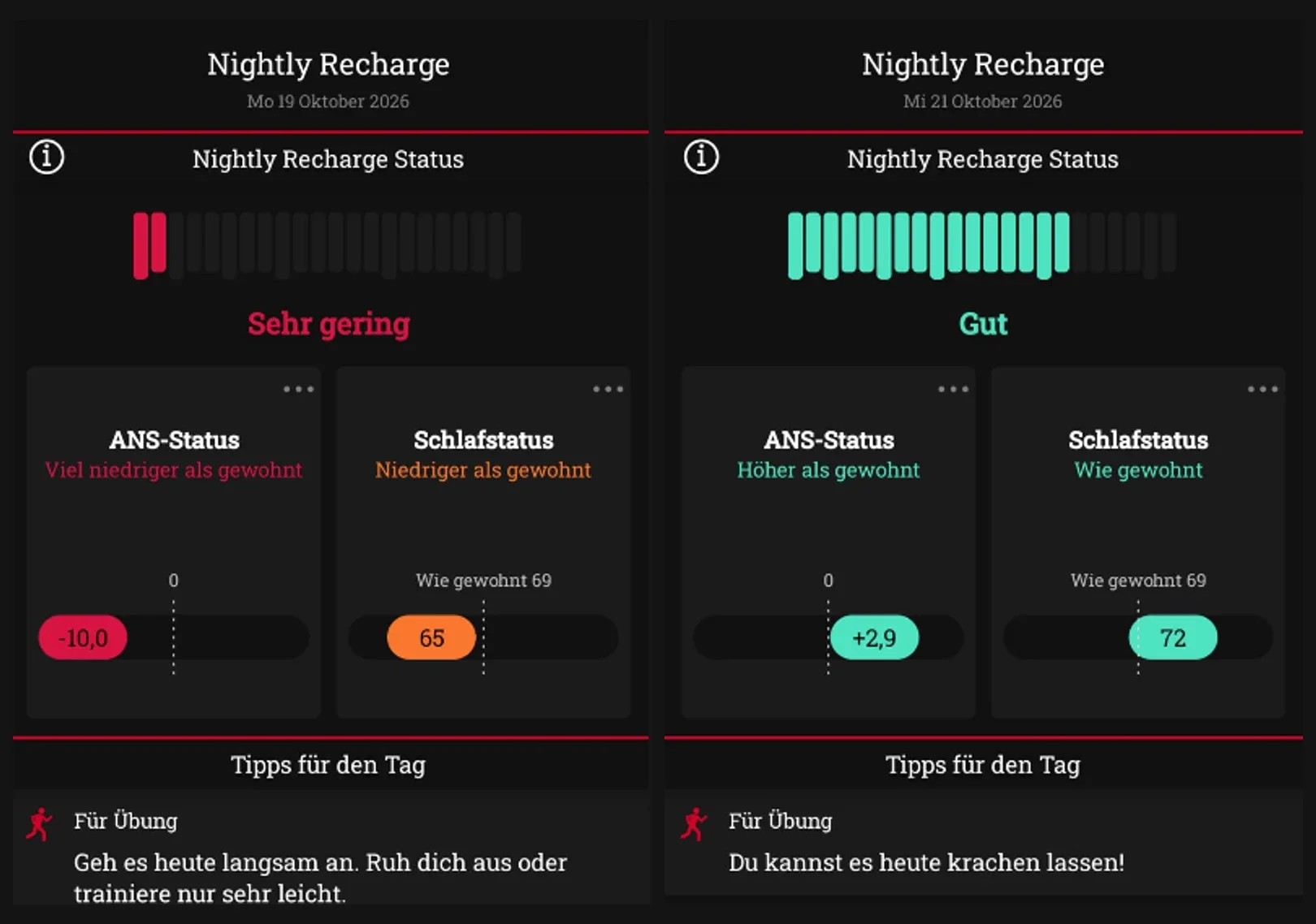
How much a score can swing, I saw in myself in October. In a night with an infection and fever, my ANS charge was at −10, the lowest value on the scale. Two nights later it was at +2.9, and the app said: "You can go all out today!" After a fever, though, no training belongs in the plan for the time being, even if the value looks good again. It shows a calm night, not an infection that has run its course. When you can get back into training is best checked with your doctor if in doubt. The ANS charge is also not a pure HRV value. Polar combines heart rate, HRV and breathing rate from the first hours of sleep and compares them with your average over the last 28 days [8]. With a fever, it is mainly heart rate that goes up, so part of the swing comes from there. Nightly Recharge as a whole then adds the sleep charge on top.
The manufacturers analyse different parts of the night. Oura takes the whole night in five-minute segments and averages them [9]. Polar uses roughly the first four hours of sleep [8]. According to Whoop staff, Whoop weights deep sleep and late night phases more heavily [11]. Garmin states a rolling seven-day average, but not which part of the night the measurement covers [10].
This explains why a ring and a watch can show different numbers on the same morning. In a sleep lab study with ECG, RMSSD in REM sleep was around eighteen percent higher than in deep sleep. The values also varied more within one night than between different nights [6].
How much this matters, I calculated from one of my own nights. In May I wore a chest strap that recorded every heartbeat next to my Polar watch. For heart rate, both were almost identical, 57 beats per minute on the watch, 58 on the strap. For HRV, the watch showed 45 ms for the first four hours, the strap 39 ms for the same period. Even bigger was the difference made by the time window alone. From the same strap data, the whole night comes out at 46 ms and the last four hours at 53 ms. That is a single night and not a study, but it shows why you shouldn't compare values from watch, ring and strap with each other, only with yourself.
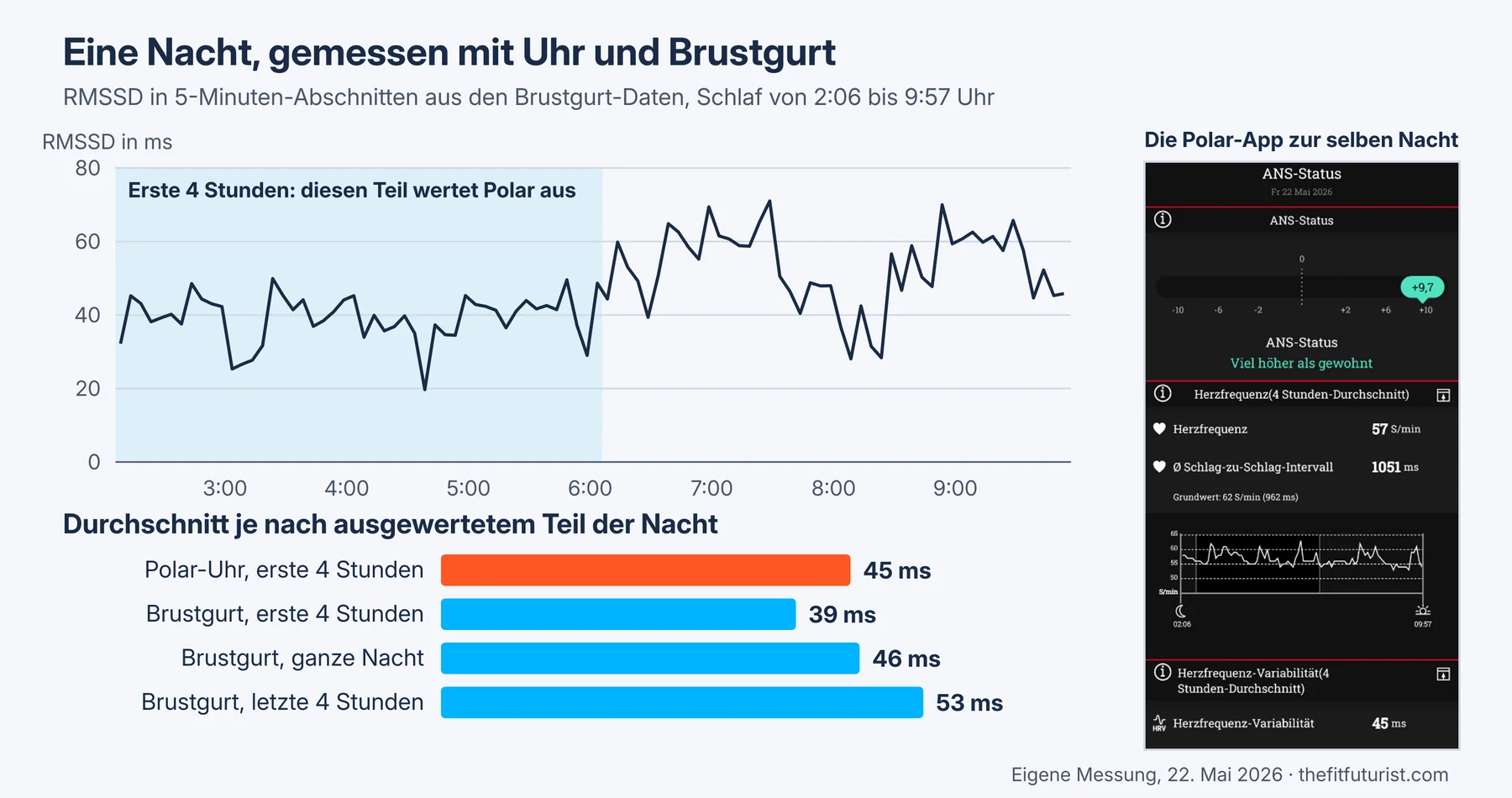
That is no reason to switch devices. As long as you stick with the same device, it measures by the same principle every night.
Guide: measuring HRV in the morning with a chest strap or phone
For the morning measurement you need a chest strap and an app. Two apps have become established for this. Both show you RMSSD directly and work with common Bluetooth chest straps such as the Polar H10 [12, 13].
App | Price | Without a strap it measures via | What stands out |
|---|---|---|---|
Free on the App Store and Google Play | The motion sensor, with the phone lying on your breastbone | Builds in a rest phase of up to one minute by itself [13] | |
One-off €9.99 on the App Store, also available for Android (as of October 2026) | The camera, with your finger on the camera and flash | According to the developer, 60 seconds are enough [12], also imports night-time values from Oura and Apple Watch |
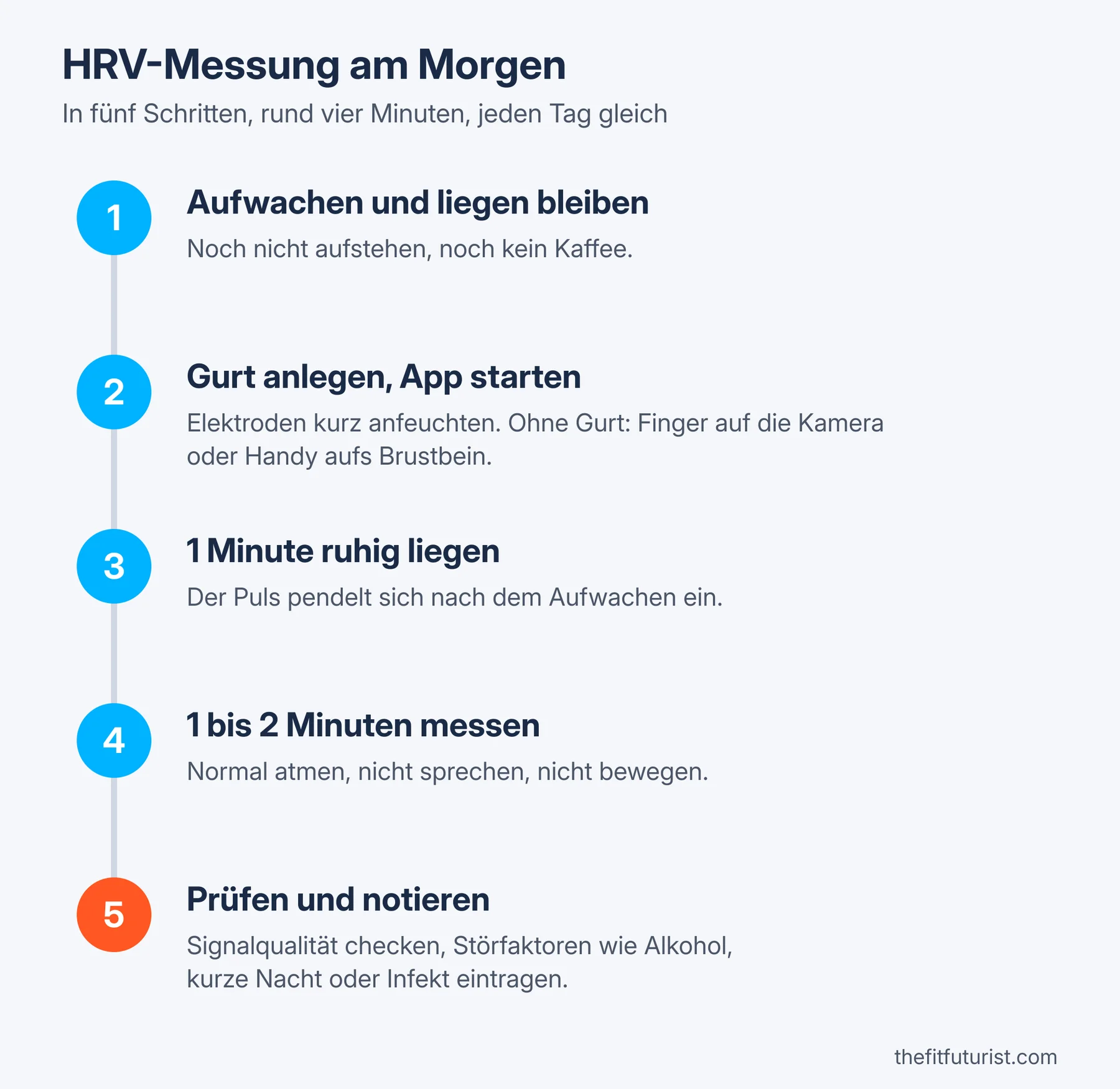
Three things are easy to overlook:
Measure in the same position every day, ideally lying down.
Breathe normally. Deliberately slow or deep breathing artificially pushes HRV up.
If you need to go to the toilet first, do so every day.
Measuring without a chest strap
For camera measurement there is a study with 29 people that found hardly any differences from a chest strap and ECG at rest [5]. However, it was only tested with the iPhone, and the developer of HRV4Training worked on the study. That is good enough to get started, but in the long run a chest strap is more reliable.
How to get the camera measurement right. Place your finger before you start and cover the camera and flash completely. Press lightly, not firmly, and keep your finger and the pressure steady. Measure in a darkened room and take off the phone case [12].
What distorts the value
HRV reacts to everything that keeps your body busy. The table shows how strongly and for how long:
Confounder | What happens to HRV | How long |
|---|---|---|
Alcohol | Drops even with small amounts, the more, the stronger [17] | Mainly the first hours of the night, so your next reading |
Infection | Often drops a few days before the first symptoms [18] | Until the illness subsides |
Hard training | The recovery system needs longer after intense sessions [21] | Easy up to 24 hours, at threshold 24 to 48, high intensity at least 48 hours |
Training late in the evening | Heart rate is raised in the first hours of sleep, HRV over the whole night barely changes [20] | The first hours of the night |
Heat in the bedroom | Less recovery overnight at 30 °C than at 22 °C [19] | The night itself |
Menstrual cycle | Somewhat lower in the second half of the cycle [22] | The second half of the cycle, every month |
Short night | Inconsistent, in one study HRV remained unchanged after shortened sleep [23] | Unclear, still worth noting |
A low value after a wedding party says nothing about your training. So jot down briefly what was going on, including things like travel, stress or a heavy late meal. Whether they shift your value, you will see for yourself after a few weeks. Also write down your resting heart rate. It comes from the same measurement and is the more robust of the two values [4].
Pulse wave or heartbeat: what watch, ring and chest strap measure
A chest strap measures the electrical signal of the heart and detects every beat to the millisecond. Watch, ring and phone camera, on the other hand, use light to measure the pulse wave at the wrist or finger. It doesn't always arrive in the same rhythm as the heartbeat, because breathing, movement or cold fingers shift it.
Lying down and at rest, the difference is small, about three milliseconds for RMSSD, around eight when sitting [2]. In a large study with 931 adults, the optical measurement was on average 5.6 milliseconds too low [3]. At night, when you lie still, good devices come close to the ECG, the Oura ring closest of all [4, 7]. More on the limits of optical measurement is in our assessment of how accurately wearables measure.
When a chest strap is worth it
At night, lying down, you can do without one. You reach for a chest strap in these cases:
If you measure in the morning while sitting or standing. That is exactly where the deviation of optical measurement grows [2].
If you measure during exercise, for example to determine your aerobic threshold via HRV. Optical sensors are too inaccurate for that. How it works is explained in our article on the aerobic threshold with DFA α1.
If you use an Apple Watch and want RMSSD. The watch only shows SDNN in the Health app.
If the camera measurement often reports poor signal quality for you, for example because of cold fingers.
What is a good HRV value?
There is no generally good HRV value. Absolute values differ greatly between people, depending on age, genetics, device and measurement method. An RMSSD of 45 milliseconds can be excellent for you and conspicuously low for someone else. Comparing yourself with friends or with tables from the internet is therefore misleading.
Only your own trend is meaningful. After three to four weeks of regular measurement, you know your normal range, meaning how high your values usually are and how much they fluctuate. The manufacturers do it the same way: Garmin only shows HRV status after about three weeks [10], Polar compares with your average over the last 28 days [8].
So pick one device and one app and stick with them. A constant measurement error hardly matters when you compare against yourself, but switching devices does: your comparison baseline then starts from scratch. How far implementations of the same concept can diverge is shown by the study of 206 HRV apps. How little manufacturers reveal about their metrics is covered in our review of the fourteen readiness scores on the market.
How to continue
If you already wear a watch or ring that records HRV at night, you don't need anything new. Otherwise, the free Kubios app with your phone is enough to get started. This is what the first weeks look like:
Period | What you do |
|---|---|
Day 1 | Choose morning or night-time measurement, set up the device or app, try the morning measurement once |
Weeks 1 to 3 | Measure on at least five days per week, always the same way. Write down resting heart rate and confounders. Don't change anything in your training yet. |
Week 4 | Read off your normal range: where are your values most of the time, and how much do they fluctuate? Garmin, Polar and the apps now show it themselves. |
From week 5 | Build the value into your training and postpone hard sessions when your weekly average drops below your normal range |
How to calculate your normal range and when a hard session is better turned into an easy one is explained in our guide to HRV-guided training.
Sources
Plews DJ, Laursen PB, Le Meur Y, Hausswirth C, Kilding AE, Buchheit M: Monitoring Training With Heart-Rate Variability: How Much Compliance Is Needed for Valid Assessment? International Journal of Sports Physiology and Performance, 2014. doi 10.1123/IJSPP.2013-0455
A Comparative Study Between ECG- and PPG-Based Heart Rate Sensors for Heart Rate Variability Measurements: Influence of Body Position, Duration, Sex, and Age. Sensors, 2025. PMC12473955
Pulse rate variability is not the same as heart rate variability: findings from a large, diverse clinical population study. 2025. PMC12343505
Dial M et al.: Validation of nocturnal resting heart rate and heart rate variability in consumer wearables. Physiological Reports, 2025. doi 10.14814/phy2.70527
Plews DJ et al.: Comparison of Heart-Rate-Variability Recording With Smartphone Photoplethysmography, Polar H7 Chest Strap, and Electrocardiography. International Journal of Sports Physiology and Performance, 2017. doi 10.1123/ijspp.2016-0668
Herzig D, Eser P, Omlin X, Riener R, Wilhelm M, Achermann P: Reproducibility of Heart Rate Variability Is Parameter and Sleep Stage Dependent. Frontiers in Physiology, 2018. doi 10.3389/fphys.2017.01100
Deriving Accurate Nocturnal Heart Rate, rMSSD and Frequency HRV from the Oura Ring. Sensors, 2024.
Polar: Nightly Recharge White Paper, 2019, and Polar Support: Nightly Recharge recovery measurement.
Oura: Why Oura Uses The Entire Night Of HRV Data.
Garmin: HRV Status, Health Science.
WHOOP Community: statements by WHOOP staff on the nightly HRV calculation.
HRV4Training: FAQ and How to get the most out of your camera measurement. hrv4training.com/faq.html
Kubios: Kubios HRV App, FAQ. kubios.com/hrv-app
Amekran Y, El hangouche AJ: Effects of Exercise Training on Heart Rate Variability in Healthy Adults: A Systematic Review and Meta-analysis of Randomized Controlled Trials. Cureus, 2024. PMC11250637
Shaffer F, Ginsberg JP: An Overview of Heart Rate Variability Metrics and Norms. Frontiers in Public Health, 2017. doi 10.3389/fpubh.2017.00258
Billman GE: The LF/HF ratio does not accurately measure cardiac sympatho-vagal balance. Frontiers in Physiology, 2013. doi 10.3389/fphys.2013.00026
Pietilä J, Helander E, Korhonen I, Myllymäki T, Kujala UM, Lindholm H: Acute Effect of Alcohol Intake on Cardiovascular Autonomic Regulation During the First Hours of Sleep in a Large Real-World Sample of Finnish Employees. JMIR Mental Health, 2018. doi 10.2196/mental.9519
Natarajan A, Su HW, Heneghan C: Assessment of physiological signs associated with COVID-19 measured using wearable devices. npj Digital Medicine, 2020. doi 10.1038/s41746-020-00363-7
Ho YT et al.: Nocturnal heat impairs sleep architecture and autonomic activity in young men, with BMI-dependent effects on sleep. Sleep Medicine, 2026. doi 10.1016/j.sleep.2026.109155
Myllymäki T, Kyröläinen H, Savolainen K et al.: Effects of vigorous late-night exercise on sleep quality and cardiac autonomic activity. Journal of Sleep Research, 2011. doi 10.1111/j.1365-2869.2010.00874.x
Stanley J, Peake JM, Buchheit M: Cardiac parasympathetic reactivation following exercise: implications for training prescription. Sports Medicine, 2013. doi 10.1007/s40279-013-0083-4
Schmalenberger KM et al.: Menstrual Cycle Changes in Vagally-Mediated Heart Rate Variability are Associated with Progesterone: Evidence from Two Within-Person Studies. Journal of Clinical Medicine, 2020. doi 10.3390/jcm9030617
Papadakis Z et al.: Effects of High-Intensity Interval Exercise and Acute Partial Sleep Deprivation on Cardiac Autonomic Modulation. Research Quarterly for Exercise and Sport, 2021. doi 10.1080/02701367.2020.1788206