Coaches who watch the barbell instead of the athlete detect velocity loss in strength training far more accurately – and it can be trained. A new study shows: after a short intervention, the error drops to an average of 1.5 reps. That's good enough to apply VBT principles meaningfully even without a sensor.
Coaches detect velocity loss without a device – what a new Bar Strategy study shows
 Christopher Klenk4 min read
At a glance
Experienced coaches detect velocity loss in strength training far better when they deliberately watch the barbell instead of the whole athlete. A study in Sports Medicine Open (March 2026) trained 20 strength coaches with a short intervention and reached a mean error of 1.5 reps – with considerable individual variance, though. Pragmatically useful for many gym situations, no replacement for a device. The limits show up at light loads and tight thresholds – exactly what you should know.
Stay on top of AI training & analysis? One click — and Google shows you my articles first.
Add as a preferred source on GoogleThe core idea: where do you look?
Velocity-Based Training (VBT) works like this: you end a set as soon as bar speed has dropped by a defined percentage – for example 20% compared to the first rep. That gives you a reference for actual fatigue, independent of how heavy the weight feels. Normally you need a device for that. But what if you don't have one?
A research group around Asaf Ben-Ari (Tel Aviv University) and Antonio Dello Iacono (University of the West of Scotland) first investigated in 2025 whether coaches can also do this by observation. The result: yes – with an average error of 2.6 reps. They also noticed that coaches who fixed their gaze on the barbell instead of watching the athlete in general were clearly more accurate. The researchers called this the "Bar Strategy". The new follow-up study takes one step further and asks: can it be taught deliberately?
What the study shows
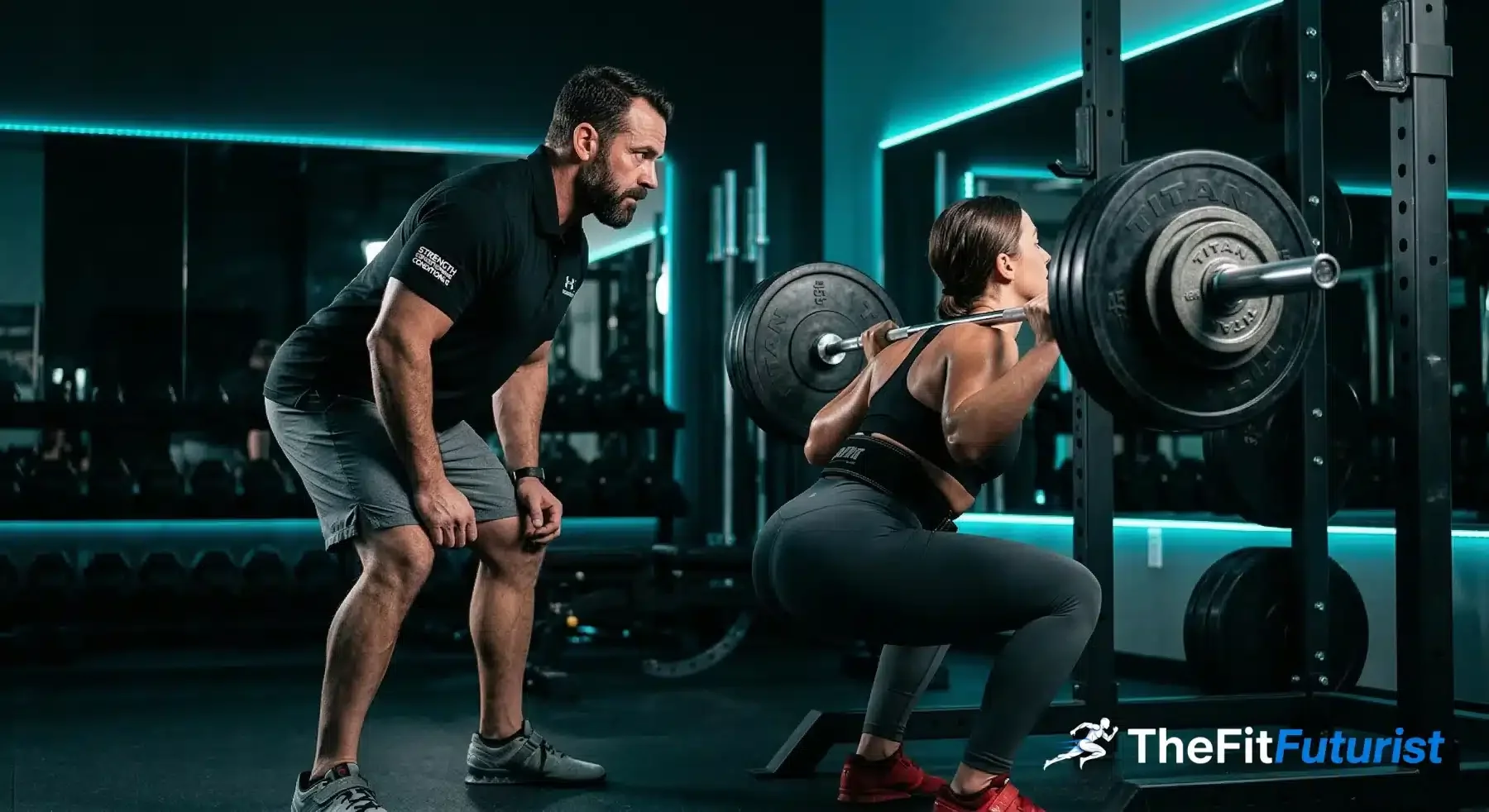
20 strength coaches, an instructional video on the Bar Strategy, then practice videos of bench press and squat at 45%, 65% and 85% of 1RM – that's how the session ran. Task: identify when the 20% and 40% threshold was reached. The coaches used the Bar Strategy in just under 79% of trials and reached an average error of 1.5 reps. Accuracy was highest at heavy loads, and detecting the 40% threshold was easier than the 20% threshold – which is in line with findings from the study on the load-velocity profile in the deadlift – heavy loads simply make velocity changes more visible. Mental fatigue had no effect on the results.
20% vs. 40% velocity loss – what does that mean?
20% velocity loss means: the barbell is moving 20% slower than on rep 1 – a common cutoff in hypertrophy training where you still leave reserves in the tank. 40% is much further into fatigue and, depending on the protocol, also shows up in the maximal strength range – the boundary isn't rigid. The more visible the drop-off, the easier to detect – which is why the 40% threshold was also hit more accurately in the study.
My assessment
An error of 1.5 reps is good enough for practice. For comparison: the devices that measure velocity loss have their own measurement tolerances – and a one-rep deviation doesn't make a relevant difference for most training goals. This isn't a replacement for a dedicated strength-training tracker like Fort, but it's not nothing either.
What really interests me about this finding: observational skill is trainable, and with manageable effort. The intervention consisted of an instructional video, a practice phase with eye-tracking feedback and a short hands-on round – that's more than "just watch a video", but it's not a multi-week course. That means: if you as a coach are already working with VBT devices, it's still worth deliberately practising the Bar Strategy – because it gives you a better feel for what the sensor is showing you. And in sessions without a device, you're not stuck.
One real caveat remains: at light loads and a tight 20% threshold, perception is the weak spot even after training. Anyone training at 45–60% 1RM in the higher rep range and relying on an accurate VBT signal should keep that in mind. For heavy compound lifts in the classic strength or hypertrophy range – which is exactly what most serious trainees do – the Bar Strategy works well. What's still missing: data from real-world gym use. The authors call for that themselves, and until then the finding remains a promising lab result.
Source
Ben-Ari A et al. Sharpening the Coach's Eye: An Observational Study Investigating the Trainability of An Eye-Tracking Strategy for Perceiving Barbell Velocity Loss in Resistance Training. Sports Med Open. 2026 Mar 11;12(1):28. doi: 10.1186/s40798-026-01003-2
Predecessor study: Dello Iacono A et al. The Coach's Eye. Sports Med Open. 2025 Jul 9;11(1):83. doi: 10.1186/s40798-025-00890-1