If you train alone, you know the problem: you can't see yourself. Is your back rounding on the deadlift? Are your knees caving in on the squat? Without a mirror, training partner or coach, you're training blind and may groove in errors you only notice once it hurts. A South Korean research team looked at whether a smartphone app with AI-based real-time movement recognition can help.
Study: smartphone AI spots form errors, beginners stuck with it for 16 weeks
 Christopher Klenk7 min read
At a glance
216 young adults with limited gym access trained for 16 weeks with an app that rates their form in real time via the smartphone camera. A third dropped out. Those who stayed completed 88% of sessions. Strength and body values improved about as much as you would expect in beginners. In a separate test with 30 people, the form rating matched physiotherapists 95.8% of the time. There was no comparison group, so how much of this is down to the app remains open.
Stay on top of AI training & analysis? One click — and Google shows you my articles first.
Add as a preferred source on GoogleTraining alone: who tells you whether your form is right?
Most people who train at home or without a coach have no reliable feedback on their form. A mirror only shows one angle and distracts you during the exercise. Filming yourself and analysing it afterwards takes effort and does not help in the moment the error happens. So many people train with sloppy form without noticing and settle into movement patterns that are less effective at best and lead to overload at worst.
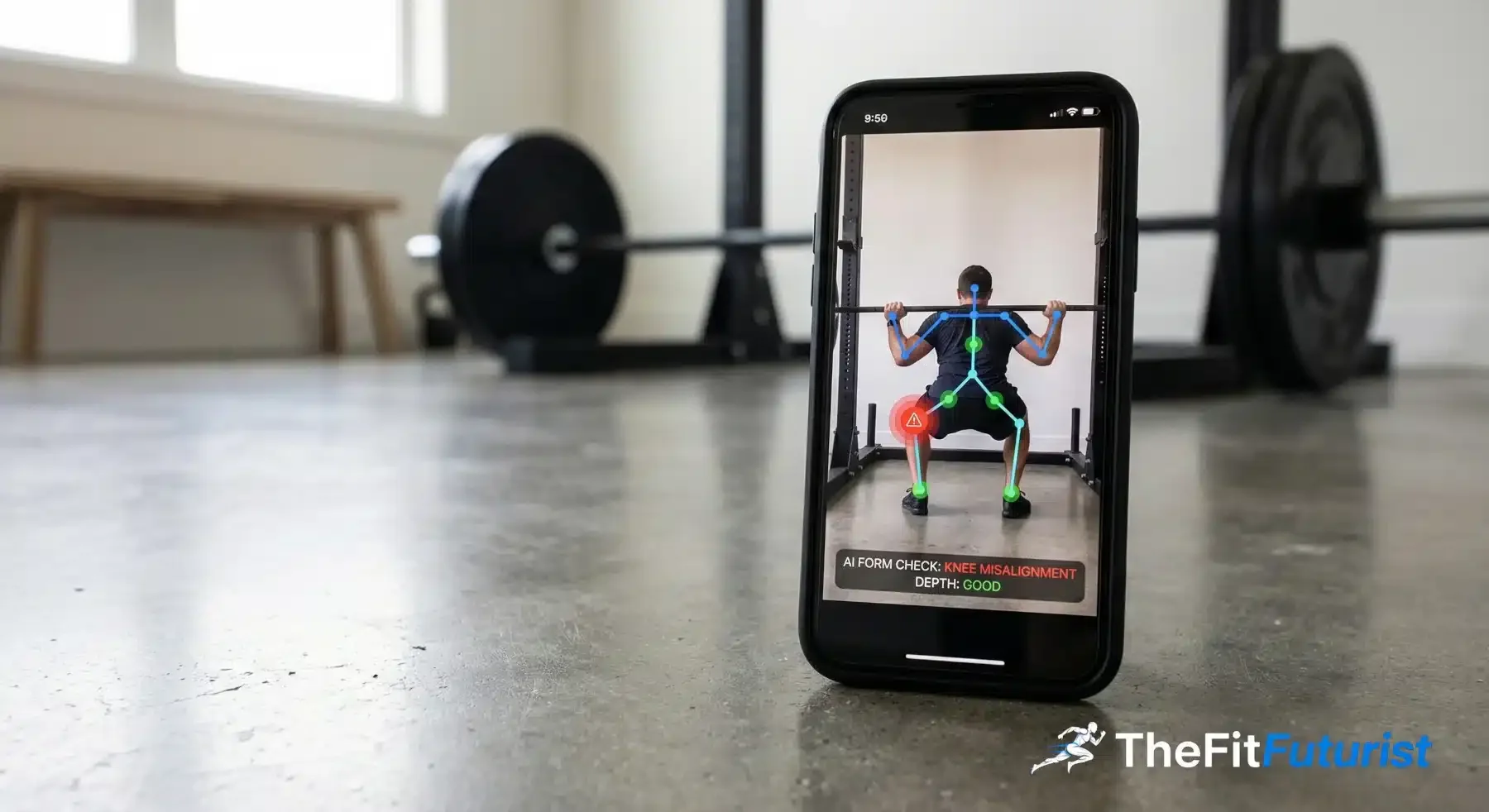
This is the gap the app in the study wants to close. It uses Google's MediaPipe, an open-source framework for body tracking, to capture 33 body landmarks in real time via the smartphone camera. From these it calculates joint angles and compares them with reference values for clean execution. If something is off, you get instant feedback: a coloured skeleton over the camera image (green for clean form, red for errors), plus text and voice cues. Everything runs on the phone itself, with no internet connection and no upload.
WHAT IS MEDIAPIPE?
MediaPipe is an open-source framework from Google. Its pose component (BlazePose) detects 33 three-dimensional body landmarks in real time on mobile devices, without the cloud. The technology already powers various fitness and AR apps and is freely available.
What the study looked at
The team around Seoyoon Heo (Kyungbok University) had 216 young adults (average age 23.8) train with the app for 16 weeks; the study ran at Kyungwoon University in Gumi. Participants had done no regular strength training in the previous six months and had limited access to a gym. The programme consisted of three 30-minute sessions per week with seven basic exercises: squat, bench press, deadlift, barbell row, military press, pull-ups and dips. Participants chose their own load, with the app giving recommendations. 146 people (67.6%) completed the programme, 69% of them men.
The study had no control group. Everyone used the app, and there was no comparison group with classic training or without the app. The changes therefore cannot be clearly attributed to the AI, they could just as well come from the structured training itself. The programme was not entirely unsupervised either: the study describes the sessions as supervised, and certified staff provided the equipment.
The results
The training results were about what you would expect from previously untrained people on a progressive strength programme (mean values):
Metric | Change | Effect size |
|---|---|---|
1RM (leg press) | 34.67 to 39.06 kg (+12.7%) | d = 1.148 (large) |
Body fat | −2.9 percentage points | d = −1.373 (large) |
Skeletal muscle mass | +2.19 kg | d = 1.433 (large) |
FMS score | +0.29 points | d = 0.285 (small) |
VO2max | +1.8 mL/kg/min (+4.8%) | d = 0.917 (large) |
The numbers are solid, but not surprising. The authors themselves describe the 12.7% strength gain as typical for beginners, which also matches my experience as a coach. Note: according to the methods, it was measured on a leg press, even though the study calls the value "squat". Whether the results would have been different with a coach or a paper plan, the study cannot say without a comparison group.
Two numbers I took a closer look at
Two points go beyond the expected strength gains.
First: those who stayed stuck with it. Those who completed the programme attended 88% of sessions on average, 42 out of 48. 76.7% even completed more than 85% of all sessions. That also means: 70 of 216 dropped out, 23 of them because of military service. Whether the real-time form feedback, the app's game elements (achievements, streak counter, progress dashboard) or simply taking part in a study is responsible cannot be separated. My guess from 17 years of coaching: it is the combination. Form feedback gives confidence, game elements give structure and small wins. The study cannot prove that.
Second: the movement recognition works. In a separate test with 30 people, the app's rating matched physiotherapists 95.8% of the time. The study reports two agreement values for this (ICC 0.91 and 0.94). Landmark detection reached 97.2% at 28.6 milliseconds of processing time, fast enough for smooth real-time feedback. For a smartphone camera without extra sensors, I find that impressive. So the technology can tell whether your knees clearly cave in on the squat and tell you while it happens. However, it works with fixed angle thresholds, and subtle faults can slip through. A similar camera technique measures heart rate from face video, by the way, tested while walking.
This matters especially for beginners who don't yet have a good feel for movement patterns. If you deadlift for the first time and nobody is watching your spine, this gives you at least a basic safety net. An experienced coach still sees more than a 2D camera can capture. My take: better than no feedback at all, but the study did not prove that. That camera-based movement analysis goes beyond form feedback is shown by the BackTracker study on back pain classification: there, a neural network identifies the type of pain from a simple video with 92% accuracy. A camera plus a neural network is behind that one too.
LIMITS OF THE TECHNOLOGY
A smartphone camera works in two dimensions. When the upper body hid landmarks, accuracy on the deadlift dropped by 4.3 points, and by 2.8 on average across all exercises. Poor light or awkward camera angles are likely to make this worse in practice. No 2D system can reliably spot subtle compensation patterns. Then there is a mundane problem: the phone has to stand steady, at the right distance and angle. Where exactly the 97.2% comes from, the study does not describe. I suspect lab conditions rather than a phone propped against a water bottle.
What remains open
Some things remain open. The study has no control group, so it cannot say whether people train more often with the app than without. The group was young and limited to a Korean university setting. How the technology performs with older people, advanced lifters or in less controlled conditions is unclear.
The app is not publicly available, it is a research application. Whether it will become a product, the authors don't say. There is no follow-up either, so it is unknown whether participants kept training after the study. As the next step, the authors themselves call for a study with a randomly assigned comparison group and a more diverse set of participants.
My take
The study does not prove that AI-based apps deliver better training results than conventional training. It shows that smartphone movement recognition is good enough to spot rough form errors on standard exercises, and that beginners in this setting trained regularly over 16 weeks. To me, movement analysis is one of the areas where AI in fitness has the most tangible benefit. This study is a hint for that, not proof.
MediaPipe is freely available and runs on ordinary smartphones. I expect this kind of movement analysis to show up in many more fitness apps over the next few years. If you train at home without a partner, such apps can help you catch rough form errors early, before they become habits. For advanced lifters this does not replace coaching, but as an extra pair of eyes on standard exercises I find the technology interesting.
Source
Heo, S.; Choi, T.; Choi, W. (2026): Clinical Validation of an On-Device AI-Driven Real-Time Human Pose Estimation and Exercise Prescription Program; Prospective Single-Arm Quasi-Experimental Study. Healthcare, 14(4), 482. doi.org/10.3390/healthcare14040482 (open access)