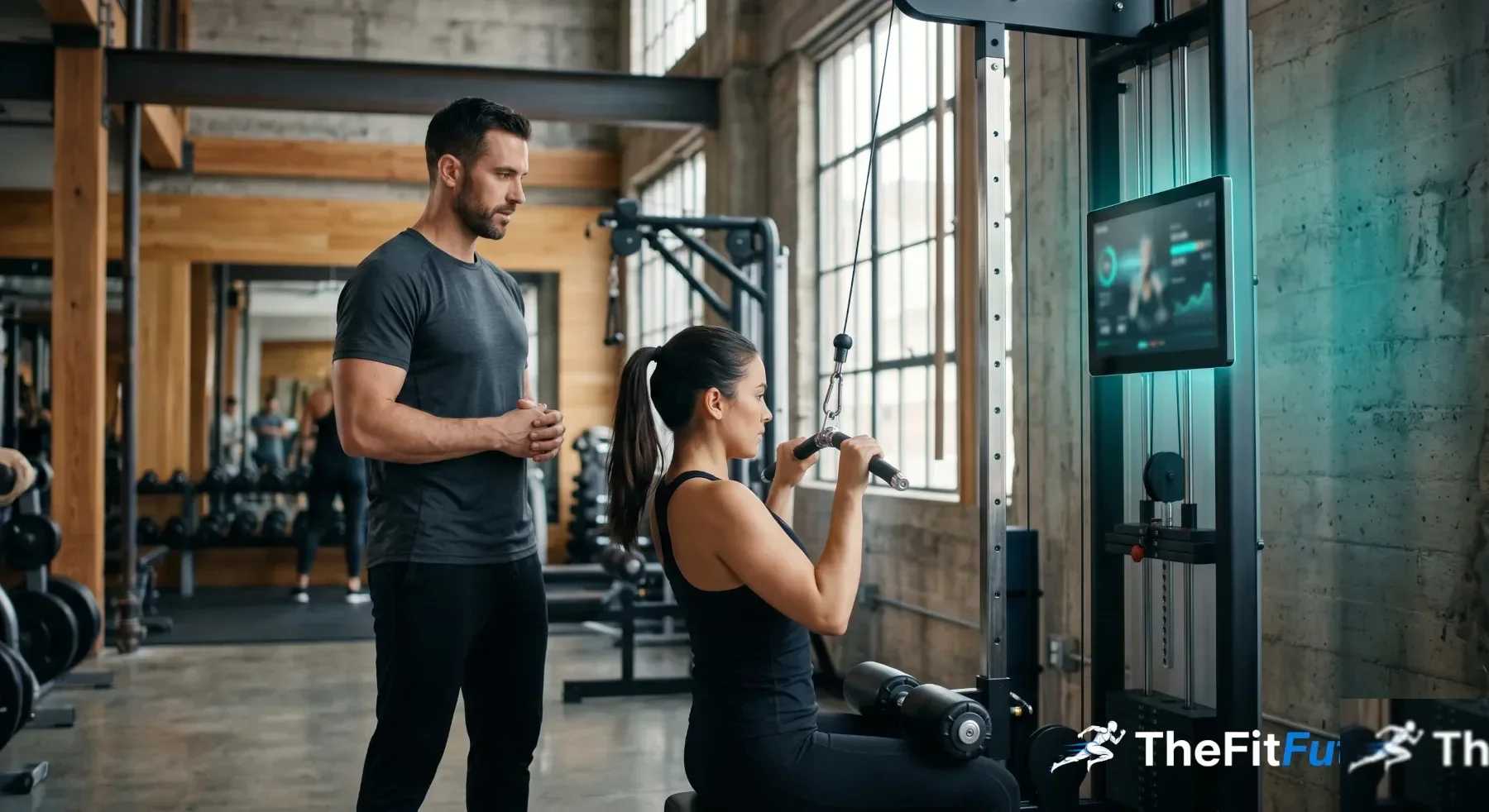
In spring 2026, Hotworx launched TrainingTRAX — an AI system inside the studio app that builds a 90-day plan, generates an avatar of your future physique, and runs a 24/7 chat coach. Announced via PRNewswire on April 22, it is pitched on the Hotworx website as "guidance similar to a personal trainer — without the added cost". Hotworx isn't alone: New York Sports Club rolled out MYCO, Vasa Fitness shipped a Demotu-powered app the same month, Life Time Fitness has been running a Microsoft-Azure-based AI coach since mid-2025, and Planet Fitness disclosed in its February 2026 earnings call that it's piloting AI tools that support its in-club trainers. The question of whether AI in the gym can replace the trainer is no longer theoretical.
The short answer: it doesn't replace the classic personal trainer. It doesn't even replace his planning work — because plan creation is not plan generation. What it does replace is what most studios have been selling as personal training all along.
This is a practitioner's view from 17 years of training people, not a press release roundup. If you want a vendor comparison, you're in the wrong place. If you want to understand what's actually under the hood and what it means in practice, keep reading.
At a glance
At a glance AI coaching is rolling out across US gym chains in 2026. Hotworx, NYSC, Vasa, Life Time, and Planet Fitness are all live or piloting. Standalone apps — Fitbod, Future, Freeletics — are getting smarter at the same time. All the chains push hybrid models, because pure AI solutions have two structural weaknesses: they don't see the person in front of them, and they ask the wrong questions. What AI does well is in-between-session coverage. What it can't do is what a good trainer does in the first session: deviate from the standard intake when something doesn't add up.
Stay on top of AI training & analysis? One click — and Google shows you my articles first.
What Hotworx, NYSC, Vasa, Life Time and Planet Fitness are rolling out
Within a few months, the major US chains have shipped or piloted their own AI coaching tools. Hotworx launched TrainingTRAX for its Sweat Elite members in late March 2026. Three top goals, 90-day plan, selfie-to-avatar visualization. New York Sports Club launched MYCO with Zing Coach (Palta-backed) for $15/month extra. Vasa Fitness partnered with US-based provider Demotu. Getting started means a free in-person trainer consultation: 3D movement analysis, InBody scan, then the plan in the app. Life Time Fitness has run a Microsoft-Azure AI coach since mid-2025 — and notably, it's complimentary and accessible even to non-members. On its Q4 2025 earnings call (February 24, 2026), Planet Fitness said it is piloting AI-driven tools that augment its in-club trainers with personalized coaching and workout support, alongside AI-enabled CRM and churn modeling.
What unites all five: the AI lives in the app, not on the gym floor. It fills the gap between sessions; the trainer on the floor stays untouched — and the whole package gets sold as a member-retention argument in the same breath.
The standalone app market is moving in parallel
Outside the chains, the consumer-facing AI fitness app market is more mature than the gym-integrated tools. Fitbod uses ML on millions of training sessions to adapt sets, reps and weight in real time. Future pairs an AI engine with human coach check-ins for $149–199/month — a hybrid model from day one. Freeletics ships AI-generated workouts based on goals and equipment. SensAI bets on wearable-driven, day-level adaptation that reasons through recovery signals before suggesting workload.
The standalone apps and the gym-integrated tools are converging on the same architecture: pattern recognition over training data, plus a chat or recommendation layer. The differences are mostly distribution channels and which data they have access to.
Provider
Type
Model
Status
Hotworx
Gym chain
TrainingTRAX (Sweat Elite, app-only)
Live since late March 2026
NYSC
Gym chain
MYCO with Zing Coach
Live, $15/month
Vasa Fitness
Gym chain
Demotu app + start with trainer consultation
Live since April 2026
Life Time Fitness
Gym chain
L•AI•C (Microsoft Azure)
Live since mid-2025, free for everyone
Planet Fitness
Gym chain
AI coaching pilot
Pilot announced Feb 2026
Fitbod
Standalone app
ML-based progressive overload
Live
Future
Hybrid app
AI plan + human coach check-ins
Live, $149–199/month
Freeletics
Standalone app
AI-generated workouts
Live
What studios sell as "AI coach" — and what's actually running underneath
"AI" has become a marketing word that papers over three very different technologies. If you want to judge what these tools actually do, you have to separate the layers.
Layer
What it is
Example in fitness
Strength / Weakness
Programmed flow
If-then rules, predefined paths
Hotworx Body Vision, app onboarding flows
Strong: identical output. Weak: no real personalization
Classical ML
Pattern recognition on large datasets
Fitbod, EGYM Genius (11+ billion workout data points, per EGYM)
Strong: recommendations from real training histories. Weak: optimized for the average
LLM agent
Language model with reasoning, calling tools
Rare in studio apps (Life Time L•AI•C is one), more common in Claude/ChatGPT skills
Most studio solutions are a mix of layer 1 and layer 2. True LLM agents — Claude, GPT, Gemini calling tools and reasoning over open-ended input — are the exception in this space. Life Time's L•AI•C is one of the few. Hotworx's AI Coach Chat comes close, but the company explicitly markets it as "laser-focused on the HOTWORX methodology" — meaning it's tightly fenced in.
The output variance of real LLMs is something I run into in my own practice. I give Claude the same prompt for a training plan twice in a row: once the mobility block shows up, once it doesn't. Once the deload week is included, once it isn't. For me as a trained practitioner, that's not a problem — I see what's missing and ask for it. For someone generating a plan for the first time, it is a problem: they don't know what they're not getting. That's the gap classical ML systems fill — they're more stable, but also more generic. Both are tradeoffs, not "intelligent coaching".
Hybrid wins, AI-only loses
Notice how uniformly the gym chains all communicate the same line: AI is meant to support trainers, not replace them. Vasa, NYSC, Life Time, Planet Fitness — same message every time. That's not PR boilerplate. That's damage control.
Anyone who's tried pure AI-only solutions knows why. Apple scaled back its internally code-named "Mulberry" AI health coach project in early February 2026 — Bloomberg's Mark Gurman broke the story exclusively. According to the report, the decision followed a leadership change in Apple's health organization, and services chief Eddy Cue didn't consider the plan competitive with Oura and Whoop. The same structural problem applies in fitness: an AI that recommends the wrong plan to a member with a herniated disc is a problem for the gym, not for the app vendor.
Hybrid works because the human trainer stays in the loop as a filter and as the responsible party. The AI does plan generation; the trainer validates and adjusts to reality. That's not romance — that's risk management. I've covered what the studies actually say about AI vs. human coaches elsewhere.
Is this still personal training?
Hotworx pitches TrainingTRAX with the line "guidance similar to a personal trainer — without the added cost". Honest, and it gives the whole game away.
"Personal" carries two meanings. It can mean tailored to the person — which AI with enough data points can do reasonably well. It can also mean delivered by a person — which AI cannot do. Studios are selling meaning one with the vocabulary of meaning two. If you're advertising "without the added cost", you should drop the word that comes from the cost too.
A more honest term would be AI-assisted coaching, or simply training app with personalization. But that doesn't sell as well. The phrase personal training carries thirty years of industry weight — relationship, accountability, presence. If you take the phrase, you take the promise. That's where this gets uncomfortable.
Intake is the hardest task — and that’s exactly where AI fails
This is, in my view, the actual point — and probably the most important takeaway from the first two years of AI-in-the-gym: the industry got the division of labor backwards. The naive assumption was that AI handles the easy stuff (training plan, tracking) while the trainer keeps the hard parts. After 17 years of training people, my read is the opposite. The intake is the hardest job — and that's exactly where AI fails.
Here's the pattern I've seen repeatedly. A new client says in the first session, "I want to lose weight." Over the next twenty minutes it becomes clear the real issue is sleep deprivation, or stress, or a history of disordered eating, or simply a distorted self-image. The actual goal isn't "lose weight" — it's something else entirely, and it's specific to this person. A chat-based AI never picks that up. It registers the typist, not the person behind the keyboard. It can't ask the right follow-up question because it doesn't know what to look for. It has no gut-feeling response when someone comes in asking for back exercises — but the real issue is a stiff right knee generating compensatory movement patterns that load the spine. The back is where it hurts. The knee is where it starts. A trainer sees this in the first five minutes. The AI gives back exercises.
The job AI is least equipped for is the hardest one — and it comes first.
A predictable rebuttal is coming: "intake can be automated too." Partly true. Structured intake bots will get better. Adaptive questionnaires are already feasible, and for most standard cases they're enough. What they will not match is the judgment of an experienced trainer to deviate from the standard intake at the right moment — because something in the tone of voice was off, because they noticed how the client moved on the way to the bench, because there's a gap between what's being said and what's visible. That's not "feed it more data." That's a different kind of processing. And that's where the actual value of an experienced trainer sits: not in running through the intake, but in knowing when to abandon it.
What AI does well is everything that comes after a properly-set frame. Reminders, plan adjustment within the corridor a human laid out, answering "can I train through this DOMS?" at 10pm on a Tuesday. Without that frame, AI optimizes into the void — it adjusts the wrong goal with high precision. With a frame, it's a useful tool. So the productive question isn't "AI or trainer." It's "who sets the frame, and who works inside it." More on this in my overview of AI in fitness — what actually works.
Why this trend won't slow down — gyms save, members gain, trainers lose
If you look at this soberly, the trajectory is hard to argue with. The economics are too strong — and they hit three groups differently.
For gyms, staff is expensive. An AI that takes over a meaningful chunk of plan adjustment and routine member communication is not optional. EGYM markets its solution to operators with the explicit pitch "saving your business money". Hotworx sells TrainingTRAX as a substitute for the consultation "without the added cost." That's the objective function, no euphemism.
For members, the upside is real: 24/7 baseline coaching, no booking needed, no PT pricing. For shy members — who in a classic gym might never engage a trainer at all because the social barrier is too high — an app is a genuine improvement. The first step toward more movement gets easier.
For trainers, this is the hard part. Personal training in the US easily costs more per session than an AI coach costs per month. Regular gym-floor trainers, on the other hand, are poorly paid, like in plenty of other jobs. If AI takes over plan generation and routine follow-up, the trainer's job shrinks to onboarding, movement diagnostics, and the one thing AI structurally cannot do: deviate from the standard flow when the situation calls for it. That's not less important — but it does mean fewer trainers will serve more members. My guess is that gyms will cut staff here soon.
If you're a trainer thinking about the next few years, focus on what AI can't do — intake with improvisation, hands-on movement diagnostics, real relationships. If you sell yourself as a substitute for a generic training plan, you'll be replaced. If your gym rolls out an AI app this year, ask specifically about the onboarding process. If it isn't run by a human, but by a selfie upload and three multiple-choice questions, you know what you're not getting.
Sources
EGYM: "EGYM Genius AI: Questions that matter to operators, answered". FAQ. us.egym.com
Zing Coach: "Zing Coach and New York Sports Club Partner to Shape the Future of Health Club Member Experience". Press release, April 13, 2026. zing.coach
Athletech News: "NYSC Adds AI Coaching in Retention Play". Article, April 13, 2026. athletechnews.com
VASA Fitness: "VASA Fitness and Demotu Launch Industry-First AI-Powered Personal Training App in the HVLP Category". Press release, April 13, 2026. vasafitness.com
Life Time: "Life Time Launches Complimentary AI Health Companion for Everyone: Just Ask L•AI•C". Press release, July 29, 2025. ir.lifetime.life
Planet Fitness: "Planet Fitness (PLNT) Q4 2025 Earnings Transcript". Transcript via The Motley Fool, February 24, 2026. fool.com
Gurman M., Bloomberg: "Apple Is Scaling Back Plans for New AI-Based Health Coach Service". Article, February 5, 2026. bloomberg.com · Summary at 9to5mac.com