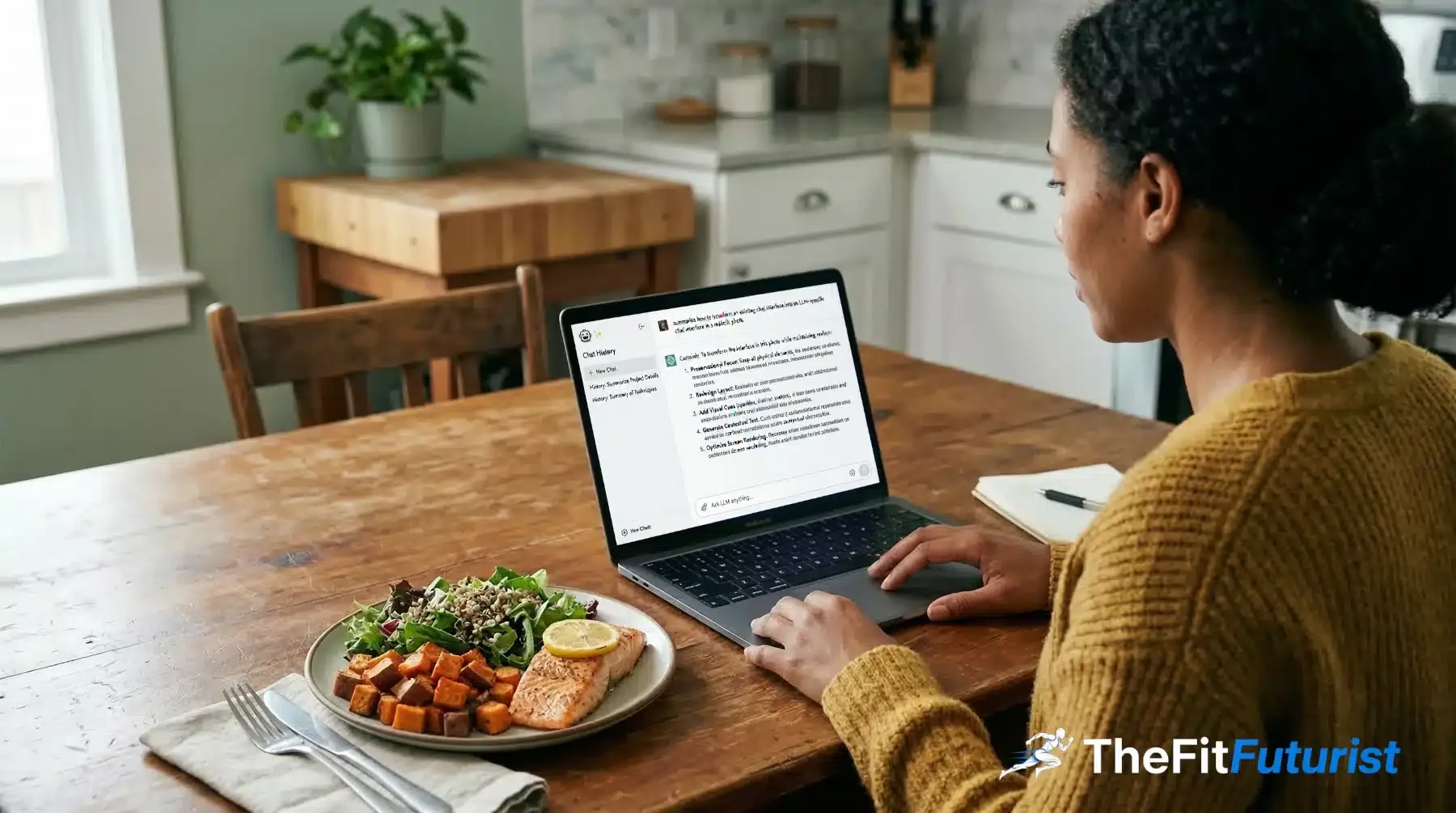
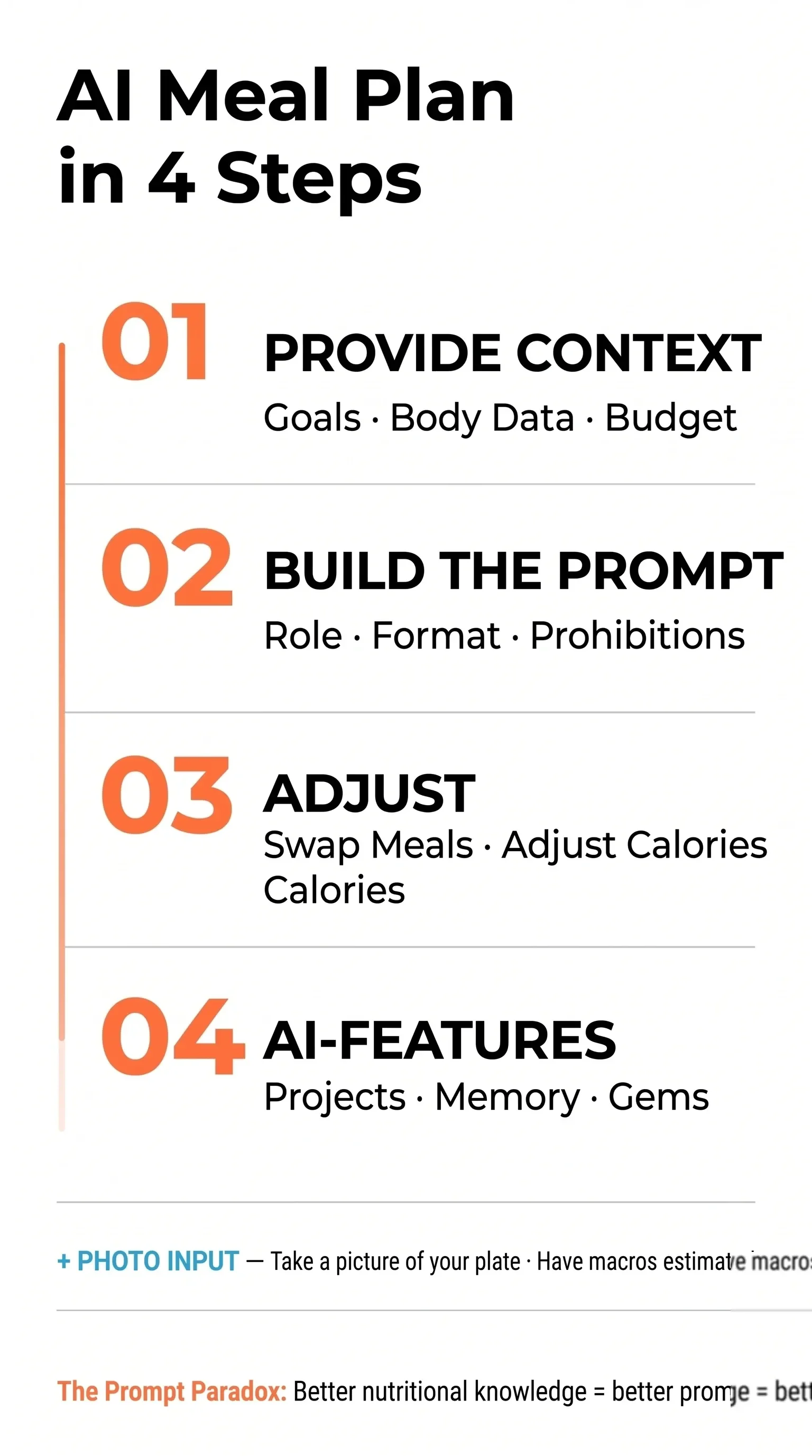
You want to build a nutrition plan with AI - and what you've been getting so far looks like a template diet from a fitness magazine. The problem: Without the right context, ChatGPT, Claude and Gemini deliver generic plans that fit you about as well as a stock training shoe fits a competitive runner. The solution: a structured prompt and your own nutrition knowledge. Anyone who knows total daily energy expenditure (TDEE), macro distribution and caloric deficit can ask for these things specifically - and get plans that actually match their training and daily routine.
This article walks you through four steps to get a usable nutrition plan out of any of these models - including concrete prompt templates for muscle gain, fat loss and general nutrition. I'll also explain which platform features durably improve the workflow and where the limits lie - regardless of how good your prompt is.
At a glance
ChatGPT, Claude and Gemini can produce a solid nutrition plan in a few minutes - provided you supply body data, total energy expenditure, macro targets and intolerances in the prompt. The better your nutrition knowledge, the more precise your request and the more useful the result. Platform features like Projects, Memory and Gems store this context permanently so you don't start from zero. What no model can do: real-time tracking, blood work interpretation and medical diagnoses - for that you need a human.
Stay on top of AI training & analysis? One click — and Google shows you my articles first.
No model knows that you weigh 84 kilograms, do strength training three times a week and can't tolerate dairy - unless you tell it. That sounds obvious, but this is exactly where most AI nutrition plans fail: too little input, too generic an output. The six categories below cover the context that really matters.
"no fish", "meal prep on Sunday", "quick to prepare"
Adherence - whether you actually stick with the plan
Budget
"max. 6 EUR/day", "no supplements"
Makes the plan realistically doable
If you don't yet know your total daily energy expenditure, let the AI calculate it right in the first step: weight, height, age, sex and training volume are enough for a usable estimate. Take the result as a starting point, not as immutable truth - calorie calculators have tolerances of around ±10%. In the prompt templates further down you'll see "TDEE" in this spot - that's the English abbreviation that AI models respond to most reliably. Same thing.
Upload existing logs
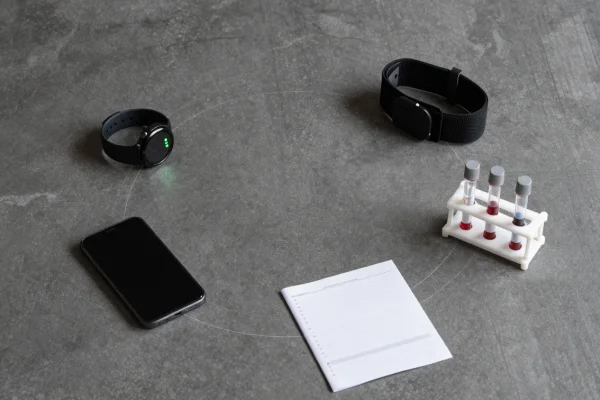
All three major platforms can read files - and that makes a noticeable difference. If you export your food diary from MyFitnessPal as CSV, upload a week of macro tracking as a screenshot or add your blood work as a PDF, the model no longer has to guess. It can spot where you chronically eat too little protein, which meals you keep skipping or where your caloric deficit actually sits - instead of where you think it sits.
In practice: in Claude you can store such files directly inside a Project so they're available in every new conversation. With ChatGPT you upload them to the chat or attach them to a Custom GPT. Gemini reads Google Sheets data straight from Drive - if you keep your tracking there, that's a real workflow advantage.
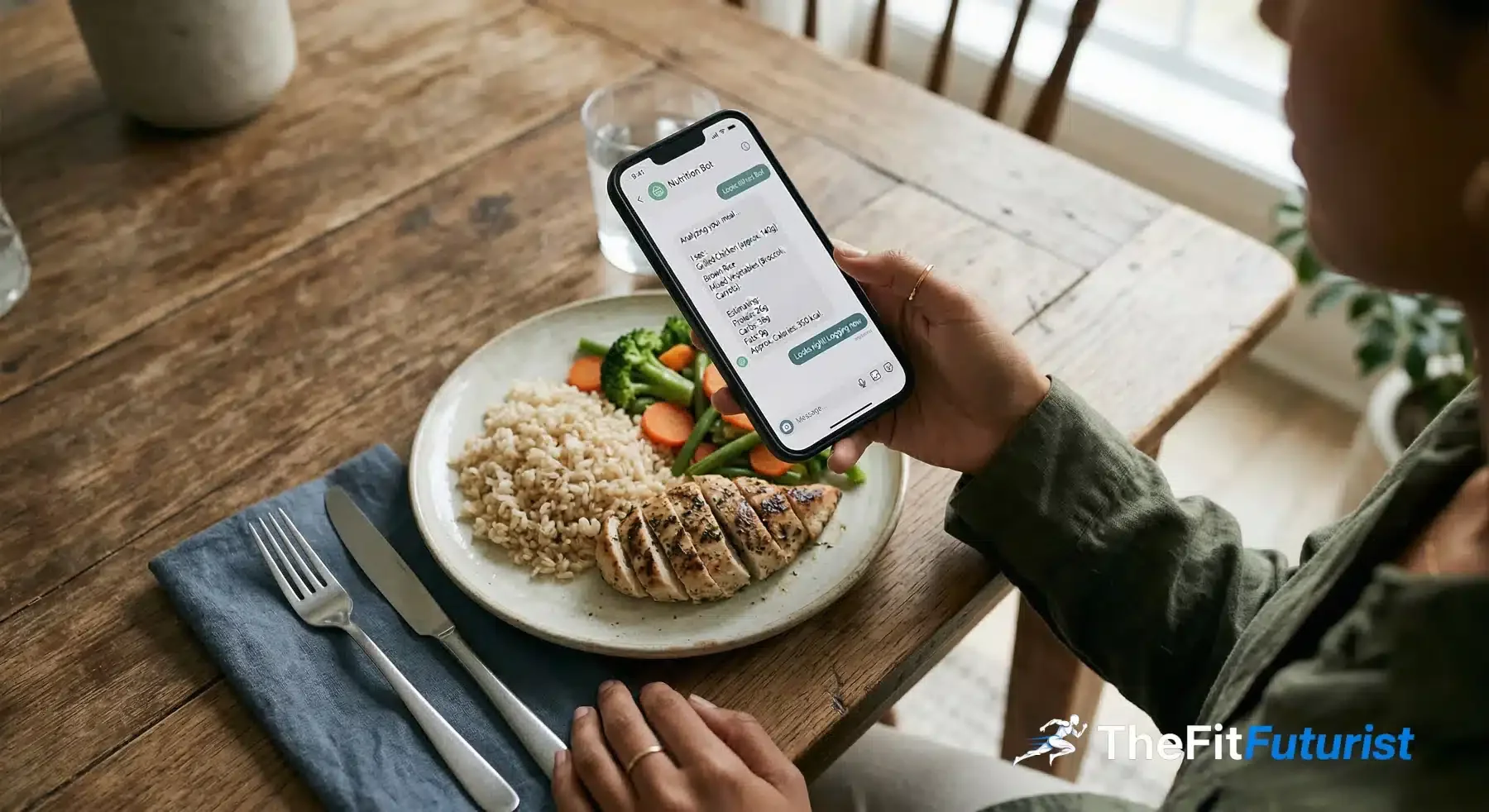
Photo input: snap your plate, have macros estimated
All three platforms can read images - and that opens up a workflow no training-plan tool offers. You take a photo of your plate and ask: "Estimate calories and macros for this meal." The result isn't a lab analysis, but it's a substantially better anchor than a look at your memory. For meal prep it works the same way: photo of the finished container, state the portion size, have the macros calculated.
Even more useful is the fridge prompt: a photo of the available ingredients plus "What can I cook from these that fits my daily plan of about [X] kcal and [Y]g protein?" That flips the usual planning process - instead of designing an ideal plan and then shopping, you work with what's already there. For everyday adherence, that's often more realistic than any weekly plan.
How accurate are photo estimates?
Not very - and that's well documented by now. A study published in 2025 tested ChatGPT-4o, Claude 3.5 Sonnet and Gemini 1.5 Pro against 52 standardised food photos. The result: the models identify ingredients reliably but systematically underestimate large portions and show high deviations on macronutrients. The authors conclude that these models are not yet suitable for precise tracking with athletes or in clinical contexts - but are certainly useful for rough everyday estimates. Treat them as orientation, not measurement. Study (PMC, open access)
Step 2: The right prompt structure for a plan that works
A good nutrition-plan prompt has five elements: a clear role for the model, your personal framing, the desired format, explicit prohibitions - and a completeness check at the end. That sounds like more effort than "build me a nutrition plan". It is. And the difference in output is substantial.
Bad prompt
Prompt
Build me a nutrition plan for muscle gain.
Thousands send this prompt to ChatGPT every day - and get back the same generic weekly plan every day: oatmeal for breakfast, chicken breast for lunch and Quark (German fresh cheese, similar to thick yoghurt) in the evening. The model fills in the missing information with the average it knows from its training data. For you that means: the plan suits somebody, just not necessarily you.
Good prompt - base structure
Prompt
Role: You are an experienced nutrition coach focused on sports nutrition.

Context:
- Goal: [your goal + timeframe]
- Body data: [weight, height, age, sex]
- TDEE: approx. [X] kcal/day ([training frequency + job])
- Macro target: [protein / carbs / fat in grams]
- Intolerances: [list or "none"]
- Preferences: [what you dislike, meal prep yes/no, cooking time]
- Budget: [EUR/day]

Task: Build a [X-day] nutrition plan.

Format: Table with meals (breakfast, lunch, dinner, snack), calories and macros per meal. Shopping list for the whole week separately below.

Avoid: Repetitive standard meals with no variety. Make the plan realistic for daily life, not theoretically ideal.
The prompt paradox
If you don't know what TDEE, macros or caloric deficit mean, you can't request these things specifically. The model then fills the gaps with default values - and produces a plan that fits the average person, not you. Basic knowledge of sports nutrition isn't optional, it's the prerequisite for useful AI use. The same applies to nutrition as it does to the self-built AI training plan.
Step 3: Test, adjust, improve
A good nutrition plan doesn't emerge from the first prompt. The model delivers a draft - and you decide what doesn't fit. That's not a bug in the system, that's the process. Anyone who treats this as a one-off task no longer has an accurate plan after a week.
Three types of adjustments work well: first, swapping individual meals - "Replace Thursday lunch with an option under 500 kcal that can be eaten cold." Second, adjusting calories when you notice the first draft went too high or too low - your body is not a calorie calculator, and adjustments after 1-2 weeks are normal. Third, sharpening intolerances you forgot in the first prompt - "Replace all dairy with lactose-free alternatives and check the calorie balance."
The practical part is that all three platforms remember the conversation so far. You don't need to re-enter your context each time - as long as you stay in the same chat. This is exactly where the platform features in Step 4 come in: they make that context permanently available, even when you start a new conversation.
Step 4: Platform features that take your workflow to the next level
The biggest difference between a one-off experiment and a real nutrition workflow is context management. All three platforms have built features that solve this - in different ways.
ChatGPT: Custom GPTs & Memory
Memory stores information about you permanently - your weight, your macro targets, intolerances. You only have to enter this data once, then it's available in every new conversation. The catch: you don't always have full control over what gets stored and what doesn't. If you share sensitive health data, keep that in mind.
Custom GPTs go further: you build a "nutrition assistant" once with fixed instructions - macro targets, dietary style, preferences - and call it up when you need it. That especially makes sense if you plan for several people (family, clients) or switch between different phases (bulk vs. cut).
Claude: Projects & Skills
Claude Projects work similarly to Custom GPTs, but with a cleaner separation: you store instructions and files in the Project, and every new conversation inside the Project draws on them. That's especially practical for nutrition planning if you upload tracking exports, recipe lists or a food diary as reference - they stay permanently available without you having to re-attach them every time.
What Claude currently lacks: an automatic memory function that saves information from conversations on its own. Depending on your perspective, that's an advantage or disadvantage - you have full control over what ends up in the Project.
Gemini: Gems & Google integration
Gems are Gemini's version of Custom GPTs: configurable assistants with fixed instructions. For nutrition planning you can set up a Gem with your body data and goals and call it directly via Google One. But Gemini's real edge lies elsewhere: the direct Google integration. Gemini can access Google Docs and Drive - if you keep your tracking in Google Sheets or want shopping lists straight in Docs, that's a genuine workflow advantage over the other platforms.
Features compared
Feature
ChatGPT
Claude
Gemini
Persistent context storage
Memory (automatic)
Projects (manual)
Gems + Memory
Custom instructions
Custom GPTs
Project Instructions
Gem Instructions
File upload (logs, PDFs)
Yes
Yes
Yes
Google Drive / Docs integration
No
No
Yes
Strength for nutrition planning
Broad user base, many GPTs
Strong reasoning, clean outputs
Google workflow integration
Is a thinking model worth it?
Thinking models like o1 (OpenAI) or Claude's Extended Thinking handle complex requests with longer internal processing - they're designed for multi-step analytical problems. But building a nutrition plan is not an analytically complex task, it's a structured one: context in, plan out. The standard model is entirely sufficient - with thinking models you pay for an advantage you don't need here.
Thinking training plan and nutrition plan together
This is the point where an LLM is clearly superior to an app subscription: you can feed both plans into the context simultaneously and ask specifically about their interaction. A nutrition app doesn't know what your training plan currently has in store. An AI that you hand both documents to does.
Concretely: during a bulking phase with high training volume you need a caloric surplus and enough carbohydrates to support the sessions. During a diet phase before summer you want to set the deficit in a way that preserves muscle mass - which means: keep protein high, reduce carbohydrates but don't eliminate them. And during a deload or recovery week caloric expenditure drops, so the plan has to be adjusted downward. No algorithm picks that up by itself - but if you tell the AI which phase you're in, it factors it in immediately.
Prompt - adjust nutrition to training phase
Prompt
I'm switching from a bulking phase into a cutting phase. So far I've been eating ~[X] kcal/day with a caloric surplus (TDEE approx. [Y] kcal). My training plan stays similar: [training frequency and type].

Adjust my nutrition plan for the next 8 weeks:
- Goal: moderate deficit (~400 kcal/day), preserve muscle mass
- Protein: keep at least [X]g/day
- Carbohydrates higher on training days than on rest days
- Intolerances: [list]

Show me a sample training day vs. rest day in a direct comparison.
If you already have an AI training plan, you can upload it directly as a file and have it optimised together with the nutrition plan - that's the next logical step.
Prompt templates for your AI nutrition plan
The following templates are ready to use - just swap the bracketed values for your own data. Important: don't treat the model's draft as the final document, treat it as a starting point for iteration.
Muscle gain / caloric surplus
Prompt - muscle gain
Prompt
You are an experienced nutrition coach focused on sports nutrition for strength and hypertrophy training.

Build me a weekly nutrition plan for muscle gain with the following parameters:
- Goal: muscle gain (moderate caloric surplus, ~300 kcal above TDEE)
- Body data: [weight] kg, [height] cm, [age] years, [sex]
- TDEE: approx. [X] kcal/day ([training frequency] strength training + [daily job])
- Macro target: approx. [protein]g protein / [carbs]g carbohydrates / [fat]g fat
- Intolerances: [list or "none"]
- Preferences: [e.g. no fish, meal prep on Sunday for weekdays]
- Budget: max. [X] EUR/day

Format: daily plan for Mon-Fri as a table (breakfast, lunch, dinner, snack) with calories and macros per meal. Sat/Sun as flexible variants. Shopping list for the week separately.

Avoid: repetitive one-size-fits-all meals. Make the plan realistic for daily life, not theoretically optimal.
Fat loss / caloric deficit
Prompt - fat loss
Prompt
You are a nutrition coach with experience in evidence-based weight loss.

Build me a 5-day nutrition plan for fat loss with the following parameters:
- Goal: fat loss (caloric deficit ~500 kcal below TDEE, target: approx. 0.5 kg loss/week)
- Body data: [weight] kg, [height] cm, [age] years, [sex]
- TDEE: approx. [X] kcal/day ([training frequency] + [daily job])
- Calorie target: approx. [X] kcal/day
- Macro target: high protein (at least [X]g) to preserve muscle mass
- Diet style: [e.g. vegetarian, vegan, omnivore]
- Preferences: [e.g. quick preparation max. 20 min, no elaborate recipes]

Format: 5-day plan as a table with calories and protein per meal. Briefly explain why a high protein share is useful during a caloric deficit - one sentence is enough.

Avoid: an overly aggressive deficit that goes below basal metabolic rate.
General healthy nutrition
Prompt - general healthy nutrition
Prompt
You are a nutrition coach focused on long-term, everyday-friendly eating habits.

Build me a flexible nutrition toolkit for a balanced, healthy diet:
- Goal: maintain weight, general health, more energy in daily life
- Body data: [weight] kg, [height] cm, [age] years, [sex]
- Activity: [training frequency], [daily job]
- Calorie range: approx. [X]-[X+200] kcal/day
- Diet style: [e.g. omnivore, no pork]
- Preferences: [e.g. Mediterranean, high vegetable share, few processed foods]

Format: instead of a rigid daily plan, give me seven options per meal type (breakfast, lunch, dinner) as a pick-and-choose toolkit. Plus five snack options under 200 kcal. Brief justification of which nutrients each group covers.
Pre/post-workout nutrition
Meal timing around training is an area that a pure nutrition plan often ignores - because it can't be answered sensibly without knowledge of the training plan. If you think about both together, you can ask specifically: what do I eat 2-3 hours before training, what right after, and how does that change on training-free days? The anabolic window after training - the phase of elevated protein synthesis - is, in the research, much shorter and far less dramatic than much of the fitness media makes it out to be. Still, it makes sense to spread protein intake across the day instead of bundling it all into one meal.
Prompt - pre/post-workout meals
Prompt
You are a nutrition coach focused on sports nutrition.

I train strength training [X] times a week, usually at [time]. My daily plan is about [X] kcal with [X]g protein.

Build me:
1. A pre-workout meal (2-3 hours before): carb-focused, easy to digest, approx. [X] kcal
2. A post-workout meal (within 1-2 hours): protein-rich, approx. [X]g protein, approx. [X] kcal
3. A variant for training days vs. rest days: how does calorie distribution change?

Framework: [goal], [intolerances], [preferences]

Explain in one sentence why protein timing is useful - but without overhyping the anabolic window.
What AI tools can do - and where you're on your own
An LLM has read texts - nutrition studies, books, forums, guidebooks. It understands nutrition as a concept, not as your personal metabolism. That sounds like an obvious limitation, but it's routinely underestimated.
What AI tools are good at: Building a structured weekly plan to your specs, calculating macronutrients for every meal, suggesting recipe alternatives if you swap out a food, generating a shopping list from the plan and explaining why a particular macro split makes sense for your goal.
What they can't do: The model can't see what you ate yesterday - unless you tell it. It can't interpret blood test values, can't diagnose a nutrient deficiency and can't predict how your energy level will develop after three weeks of caloric deficit. A study by the University of Hohenheim and the Max Rubner Institute in 2024 showed that AI-generated nutrition plans are often more balanced than what many people eat on average - but at the same time showed weaknesses in macronutrient and fatty-acid distribution that a human nutrition coach wouldn't have made. Recent data also suggests that AI-generated plans without calibration can produce considerable calorie deviations for certain groups - especially adolescents and people with specific illnesses; which models hold up on such safety-critical questions and which don't varies quite a bit.
My take: AI is not a substitute for nutrition counselling on medical issues - for diabetes, kidney insufficiency, eating disorders or complex intolerances, you go to a specialist. But for healthy athletes who want a realistic everyday plan for muscle gain or fat loss, AI is a serious tool - if you use it properly.
For medical nutrition questions
For conditions like diabetes, kidney insufficiency or clinical eating disorders, no AI tool replaces consultation with a qualified nutrition specialist. The models don't know the diagnosis, can't interpret lab values and carry no liability for the recommendations they produce. For medical issues, this is the wrong shortcut.
Your plan, your control
An AI nutrition plan is not a finished document - it's a draft that you understand, review and adjust. That's the difference from a nutrition plan in an app that tells you what to eat without you knowing why. Here you know it: because you supplied the context, built the prompt and questioned the result.
Start with the simplest step: estimate your total daily energy expenditure, pack the six context categories into a structured prompt and see what the model makes of it. Then adjust one meal. Then another. After two iterations you'll have more control over your nutrition plan than you would with any off-the-shelf diet programme - and you'll understand why it looks the way it does. That's the goal. If you're looking for an overview of all the areas where AI is used in a fitness context, you'll find the bigger picture there.
Frequently Asked Questions
How long does it take to build an AI nutrition plan?
A first draft takes 5-10 minutes: estimate total daily energy expenditure, structure context, send prompt, read the result. If you want a fully worked-out weekly plan with meal-prep structure, shopping list and recipe variants, plan for more like 30-45 minutes - most of that for iteration and fine-tuning. That's a one-off effort. If you store the context inside a Project or Custom GPT, you'll spend significantly less time on follow-up plans.
Do I need a Pro subscription or are free models enough?
For a simple nutrition plan, the free version of ChatGPT, Claude or Gemini is enough. The main limits on the free tier: a capped number of messages per day, no or restricted file upload and no access to the latest models. If you plan regularly, want to use file uploads, or want full access to the platform features from Step 4 (Memory, Projects, Gems), you're better off with a Pro subscription at around 20 EUR/month. For occasional use, the free tier is a sensible entry point.
Which model is best - ChatGPT, Claude or Gemini?
For nutrition planning, all three platforms perform at a comparable level if you supply the context well. ChatGPT has the largest user base and the most community resources. Claude often produces more structured, cleanly formatted outputs. Gemini has the Google-integration advantage if your workflow is already there. Which model actually performs best depends on the specific task - for that there's a domain-specific benchmark on TheFitFuturist that tests exactly this question with concrete tasks from the fitness and nutrition space.