You check your watch in the morning, see a low HRV and wonder: easy day or push through? A new study from China goes one level up. A system learns by trial and error to choose, week by week, between more intensity, more volume and active recovery. So far only in a simulation.
It learned on a digital twin, a computer model that uses data from 25 track and field athletes to predict how the body responds to a training week.
At a glance
Researchers at AnYang Normal University built an agent that learns by trial and error to manage training load. It practised on a simulation model built from 24 weeks of data on 25 track and field athletes: HRV, a sleep score, load from RPE times duration and a weekly 400 m test. It earns points for faster 400 m times and for good recovery values. In the simulation, performance improved and the acute to chronic workload ratio (ACWR) stayed below the danger threshold of 1.5 every week. It hasn't been tested on real athletes yet.
Stay on top of AI training & analysis? One click — and Google shows you my articles first.
The problem: two training strategies can't be tested simultaneously on the same person
If you want to know which load strategy works better, you hit a limit fast: you can't run two approaches at the same time. You can in a group, group A trains one way, group B another. But then you only learn what works on average.
What holds for the average says little about how you personally respond to more sessions or more volume.
Qi Zhang, Qing Wang and Yonggang Niu from AnYang Normal University (China) took a different route. Their study is called "Adaptive training load optimization for track and field athletes: A reinforcement learning approach". It is based on data from 25 track and field athletes (12 men, 13 women) over a 24-week season, 4,200 daily records in total. From this they built a model that predicts how a training decision affects HRV, sleep and performance.
The researchers call this a "digital twin". I checked how personal it really is: it's one shared model (a random forest) built from the data of all 25 athletes. The personal part is that every value is measured against the athlete's own norm, for example your HRV compared with your usual HRV. It is not a separate model per person. The agent can try as many strategies as it likes on this model without anyone having to train through a season.
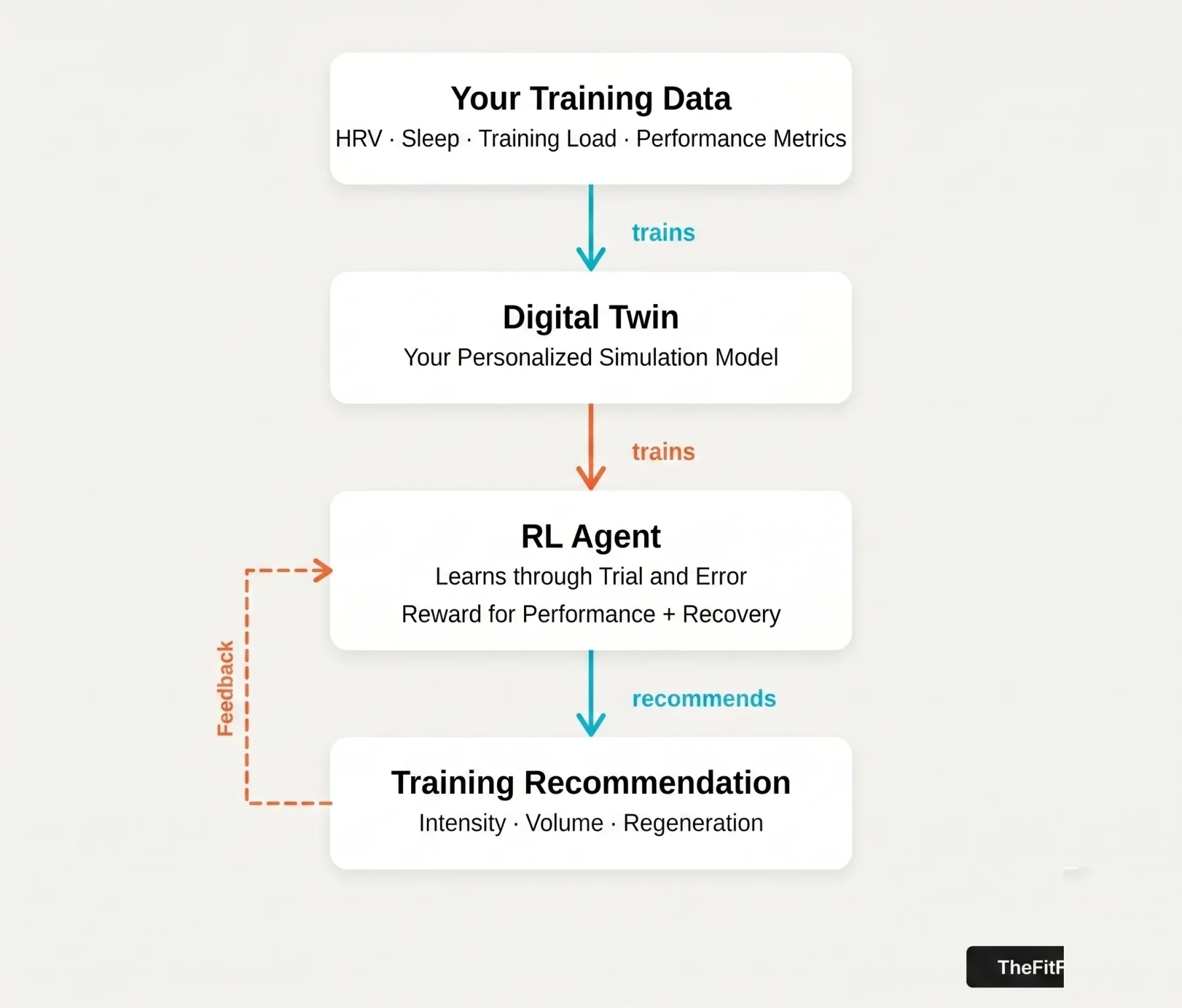
How the system works: athlete data feeds a simulation model, the RL agent learns on it and returns recommendations.
How the system decides: reward for good decisions, penalty for bad ones
The principle is called reinforcement learning. The agent looks at the current state, picks one of three options (increase intensity, increase volume or active recovery) and gets points or a penalty for it.
Training ran over 500 simulated episodes. The agent sees six values: HRV (RMSSD in the first 5 minutes after waking), a smartwatch sleep score from 0 to 100, the load of the last 7 and the last 28 days, the ratio of the two (ACWR) and the time from a 400 m test at the end of each week.
Your watch gives you HRV and sleep. In the study, load came from perceived exertion times session duration (sRPE), and performance from a fixed 400 m test every week. You would have to log both yourself. Still doable, and no lab testing needed.
The reward: points for performance and for recovery
The reward is the part I find most interesting. Reward an agent for performance alone and it overdoes it. The authors show this themselves: in a version that only earned points for faster 400 m times, the simulated athlete ended up in the danger zone from week 9 on.
So there are two rewards. One for faster 400 m times, one for recovery: rising HRV and sleep score earn points. An ACWR between 0.8 and 1.3 earns a small bonus. From 1.5 on, load counts as the danger zone and the agent takes a clear penalty.
In the simulation it worked. The 400 m time improved, from an average starting point of about 65 seconds, and the agent never pushed ACWR above 1.5 in any week. One caveat: the "injury risk" in the paper is this ACWR value. No injuries were counted. Whether it works the same way with real people is still open.
What this isn't yet
Testing happened only in the simulation model, on no real athlete. The authors call it a proof of concept themselves. The agent learned to do well inside the model. Whether it makes better real training decisions, the study doesn't show.
The authors also list limits themselves. The model assumes the body always responds the same way and that everything important can be measured. Stress, hormones and randomness are missing. It doesn't capture fatigue that builds over weeks, because it only sees the current state. And there are just three broad options: no exercise choice, no rest intervals, no specific recovery methods.
25 athletes, one season, one sport, one university: enough to show a concept. It's not a finished AI coach yet.
On other sports: the principle of simulation model, reinforcement learning and a two-part reward isn't tied to track and field. In practice it means new data, a new season and a new model for each sport.
My guess for strength training: HRV is less established there as a steering metric than in endurance sports. The model would have to be retrained from scratch.
My take
What interests me here is less the result than the approach. The simulation model solves a real problem: you can't test two strategies on the same person at the same time. In the model you can, as often as you like, without waiting for a real season.
For your training today, this study changes nothing. My reading: it shows a possible direction, away from fixed rules like "low HRV, so easy day" toward a system that learns from data. Whether that beats the rules has to be shown in a test with real athletes first.
The full study was published in Scientific Reports: Zhang, Wang and Niu (2026), "Adaptive training load optimization for track and field athletes: A reinforcement learning approach", Sci Rep 16, 14862 (DOI: 10.1038/s41598-026-41946-w).